

Instagram Transcript Scraper — Instagram Reels Transcript API
Pricing
from $10.00 / 1,000 reel transcripts
Instagram Transcript Scraper — Instagram Reels Transcript API
Instagram reel transcripts: reels as text — speech-to-text, first-3s hook, language, timestamps; a row per reel with date, plays, likes. Handle in, paste reel links or chain a dataset ID. No login. Private and failed reels are never charged; on-screen text read off a silent reel costs a transcript.
Pricing
from $10.00 / 1,000 reel transcripts
Rating
5.0
(1)
Developer

Steadyfetch Team
Maintained by CommunityActor stats
1
Bookmarked
7.1K
Total users
4.2K
Monthly active users
2 days ago
Last modified
Categories
Features
Share
A creator's handle in, their reels back as text — full speech-to-text, the first-3-seconds hook, language and timestamped segments, one row per reel. No scraper, no login, any length. Price: $0.015 a reel on the Apify free plan, $0.014 on Bronze, $0.0125 on Silver and $0.01 on Gold and above — the first 3 minutes of a video included, then $0.005 per started minute, platform usage included; a photo post $0.035 to $0.025 by plan. Paste zachking (or a profile URL) and the actor lists that creator's reels itself and transcribes them, in one box. Just want to see it work? Click Start with nothing set — or send an empty input from the API or an agent — and the run is a 2-reel sample of zachking's latest reels, transcribed and charged like any run. Changed only an option — the on-screen-text toggle, a cap, New reels only, a watchlist name — and named nothing? Those settings are applied to the same sample and the run goes ahead, charged like any run, with one uncharged sample_note row saying which settings were yours; a cap smaller than the sample is honoured exactly, a bigger one never grows it. Have a pile of links? Paste reel links, post links, profile links and handles together into startUrls and the actor sorts each entry by its own shape. You can still paste reel links, pass CDN media URLs, or chain any Instagram scraper by dataset ID. You are charged only when a transcript is delivered — private accounts, missing handles, expired URLs, text-free music-only reels and image posts with no readable words charge nothing; a photo post whose words are read is its own image-text charge. (By default a reel confirmed silent has its on-screen copy read instead, charged like a transcript; switch off Read on-screen text on silent reels to stop it.)
See a real run before you spend anything: sample dataset — three reels from one verified run, three transcripts charged, each with its 3-second hook and timed segments. Unedited.
Using an AI agent? Pin this actor in Apify's MCP server with one link: https://mcp.apify.com?tools=steadyfetch/instagram-reel-transcript-scraper
- Actor id:
steadyfetch/instagram-reel-transcript-scraper - Input:
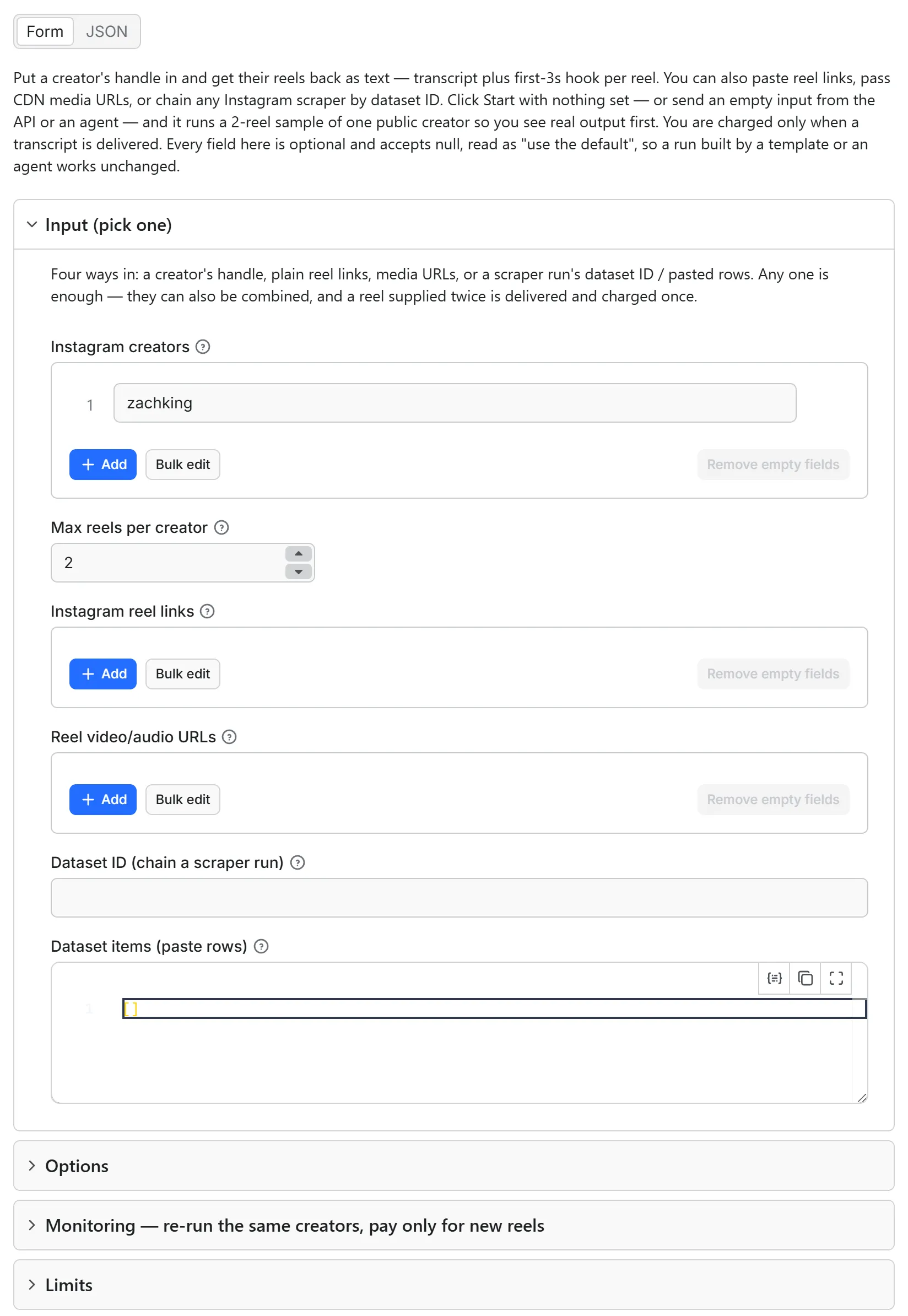
{ "handles": ["zachking"] }— the one field you have to set. - Cap the bill: on a run, set
maxTotalChargeUsdas a run option or in its input (the lower applies), e.g.0.50— the run stops when it reaches it. A run your cap stops says on its run page how many reels are left and the figure to set to cover them. - How often it changes: a creator's reels change only when they post, so the pace is theirs — a daily run fits a creator who posts every day, a weekly one fits most others. A reel an earlier run delivered comes back uncharged for 90 days, so a scheduled re-run charges what is new.
This is a transcript of what is said in the audio — not the caption text under the post. Running the same creators again? A reel an earlier run delivered comes back uncharged for 90 days — automatically, however it arrives (a scoped API token needs key-value store Read, Write and Create permission for that check to run). Following creators over time? Name a watchlist and re-run on a schedule: with New reels only you get only what is new (see Watch creators on a schedule). Sending a batch from code or an agent? Put the reel links in reelUrls — 30 or 300 in one run is normal — and add newReelsOnly: true on a scheduled re-run, so reels bought in the last 90 days are skipped before download. A batch is transcribed up to 25 a day on the Apify free plan; paid plans have no daily limit. Want to know what each reel shows? Switch on Describe each reel and each newly transcribed reel up to 3 minutes also comes back with timed scenes, a short description and a summary for someone who cannot watch — at $0.03 a described reel on the Apify free plan, $0.025 on Bronze and $0.02 from Silver, charged only when a description is delivered. The free plan describes up to 5 reels per account in any 24 hours.
Unofficial. Not affiliated with, endorsed by, or sponsored by Instagram or Meta Platforms, Inc. This actor reads publicly available reels; Instagram is a trademark of Meta Platforms, Inc.
| You give it | You get back |
|---|---|
An Instagram handle (nasa, @nasa, or a profile URL) | transcript — full speech-to-text, any length (first 3 minutes included, then a small per-minute surcharge) |
…or plain reel links (instagram.com/reel/… / instagram.com/p/…) | hook3s — the reel's opening line, plus hookStartSeconds |
…or reel video/audio URLs (videoUrl / audioUrl from any Instagram scraper) | language, durationSeconds, timestamped segments |
| …or your scraper run's dataset ID (one-click chaining), or pasted dataset rows | the reel's shortCode, postUrl, ownerUsername, caption, takenAt, isPinned, plays, likes, comments, thumbnailUrl, urlExpiresAt |
…or a mixed list of links and handles in startUrls | every row the same shape, whichever way the reel arrived |
| …plus a watchlist name (optional) | isNew and firstSeenAt on every row — and, with New reels only, nothing you already paid for |
Output
One reel in, one JSON row out. Delivered rows carry the transcript and charged: true; anything that could not be delivered carries a status saying why, and charged: false. Real rows from the live example run below (long text trimmed with … for the page):
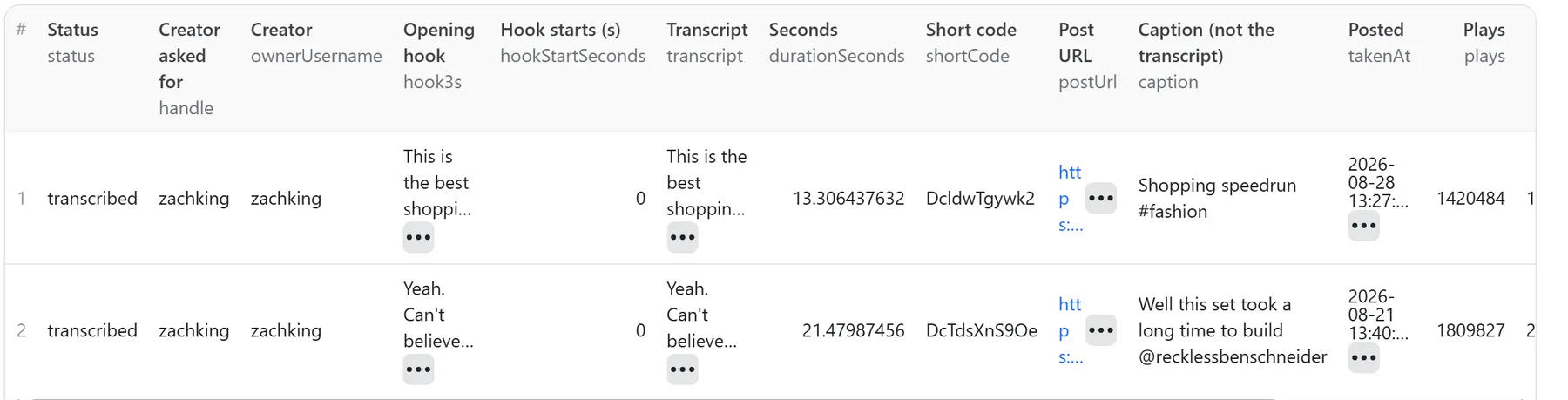
| status | charged | hook3s | hookStartSeconds | transcript | language | durationSeconds |
|---|---|---|---|---|---|---|
transcribed | true | I think we got my mom the perfect Mother's Day gift this year, and I'm so excited. | 0 | I think we got my mom the perfect Mother's Day gift this year, and I'm so excited. There's nothing like gifting a good gift. I'm not going to lie. I haven't always hit the nail on… | English | 61.09 |
transcribed | true | I am just a girl on a healthy hair journey of over eight years and one of the things that I've | 0 | …realized is that most people tend to focus on the hair itself and forget to take care of the scalp… | English | 51.15 |
transcribed | true | What I eat in a day to serve a look. | 0 | What I eat in a day to serve a look. The Sephora savings event is happening and everything is on sale at Sephora. This only happens, by the way, two times a year… | English | 110.41 |
The first row above in full, exactly as it sits in the example dataset (transcript trimmed with … for the page):
Browse the full live example dataset → — real output from a verified run. That run was fed direct media URLs, which is why shortCode, postUrl, ownerUsername and caption come back null above. Run it with a handle instead and every one of those columns is filled — plus takenAt, plays, likes, comments and thumbnailUrl, which ride along inside the listing the actor already reads, at no extra charge.
Every reel row also carries two fields from your account's own memory of the reels it has answered — "isNew": true for a reel your account's memory does not hold (never answered, or its 90 days have run out), "isNew": false for one it holds, and "firstSeenAt", the day the reel's 90 days began for your account as this run found them (this run's clock for a new reel). With a watchlist name set, a reel on that list reads false too. A row that is not about one reel has no such answer, and both read null on the 2-reel sample run (unless it names a watchlist or New reels only) and on every row when neither the list nor your account's memory can be read.
Every field a row normally carries is always present (explicit null over silent omission); a field that belongs to one kind of row appears only on that kind, such as repeat and firstSeenRunId on a reel your account already had, possibleGap on a transcript that may be missing part of its speech, and imagesRead / imagesTotal on a photo post. possibleGap gives startSeconds (where the first missing part may begin), lengthSeconds (about how long it runs), gaps (every part that may be missing, each with its startSeconds and lengthSeconds), totalSeconds (about how long they run together) and a one-line note; that transcript is charged like any other unless those parts together cover half of what was transcribed or more, when it ships uncharged (charged: false), and a re-run hands back the same row, uncharged. Delivered rows are transcribed, or onscreen_text_extracted when the on-screen-text switch is on (the default) and a silent reel's copy was read from its frames (that row carries onScreenText instead of a transcript). Every row also carries retryable — true only when another run could plausibly get a different answer, so you can re-run the rows worth re-running and leave the rest. A third delivered status, since 16 October 2026: image_text_extracted, a photo post or all-photo carousel whose words were read from its images — transcript carries the text (one paragraph per image), segments one entry per image read, and the row carries imagesRead / imagesTotal.
What the reel shows, on request. With Describe each reel on, each newly transcribed reel up to 3 minutes also carries scenes (each with its start and end in seconds, whether it begins on a cut, and one line saying what is on screen), description (what happens, with times like (0:04)), videoSummary (for someone who cannot watch: what is shown, said and written on screen, with times) and sound (whether anyone speaks, whether music plays, and up to three words for its mood — never a genre or an instrument). They are machine-written from the reel's own video, its sound where it can be heard, and its transcript, so a detail can be missed or misread. descriptionStatus says described or not_described, descriptionReason says why a reel was not described or its description was not charged, and descriptionCharged says whether the description was charged.
Newest first means newest by date. A creator's reels come back in the order they were posted, most recent first — not in the order Instagram's grid shows them, which leads with the reels the creator pinned. A pinned reel is still delivered, in its real date position, and every handle-mode row carries isPinned so you can tell it apart or filter it out (null on rows that did not come from a handle). Reels transcribe several at a time, but the rows are written in that order regardless of which one finishes first. Pasted links and chained dataset rows come back in the order you supplied them, so you can join them back to your own list by position.
Every handle-mode row says which Instagram surface listed it. postSource is "profile-page" for the creator's profile — its listing, or the reels shown on the profile page itself — and "feed" for the deeper post feed a bigger ask walks. Pasted links and chained dataset rows leave it null.
If Instagram walls the post feed, the profile page still delivers. When Instagram refuses a creator's post feed on every connection the run tries, the actor reads the reels shown on that creator's profile page and transcribes those instead — the newest of the 12 posts that page shows. Runs that used to come back with nothing now come back with transcripts, charged exactly like any other. The profile page publishes less than the feed does, so those rows carry the caption, thumbnail and the posted date to the day, while plays, likes and comments come back null. If no reel can be read at all, the creator's row is uncharged and says to re-run.
The last row of every run is an uncharged _summary receipt: attempted, delivered, unchargedMisses, chargedRows, chargedEvents (per priced event — reel-transcript, long-video-surcharge, image-text and video-description), stoppedBy and the run's one-line verdict. It is built from the rows above it, so chargedRows always equals the number of rows marked charged: true — your invoice reconciles from the dataset itself.
Non-delivered rows carry status + statusReason instead and are never charged:
| status | what it means |
|---|---|
no_reels_found | a real public profile with no video posts in the reels we read |
private_account | the creator's posts are not publicly readable |
not_found | no public Instagram profile with that handle |
unavailable_schema | Instagram's own profile service errors on that handle (their bug, not yours) |
rate_wall / rate_limited / source_unavailable / resolve_unavailable | temporary — nothing was charged, re-run |
resolve_signin_wall | Instagram served a sign-in page instead of the reel page — about this run, not about the reel; nothing was charged, re-run |
unavailable_expired | a signed media URL that expired before we fetched it — and, when the row carried a reel shortcode, a fresh copy could not be fetched from the reel page either |
private_or_removed | a pasted link Instagram has no post for at all — private, removed, or the shortcode is wrong — or a public post whose video has been removed or restricted (the row says which) |
no_video_in_post | a pasted link to a photo post, or to a carousel whose every item is a photo — there is no video on it to transcribe; uncharged. Since 16 October 2026 such a post is read for the words in its images instead (see Photo posts and carousels), so this row now means its images could not be read on this run |
resolve_blocked | Instagram marks that reel copyright-blocked for embeds and will not serve its video |
resolve_unexplained | Instagram served the page and it carried no video and no reason we recognise — temporary, nothing charged, re-run |
no_speech | the reel has audio but nobody speaks in it — music-only or silent (never sold as a transcript); with on-screen text on (the default) a reel confirmed to have no speech whose on-screen words are read comes back as a charged onscreen_text_extracted row instead. A no_speech row with retryable: true is one this run could not confirm (or speech was heard that could not be transcribed reliably): run it again |
no_onscreen_text | with on-screen text on (the default): a silent reel with no readable copy on screen either — uncharged; also a photo post whose photos carry no readable text |
ocr_unreliable | with on-screen text on (the default): our reader could not return that reel's on-screen text — either it could not be read reliably, or the reel carries more copy than one read returns; the row's note says which, and nothing is charged either way |
demo | the sample row a run with no input returns |
run_summary / stopped_at_limit | the closing _summary receipt — the second form when a limit you set (max reels, max cost, run timeout) ended the run early, naming which one |
no_audio_stream | video-only stream — pass the audioUrl field too |
no_video_found | the row holds no reel video or audio link (an image post, say): the row names the fields it read, and its metadata ships with no result fee |
skipped_deadline | the run was near its time limit, so this lookup was skipped — uncharged; re-run, or raise the time limit the row names (Max run time when you set it, otherwise the run timeout) |
input_error | with guidance naming the fix — the input it is about is in inputField and what you typed in inputValue, never in the URL columns |
failed_* | after bounded retries; also listed in the run's ERRORS record |
Photo posts and carousels
A pasted instagram.com/p/… link is not always a video. A photo post, or a carousel whose every item is a photo, has no audio to transcribe — but its words are usually on the images: a headline, a card of copy, a slide of tips. Since 16 October 2026 this actor reads them: the first 5 images of the post are read in order and delivered as the row's transcript, one paragraph per image, with segments carrying one entry per image and imagesRead / imagesTotal saying how many of the post's photos were read ("5 of 8 images read" when the cap binds). The row's status is image_text_extracted.
It is a separate charge — one image-text event per post, never a reel transcript. The reel-transcript event promises speech-to-text, and a photo post is not that, so it is priced on its own line: $0.035 a post on the Apify free plan, $0.030 on Bronze, $0.028 on Silver and $0.025 on Gold and above. Charged only when readable text is delivered: a post whose photos carry no readable text comes back as an uncharged no_onscreen_text row; a private or removed post, a failed read and a carousel that contains a video (transcribed as a reel instead, its first video item) are never charged an image-text event. When the text reader is busy, the run waits for it while it has time left; if the run's own time runs out part-way through a post, the images already read ship and the row says the rest were not read, and a post with none read yet is left for a re-run, uncharged.
Watch creators on a schedule — pay only for new reels
Run again within 90 days and the reels your earlier runs delivered come back uncharged. Good to know: two of your runs working through the same reels at the same time can each charge a reel they reach together — run them one after the other, or put both lists in one run. The 2-reel sample run (a Start with no creator, link or dataset) does not use your account's memory unless you set a watchlist name or New reels only: its reels are charged as new each time and are not remembered for later runs. Your other runs remember the reels they answered for your account — in a key-value store called ig-reels-watch-account in your own Apify account — under every identity the reel has (its short code and its media file). Run the same creators, reel links, chained rows or media URLs again and the reels already delivered to you come back from the run that delivered them: repeat: true, firstSeenRunId, not downloaded, not transcribed, not charged. The status line counts them (2 of these you already had: handed back, not charged) and OUTPUT.repeats holds the number. Delete that store to forget everything; a reel stops counting as a repeat once its 90 days have run out. The memory is a key-value store in your own Apify account, so a run started with a scoped API token in restricted-access mode needs key-value store Read, Write and Create permission (or Actor runs set to Full access) under Settings → API & Integrations; without it the run says so on its status line and in one uncharged row, and it cannot skip what you already have (Write is what lets the run remember what it delivered; without it every run pays again).
Following a creator is rarely a one-off: the question is usually what did they post since last week? A watchlist answers that with only the new reels.
- Put the creators in Instagram creators (reel links, media URLs and chained runs work too).
- Give the run a Watchlist name, e.g.
acme-creators, and turn on New reels only. - Save the input as a Task, put the Task on an Apify Schedule (daily for a creator who posts every day, weekly for most others), and add an integration or a webhook on run succeeded — a Google Sheet, Slack, n8n, Make, or your own endpoint.
Each scheduled run then delivers only the reels the list has not answered before, each with isNew: true and its firstSeenAt. Reels already on the list are skipped before anything is downloaded — not fetched, not transcribed, not charged — and the run's status line says exactly what happened, for example: watchlist "acme-creators": 2 new reels this run, 18 already on the list were skipped (not fetched, not charged); 20 on the list now. The same numbers sit in the run's OUTPUT record under watchlist, newItems and skippedSeen, and in the _summary receipt as skippedSeen.
Some details worth knowing:
- The list lives in your account, in a named key-value store called
ig-reels-watch-<your name>(one record,SEEN). Open it in Storage → Key-value stores to see every reel the actor has answered under that name, or delete the record to start the list over. This actor runs with limited permissions and touches nothing else in your account. - Only answered reels go on the list. A delivered transcript or on-screen text counts, and so does a final uncharged verdict such as no speech. A reel with such a verdict may be read again by a later run, also under New reels only — after an update of this actor, when on-screen text is on and the verdict was no speech or no audio, or when you pass the audio link of a reel whose verdict was no audio — and it is charged only if it then delivers. An expired URL, a failed download, a creator Instagram would not serve this minute, or a reel your cost cap left out is not remembered, so the next run tries it again.
- What "new" compares against. The actor lists each creator's most recent reels (up to Max reels per creator) and checks those against the list — so a daily run with the default 10 catches anything posted since, and a creator who posts more than that a day just needs a higher number.
- Leave New reels only off and every reel runs as usual — you still get
isNew/firstSeenAton each row, which is the way to build a full picture while still knowing what is fresh. - New reels only without a watchlist name compares against your account's memory instead: reels your account bought in the last 90 days are skipped before download. Only when neither a list nor the memory can be read does the run stop with one uncharged row, instead of charging you for reels you may already have. A named watchlist it cannot open stops the run the same way, before any spend. A scoped API token without key-value store Read, Write and Create permission is the usual reason both fail at once — the run then names the permissions to grant instead of asking you to re-run.
- If your account's memory cannot be read, the run still runs: it delivers and charges as usual, and the status line and the charged rows say the repeat check was unavailable (
repeatCheck: "unavailable"). If the saved list itself is damaged and cannot be read, the run sets it aside under a side key in the same store, starts a new list, and says so in one uncharged row: that run's reels are charged as new, and later runs hand them back as usual. - One reel, one sighting, however it arrives — the same reel listed from a handle, pasted as a link, or arriving as a freshly minted media URL is one entry.
For AI agents & LLMs — copy this block
Why this Instagram transcript scraper?
- The whole chain in one box. Handle in, transcripts out: the actor finds the creator's reels, gets each one's video, and transcribes it. No scraper to run first, no dataset to copy between actors, no login and no cookies.
- A reel link Instagram will not resolve is tried again, at the same price. Pasted reel links are fetched from Instagram's own public page, and Instagram sometimes answers that page with a sign-in screen or nothing at all. A link that ends that way is tried once more and, when that serves the reel, it is transcribed and delivered exactly like any other reel: one row, one charge, the same price, nothing extra to switch on. If the second try cannot serve it either, you get the same uncharged row you would have got anyway, saying so. When Instagram refuses several links in a row on one run, the next links go straight to that second try — every fourth still asks Instagram, and the run goes back to Instagram the moment it answers — at the same price either way. A creator whose profile Instagram will not serve gets the same second try too, instead of coming back as a "please re-run" row.
- A transcript, not a caption. Some tools sell the post caption as a "transcript". This actor downloads the reel's audio and transcribes the actual speech — the caption ships alongside it, clearly labeled, so you can compare.
- Charged only on delivery. A transcript either lands in your dataset or the row carries no result fee. Expired URL → uncharged row that says so. Music-only reel with no readable on-screen text → uncharged row that says so. No "it ran and charged me but returned nothing."
- Music-only detection. Speech-recognition models hallucinate filler text ("Thank you.") on music. We detect that and never sell you the filler as a transcript: the reel's on-screen words come back instead (charged like a transcript), or an honest, uncharged row when there is nothing to read — on a music-heavy platform, this fires a lot, and it's the point.
- The silent reels, too — on by default from 17 November 2026. About 1 in 6 reels is music-only, and its message is on the screen rather than in the audio. With Read on-screen text on silent reels on (the default), a reel confirmed to have no speech comes back with the on-screen copy read from the reel's own frames — no second download, no extra event, charged at the same per-transcript price; a silent reel with no readable text stays uncharged, and a reel whose silence could not be confirmed on a run comes back uncharged and can be run again. Switch it off (or send
includeOnScreenText: false) and silent reels stay uncharged. A saved task, schedule or call that already sendsfalse(a form saved before this build may carry it) stays off. - Any video length. Long-form videos transcribe fine — the first 3 minutes are included, longer videos add a small per-started-minute surcharge instead of failing or being cut off. The one exception is your own maximum cost: when it covers only part of a long video you get the part it covers, the row says where it stopped, and it names the figure to set for the rest.
- Hook as data, and never blank.
hook3sis the reel's first 3 seconds of speech — the line creators and buyers actually study — as its own field, with full segment timestamps beside it. Reels that open on music or a title card are common here, so when nothing is said in the first 3 seconds you get the first 3 seconds of speech from wherever speech actually begins, andhookStartSecondstells you which second that is (0when the reel opens speaking). A reel with no speech at all leaves bothnull— this field is never an empty string, so "the reel opens silent" and "the reel opened talking, we lost it" can't be confused. Sort byhookStartSecondsto see which creators make you wait for the point. - Post metadata rides along at no extra charge. Every handle-mode row carries
takenAt,isPinned,plays,likes,comments,caption,thumbnailUrlandpostSource(which Instagram surface the reel was listed from) — they arrive inside the same listing the actor already reads, so they cost you nothing extra. - Works with any scraper's output. The input deep-scans your dataset rows for the reel media URLs and metadata (including reels nested inside profile results) — no field mapping, no glue code.
- Knows when your URLs expire. Every row includes
urlExpiresAt, decoded from the signed URL itself — so you can see at a glance whether a dataset is still transcribable before spending anything.
This actor may fail when the platform changes things — failed items are never charged.
How to transcribe a creator's Instagram reels (no code)
- Type the creator's handle into Instagram creators —
nasa,@nasa, orhttps://www.instagram.com/nasa/. Add as many creators as you like. - Set Max reels per creator (default 10) and click Start.
- Each reel comes back as one JSON row: transcript + hook + post metadata. That's the whole flow — no scraper, no dataset ID, no login.
Max reels per creator starts at 2 in the console form, for a quick first look; a run sent without it (API, agent or schedule) reads 10. It is best-effort. Instagram serves a creator's reels 12 at a time and sometimes stops part-way; when that happens the run keeps what it listed, says so in the run message, and charges only for transcripts it delivered.
Already holding links? Paste them into Instagram reel links instead. A pasted reel carries its creator, caption, likes and comment count; its plays can be empty or well below the reel's real play count, and it usually has no takenAt; give the creator's handle instead when you need the play count or the posted date. A pasted photo post comes back with ownerUsername, caption, takenAt, plays, likes, comments and thumbnailUrl all null. Coming from a scraper you already run? Paste that run's dataset ID here (or use Apify's Connect Actor integration to chain it automatically), or paste videoUrl / audioUrl values into videoUrls. Mixing modes is fine — a reel supplied twice is delivered and charged once. Holding a direct audio or video file on some other host — your own storage, a CDN of your own, anywhere? That is a different actor: our media transcriber (apify.com/steadyfetch/media-transcriber) reads a media file from any host, pasted into its Media URLs field. Paste one into either link field here and you get an uncharged row that says exactly that. Export as JSON/CSV, or read it via API.
Why do Instagram video URLs expire?
Instagram's CDN signs every media URL with an expiry (typically 1–3 days from when your scraper ran). Transcribe soon after scraping — a dataset from last week will have dead links. Expired rows come back as uncharged unavailable_expired with the exact expiry time, so you can re-scrape and re-run just those. Every row's urlExpiresAt field tells you how long you have.
Pasted reel links don't have this problem — the actor resolves each link to a fresh media URL at run time and transcribes it immediately. Chained rows get the same rescue: when a row's signed URL is dead but the row carries the reel's shortcode (every major Instagram scraper exports one), the actor fetches a fresh copy from the reel page before giving up, so a stale dataset still delivers. A link Instagram has no post for comes back as an uncharged private_or_removed row, one it marks copyright-blocked for embeds as resolve_blocked, and a photo post or an all-photo carousel as no_video_in_post — each with the reason stated; a page that came back with no video and no reason we recognise comes back as a retryable resolve_unexplained row, a lookup Instagram simply would not answer on this run as a retryable resolve_unavailable row, one where it served a sign-in page instead of the reel comes back as a retryable resolve_signin_wall row, and one the run's own time limit left no room for comes back as skipped_deadline — never a silent charge.
How much does it cost to transcribe Instagram reels?
One result = one reel's full transcript payload (transcript + hook + language + segments + metadata). The first 3 minutes of each video are included; longer videos add a small per-started-minute surcharge. No start fee, no subscription, no third-party API key to buy.
| Job | Approx. cost |
|---|---|
| One creator's last 10 reels | ≈ $0.15 |
| 100 reels from a creator's profile | ≈ $1.50 |
| 1,000 reels (a serious content teardown) | ≈ $15 |
| Apify free plan ($5 credit) | ≈ 330 reel transcripts, up to 25 a day; paid plans have no daily limit |
Platform usage (compute + transfer) is included in the event price — the per-transcript price you see is the whole price. Rows that don't deliver a transcript carry no result fee. A photo post or all-photo carousel is a separate image-text event, one per post (the first 5 images read): $0.035 on the Apify free plan, down to $0.025 from Gold. Cap any run with Maximum cost per run (any amount from $0.05 up) and it stops cleanly before your ceiling.
video-description — $0.03 per described reel on the Apify free plan, $0.025 on Bronze, $0.02 on Silver and above, for transcribed reels up to 3 minutes. It is off by default; switch on Describe each reel to get it. Descriptions are made one at a time, about a minute each, so a described run takes longer than a plain one. On the Apify free plan, up to 5 reels per account in any 24 hours are described, counting reels your runs still in progress have reserved; past that a reel comes back with its transcript and no description, the reason in descriptionReason, no description charge, and one note row naming the paid plans, which have no such limit. A reel longer than 3 minutes, or one the run could not describe, still comes back with its transcript and the reason in descriptionReason, and no description charge; a reel with no speech is not described, and a reel handed back from your account's 90-day memory is not described again: it comes back as it was delivered, with a description only if that run made one, and no description charge.
On the Apify free plan, runs of this actor deliver up to 25 reel transcripts per account in any 24 hours (a silent reel's on-screen text or a photo post read from its images counts as one; reels already in your account do not), and make at most 100 extra Instagram lookups per account in any 24 hours — the extra reads it spends only when Instagram will not serve a reel link or a creator's reel list directly — and all accounts on the free plan share one daily allowance of those lookups on this actor. Past any of these allowances, the run keeps everything it already delivered, ships an uncharged row saying when it resets (UTC) and what a reel transcript costs on Bronze, Apify's first paid plan, and charges nothing past it. Paid Apify plans carry no daily allowance.
For a faster run, raise the memory: at 2 GB a run transcribes about twice as many reels per minute as at 1 GB, and more at 4 GB. The default is 2 GB; change it under Run options → Memory. A run asking for 100 reels or more with less than 2 GB says so in its log as it starts and again on its status line.
Use it via API, MCP, and integrations
- API: standard Apify run API —
POST .../acts/steadyfetch~instagram-reel-transcript-scraper/runswith{ "handles": ["nasa"] },{ "reelUrls": ["https://www.instagram.com/reel/…/"] },{ "datasetId": "..." }, or{ "videoUrls": ["..."] }. Python/Node clients work as with any actor — pass the fields themselves as the run input (in Python,run_input={"handles": ["nasa"]}); settings wrapped as{"input": {...}}are read too, with one uncharged note row saying so. - Building the input from a template? Every field of this actor is optional and accepts an explicit
null, read as "use the default" — so a body rendered once per run with the fields you left unset set tonullruns exactly as if you had left them out. No field of this actor has to be removed from the body. - MCP: works from Claude, Cursor, and any MCP client through Apify's MCP server — give it a handle, reel links or a dataset ID and ask for "instagram reel transcripts". The one-click pin link is at the top of this page: add it as an MCP server URL and this actor is the only tool the client sees.
- n8n: a free ready-made template, no community nodes needed — Instagram Reel Transcripts (scrape a profile's reels → transcribe by dataset ID → spreadsheet-shaped rows, 3-minute setup).
- Make / Zapier: call it as a regular Apify actor step right after your Instagram scraper node.
Use it as an API endpoint (Standby)
You can also call this actor like an API: send a few Instagram creators or reel links and get each reel's transcript back in the same response, with no run to start and no dataset to read. The address is https://steadyfetch--instagram-reel-transcript-scraper.apify.actor, and the actor's Endpoints tab lets you try it from the browser.
| Setting | What it does |
|---|---|
handles | Instagram creators, comma-separated (nasa,zachking). Their latest reels are transcribed. At most 10 creators per request (1 on the Apify free plan). |
reelUrls | Instagram reel or post links, comma-separated. startUrls and videoUrls work as on a run. |
maxReelsPerHandle | Latest reels per creator, 10 if you leave it out. |
maxItems | The most reels one request transcribes: 50, or 3 on the Apify free plan. Send the rest in further requests. |
includeOnScreenText | On if you leave it out: the on-screen words of a reel confirmed to have no speech are read, charged like a transcript; a reel whose silence could not be confirmed comes back uncharged and can be sent again. false keeps those reels uncharged. |
POST a JSON body with the same fields if you prefer. The answer is JSON: rows (each with the same fields as a row in a run's dataset), summary (the run's closing receipt), delivered, charged (events, by name) and notes for anything you should know beyond the rows, in plain words. You are charged per event at the same prices as a run — one reel transcript per reel transcribed, plus the long-video minutes and photo-post text exactly as a run charges them. Reels with no speech and no on-screen words read (or with includeOnScreenText false), private or removed reels and failures are not charged, and if the charge for a request cannot be completed, its reels are not sent and nothing is charged.
Good to know: the endpoint does not skip reels your account already has — every request transcribes the reels it reads. A reel your account already has is charged there like any other, and one bought there is not remembered for your runs; the 90-day memory applies to runs. datasetId, pasted dataset rows, watchlists and newReelsOnly need your own account, so they stay on runs. Video descriptions (describeVideo) are made on runs only too, and a request that asks for one is refused with a message saying so. For many creators at once, a whole chained dataset, or to skip reels you already have, run the actor as usual.
Works with — Instagram scrapers you can chain from
This actor reads the media URL value in each row (any Instagram CDN .mp4 link), not a fixed field name, so it works with any Instagram scraper that exports direct media links. A row with no media URL still works if the row itself says it is a reel — type: "video", productType: "clips", or its own instagram.com/reel/… link, together with the post's short code: this actor fetches the media from the reel's own page. Some scrapers read a surface that publishes no media URL at all, and those rows used to come back empty. A row that is genuinely not a reel — a photo post, a carousel of photos — is still answered instantly with no result fee and no lookup spent on it. Verified shapes on this store:
| Scraper | Where the media URL lives in its output |
|---|---|
| apify/instagram-scraper | videoUrl (posts), latestPosts[].videoUrl (profiles) |
| apify/instagram-reel-scraper | videoUrl + audioUrl |
| apify/instagram-post-scraper | videoUrl, childPosts[].videoUrl |
| apify/instagram-api-scraper | videoUrl + audioUrl (same output shape as the reel/post scrapers) |
How to chain: run the scraper → copy the run's dataset ID into this actor's Dataset ID field, or use Apify's Connect Actor integration to pass it automatically → Start. Using a scraper that isn't listed? If its rows contain the Instagram CDN media link — in one field or in a list such as videoUrls — or say they are reels and carry a short code — it works the same way, and a row that is neither comes back as an uncharged no_video_found with its metadata intact.
Coming from another transcript actor in this suite? Its list field is called urls; here the same values go in Instagram reel links (reelUrls) or Reel video/audio URLs (videoUrls). You can paste your input across unchanged — this actor reads urls as well and places each value by its shape, with one uncharged row naming the fields this form uses.
Steadyfetch Instagram suite
Handle in, structured rows out. All-inclusive pay per event, nothing charged for starting a run, charged only on delivery. Profile posts adds one profile lookup of $0.003 per profile that delivers posts ($0.007 from 17 November 2026); a profile that delivers nothing new pays only the nothing-new check ($0.005; $0.009 from 17 November 2026), never a lookup.
| What you want | Actor |
|---|---|
| Reels turned into text, with the 3-second hook | this actor |
| A profile's recent posts, capped where you say | Instagram Profile Posts Scraper — Instagram User Posts, Reels |
The rest of the steadyfetch shelf — same contract everywhere: all-inclusive pay per event, nothing charged for starting a run, charged only on delivery (three actors add a small delivery-conditional fee: keyword volume's fresh lookup, profile posts' profile lookup, Google Jobs' search fee — each README states it).
| Family | Actors |
|---|---|
| Ad creative intelligence | Facebook · Google Ads video · TikTok · LinkedIn · Google Ads text & OCR |
| Trends & keywords | Google Trends · Trends Now · Breakout keywords · Autocomplete keywords · Keyword volume & CPC · Social trends |
| YouTube transcripts | YouTube videos · YouTube channels |
| Reel transcripts · Profile posts | |
| Jobs | Indeed · Career sites by domain · Glassdoor · Multi-board · Google Jobs |
| Amazon | Products · Search · Bestsellers · Sellers |
| Any media file | Speech to Text · any link or file |
Free n8n workflow templates for this actor are listed on our profile website (link on our Apify profile).
FAQ
Is this the same as the caption? No. The caption is text the creator typed under the post; the transcript is what's actually said in the video's audio. You get both, clearly labeled.
Do I need a scraper at all? No. Give it a handle and it lists that creator's reels itself, then transcribes them. Links you already have go into Instagram reel links. A separate scraper still earns its keep for jobs this actor doesn't do — hashtags, search, or a full post archive — and you can chain its run here by dataset ID. Searching reels by keyword or topic? Use steadyfetch/instagram-keyword-reels-scraper.
What if a creator has no reels, or the account is private? You get one uncharged row per creator saying exactly that (no_reels_found, private_account, not_found). A creator we could not read is never a failed run and never a charge.
How deep does it go? As deep as Max reels per creator (up to 500), newest first — by date, so a reel the creator pinned to the top of their grid never takes a slot a newer reel owns; it is delivered in its real date position and flagged isPinned. Instagram serves reels 12 at a time, so deeper asks take a few more requests; the run stops cleanly and tells you if Instagram cut it short.
Music-only reels? We never sell hallucinated filler as a transcript. By default (Read on-screen text on silent reels on), when a reel is confirmed to have no speech the actor reads its on-screen copy and delivers it as onScreenText — { headline, body, cta, displayUrl, rawText, truncated } — charged like a transcript. A silent reel with no readable text on screen is uncharged, and a reel whose silence could not be confirmed on a run comes back uncharged and can be run again. Switch it off (or send includeOnScreenText: false) and every music-only reel comes back as an honest, uncharged no_speech row. When the text reader is busy, the run waits for it while it has time left instead of giving up on the reel; a silent reel whose on-screen read the run's own time ran out on keeps its uncharged no_speech row, and the row says a longer run reads it. truncated is false on almost every reel; on one carrying more copy than a single read returns it is true, the text ships cut short at about 3,500 characters, and the row's note says so.
What does no_audio_stream mean? Some scrapers export a video-only stream (no audio track) plus a separate audioUrl. If we get the video-only stream, the row says so — pass the audioUrl field too and the audio path is used automatically.
Languages? Multilingual speech recognition — Spanish, Portuguese, Arabic, Japanese, and ~90 more transcribe out of the box; the detected language ships on every row.
Is it legal to transcribe Instagram reels? The reels are public content, and your scraper already collected the media URLs. US courts have held that logged-out collection of public Meta data does not breach Meta's terms (Meta v. Bright Data, 2024). As always, how you use the data is on you.
What happens on a failed download? Bounded retries, then an uncharged failed_download row plus an entry in the run's ERRORS record. This actor may fail when the platform changes things — failed items are never charged.
Feedback & support
Found an issue? Open it on the Issues tab — we usually reply within a couple of hours, always within a day. Feature requests welcome. If it earned its keep, a rating helps other buyers find it, and saving the actor keeps it one click away.


