
Google Patents Scraper: Patent Details by Number
Pricing
from $2.10 / 1,000 patents
Google Patents Scraper: Patent Details by Number
Get full Google Patents data by publication number: title, abstract, assignees, inventors, dates, legal status, expiry, CPC codes, citations, cited-by, family and optional claims. No API key.
Pricing
from $2.10 / 1,000 patents
Rating
0.0
(0)
Developer

Mivah
Maintained by CommunityActor stats
0
Bookmarked
2
Total users
1
Monthly active users
a day ago
Last modified
Categories
Features
Share
Google Patents Scraper: patent details, legal status, citations and family by number
Get the full Google Patents record for any patent publication number in one clean row: title, abstract, current and original assignees, inventors, priority, filing, publication, grant and anticipated expiration dates, legal status (Active, Expired, Ceased…), CPC classifications with descriptions, the first independent claim, citations and "cited by" lists with counts, the patent family and worldwide applications, plus the PDF link. Turn on full text to also get every claim and the description.
Built for IP and patent attorneys checking a portfolio's status and expiry, R&D and competitive-intelligence teams tracking a rival's patents, licensing and M&A due diligence, analysts who need citation counts for patent valuation, and AI agents that answer "who owns US9876543B2 and when does it expire?". Works for US, EP, WO, DE, JP, CN, KR, GB, FR and 100+ other offices that Google Patents covers. No API key and no login.
What you get
- 📄 Bibliographic data: title, abstract, country, kind code, document type, application number, PDF and Google Patents links
- 🏢 Who owns it: current assignees (after reassignments) and original assignees, inventors (names only)
- 📅 Dates and status: priority, filing, publication, grant, anticipated (or adjusted) expiration, legal status, and the full event timeline (filed, published, granted, reassigned, expired)
- 🏷️ CPC classifications: every leaf code with its description, first/main and additional codes flagged
- 🔗 Citations: patents cited (examiner-cited flagged), patents citing it ("cited by"), family-to-family citations, non-patent literature, with exact counts
- 🌍 Family: family publications, priority applications, worldwide applications with their legal status, family countries
- 📜 Claims: claim count and the first independent claim always; optionally every claim (number, text, independent or dependent) and the full description
- 🌐 Languages: English by default (Google's machine translation of non-English patents, flagged in
machineTranslatedFrom), or the original language - ✍️ Any number format:
US9876543B2,US 9,876,543 B2,EP1234567B1,WO 2020/123456 A1, or a patents.google.com URL. If the exact kind code isn't on Google Patents (e.g. EP…A1), the number without it is used and the row says so (matchedWithoutKindCode)
Input example
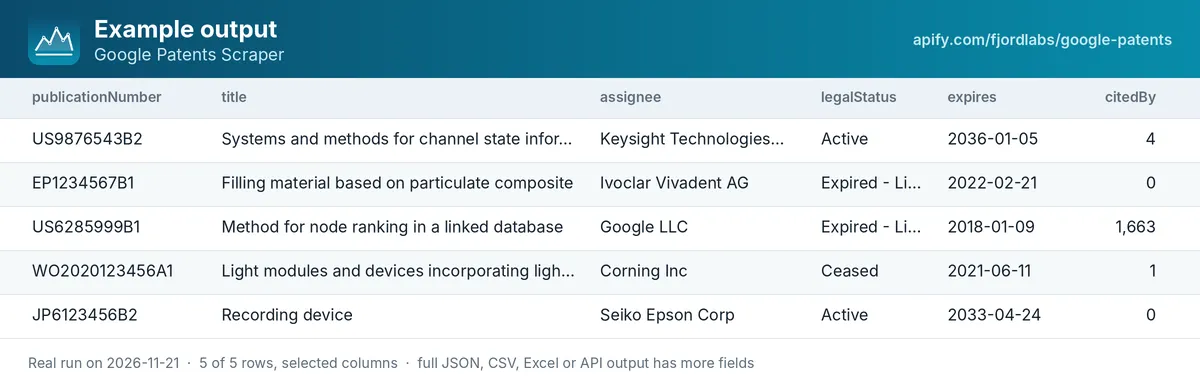
Output example
One row per patent (lists shortened):
The Patents, Abstract, CPC and claims and Citations and family dataset views show the most useful columns. A run summary is saved as SUMMARY in the key-value store. Numbers that can't be found come back as type: "error" rows.
Use cases
- IP and patent attorneys check legal status and anticipated expiry across a portfolio spreadsheet of patent numbers.
- Competitive-intelligence teams pull assignees, CPC classes and families for a rival's known patents.
- Analysts use citation and "cited by" counts as an input for patent valuation.
- Due-diligence teams fetch full claims and descriptions for a shortlist of patents in licensing or M&A work.
Pricing
Pay only for results:
| Event | Price |
|---|---|
| Actor start | $0.00005 |
| Patent (row) | $0.003 ($3 per 1,000 patents) |
Everything is in the one price: citations, family, CPC, status, and full claims and description when you turn them on. Example: checking the status and expiry of a 200-patent portfolio costs about $0.60. Errors (an entry that isn't a patent number, a number Google Patents doesn't have, a page that can't be fetched) are saved as type: "error" rows and never charged. Duplicate numbers in the input are fetched once.
Notes and limits
- No search: use patent numbers you already have, e.g. from a patent office export, a portfolio spreadsheet, a citation list or a previous run's
citedBylist. The Actor only reads individual patent pages, which is what patents.google.com's robots.txt allows; it never calls Google Patents' search. - Data is what Google Patents shows on the patent page. Legal status and expiration dates are Google's estimates, not legal advice: check the patent office register before you rely on them.
- About 1–2 seconds per patent (requests are sequential and polite, with automatic retries), so 1,000 patents take roughly 30 minutes. The default run timeout is 1 hour; raise it for lists of more than about 1,500 patents. Max 5,000 numbers per run.
- Language:
engives English text for most patents (machine-translated where the original isn't English). If a patent has no text in the language you ask for, its original language is used andtextLanguagesays which. - Popular patents can be cited thousands of times. Max items per list (default 100) caps each list; the counts are always exact. Set 0 for no limit.
- Full description text is capped at 1,000,000 characters per patent (
descriptionTruncatedsays when). - Inventor names are taken from the public patent record; addresses and postcodes are not included.
- If Google rate-limits a very large run, the Actor retries with backoff and then stops cleanly, returning the unfetched numbers as free error rows. You can then re-run them, optionally with Apify Proxy.
Changelog
- 2026-11-24: More FAQs and use cases in this README.
- 2026-11-19: First version: details by patent number, citations, family, full text; robots.txt respected (patent pages only).
How to use Google Patents Scraper
- Paste patent publication numbers (US9876543B2, EP1234567B1, WO2020123456A1) or patents.google.com URLs, one per line.
- Choose what to include: citation lists, family and worldwide applications, full claims and description.
- Keep language
enfor English text, or pick another two-letter code. - Click Start, then export the patents as JSON, CSV or Excel.
Use it from code (API)
Run it from Python with the official client (pip install apify-client):
Or with one HTTP call that returns the results directly:
It also works with Make, Zapier, n8n, Google Sheets and webhooks through Apify's integrations.
Use with AI agents (MCP)
Agents can call this Actor as a tool through Apify's MCP server (mcp.apify.com). Add fjordlabs/google-patents to the server's Actors. Results are clean JSON with a small default size, so they fit well in an agent's context.
FAQ
Can it search Google Patents by keyword or assignee?
No. Google Patents' robots.txt only allows individual patent pages, and we respect it. Use numbers you already have, e.g. from a patent office export, a portfolio list or a previous run's citedBy list.
Which patent offices are covered? Everything Google Patents has: US, EP, WO, DE, JP, CN, KR, GB, FR and 100+ more. Non-English patents come with Google's English translation by default.
Is the expiration date reliable? It's Google Patents' anticipated (or adjusted) expiration. Use it for screening, and check the official register before relying on it legally.
What if my number has the wrong kind code?
If Google Patents doesn't have that exact kind code, the Actor tries the number without it and marks the row with matchedWithoutKindCode: true.
Do I pay for numbers that aren't found?
No. Unknown numbers and failed pages come back as free type: "error" rows.
Which language do I get?
The language input decides (default en). A language suffix in a pasted URL (.../de) is ignored. If a patent has no text in that language, Google Patents falls back to the original or English.
How do I get the legal status and expiry date of a patent?
Put the publication number in patents, for example US9876543B2. The row has legalStatus and the anticipated expiration date. These are Google's estimates, so check the patent office register before relying on them.
How much does it cost to check a patent portfolio? $0.003 per patent, so a 200-patent portfolio costs about $0.60. Citations, family, CPC and full text are all included in that price, and error rows and duplicates are not charged.
Is there a way to bulk-download Google Patents data for a list of numbers?
Yes: paste up to 5,000 numbers (any format, or patents.google.com URLs) into patents and get one row each, exportable as CSV, Excel or JSON. It reads pages by number only; there is no keyword or assignee search. Use numbers from patent office exports, portfolio lists or a previous run's citedBy list.
Am I charged for errors? No. Rows that fail are never charged; you only pay for results.
More from fjordlabs
- Google Trends Scraper
- Google Trends Trending Now
- Google News Scraper
- Google Play Reviews & App Data Scraper
- App Store Reviews & App Data Scraper (iOS)
- Bulk PageSpeed Insights & Lighthouse Audit
- Google Autocomplete Keyword Expander
- App Store & Google Play Search Rank + Top Charts (ASO)
- SEO & AI-Search Readiness Audit
- Website Tech Stack Detector
- Steam Reviews & Game Data Scraper
- Chrome Web Store Extension Details Scraper
- Google Ads Transparency Center Scraper
- Hacker News Scraper
- Shopify Store Products Scraper
- Sitemap URL Extractor
- EU Public Tenders Scraper (TED)
- Domain Intel: WHOIS/RDAP, DNS, SSL, SPF/DMARC
- App Store & Google Play App Details + Developer Portfolio
- Website Screenshot API: Full Page, Mobile, PDF
- Wayback Machine Site History
- AI Brand Visibility Tracker
- YouTube Data API Scraper
- Apple Podcasts Scraper: Search, Top Charts & Episodes
- Nordic Company Registry (Norway + Finland)


