
Google News Scraper | Google News Alerts, Archive by Date
Pricing
from $0.70 / 1,000 article results
Google News Scraper | Google News Alerts, Archive by Date
Scrape Google News by keyword, topic, site, language and country at $1.00 per 1,000 articles: title, publisher, the real article link decoded from Google's redirect, publish time; any time window or date range, past the 100-result limit. Optional full text, only-new alerts.
Pricing
from $0.70 / 1,000 article results
Rating
0.0
(0)
Developer

Aurelix
Maintained by CommunityActor stats
0
Bookmarked
2
Total users
1
Monthly active users
17 minutes ago
Last modified
Categories
Features
Share
What is Google News Scraper?
Get Google News articles by keyword, topic or site, with the real publisher link, for $1.00 per 1,000 articles, past the 100-result limit, no login.
For news alerts, media monitoring and research. Any edition, any window up to a month or an exact date range, optional full text, and an only-new mode with a Slack digest.
| Input | Keywords with Google News operators (up to 50), topic sections, publisher sites, edition, time window or date range |
| Output | Title, publisher, decoded article link, Google News link, publish time, query or topic; optional full text and word count |
| Per query | Up to the number you set (max 5,000), or all that Google News's single-day searches list for the window if fewer; read day by day past Google's 100-per-search limit |
| Automate | Only new articles since last run, Slack or webhook digest (e.g. to email through Zapier, Make or n8n), schedules, MCP for AI agents |
| Price | $1.00 per 1,000 articles (from $0.70 per 1,000 articles on paid Apify plans) |
| Free to try | Runs on Apify's free plan: the $5 monthly credit covers about 4,700 articles |
| Login needed | No |
Daily monitor: only what's new, every morning
Set it once, get only the new articles every morning. With Only new articles since last run on, the first run returns everything that matches; each later run skips articles that earlier runs already returned, so you pay only for new ones.
- Paste this input into the Input tab (JSON view) and click Save as a new task; it appears under Saved tasks.
- Open the task from Saved tasks and click Schedule.
- Choose Daily, pick the hour, and save.
Cost example: 1 brand query, about 15 new articles a day ≈ $0.60/month on the free plan (from $0.47 on paid plans): one run a day for 30 days, start fee included. The first run returns everything that matches, so it costs more.
Add a Slack incoming-webhook URL in slackWebhookUrl (or any URL in webhookUrl) to get a short digest of each run's new articles; nothing is sent when a run finds nothing.
Why Google News Scraper users pick this one
- More than 100 results. Long windows are split into date ranges and deduplicated.
- Real publisher links. Decoded from Google's redirect links, included in the price.
- Archive by date. Last hour, day, week, month or any exact date range.
- Full text when allowed. Markdown from the publisher's site; skipped pages are free.
- Spending you control. Each article is checked against your maximum charge first.
Get started in 3 steps
- Enter keywords (one per line), and optionally topics, sites, the edition and a time window or date range.
- Set how many articles you want per query, and turn on full text or 'Only new articles since last run' if you need them.
- Click Start, then download JSON, CSV or Excel, or send the rows to Google Sheets, Zapier, Make, n8n or an AI agent through the API.
▶ Try it with the example input
The form opens with an example input already filled in.
How much does it cost to scrape Google News?
Pay per event: you pay only for what the run returns, plus a small start fee. Bronze, Silver, Gold and higher Apify plans pay less per result. Paid plans pay $0.90 (Bronze), $0.80 (Silver) and $0.70 (Gold and higher) per 1,000 articles.
| Articles | Free plan | Bronze | Silver | Gold |
|---|---|---|---|---|
| 100 | $0.11 | $0.095 | $0.085 | $0.075 |
| 1,000 | $1.05 | $0.95 | $0.85 | $0.75 |
| 10,000 | $10.50 | $9.50 | $8.50 | $7.50 |
Totals include the $0.005 start fee per run (at least one run per 100 articles, so 10 start fees for 1,000), rounded to the cent (amounts under $0.10 to four decimals). Apify's free plan includes $5 of credit a month, enough for about 4,700 articles.
$1.00 per 1,000 articles (from $0.70 on paid Apify plans), with the publisher link decoded at no extra cost, plus a $0.005 start fee per run, so the example run (2 queries, 10 articles each) costs $0.025. Full text is optional: $1.00 per 1,000 articles that come back with text (from $0.70 on paid plans). Articles already returned in only-new mode, duplicates and skipped full text (robots.txt, paywall, no readable text) are never charged. A search that returns nothing chargeable is free for the first 10 in a run, then $0.0001 each.
Billing events
| Event | Free plan | Bronze | Silver | Gold |
|---|---|---|---|---|
article-result | $1.00 per 1,000 articles | $0.90 per 1,000 articles | $0.80 per 1,000 articles | $0.70 per 1,000 articles |
full-text | $0.001 per article with full text | $0.0009 per article with full text | $0.0008 per article with full text | $0.0007 per article with full text |
query-checked | $0.0001 per search with nothing to return (beyond 10 per run) | $0.0001 per search with nothing to return (beyond 10 per run) | $0.0001 per search with nothing to return (beyond 10 per run) | $0.0001 per search with nothing to return (beyond 10 per run) |
apify-actor-start | $0.005 per run | $0.005 per run | $0.005 per run | $0.005 per run |
What data you get
Google News Scraper reads Google News the way its public RSS feeds show it to any visitor: give keywords (Google News search operators work), topic sections or publisher sites, pick the edition (language and country) and a time window from the last hour to the last month or an exact date range, and get one row per article with its headline, publisher, publish time and the publisher's own article link, decoded from Google's redirect link. Windows that hold more than Google's 100 articles per search are split into smaller date ranges automatically and deduplicated, so a search returns up to the number you set, not 100. Turn on full text to also get each article's text as Markdown with a word count, read from the publisher's site where its robots.txt allows it.
- status (ok, or why nothing came back: no_results, failed, skipped, unsupported_edition, invalid_input), error
- title, publisher, publisher_url, url (decoded publisher link), url_resolved, google_news_url, published_at (ISO 8601 UTC), snippet
- query or topic, language, country, edition (ceid), article_id
- With full text on: full_text (Markdown), word_count, full_text_status
- source_url, scraped_at
| published_at | title | publisher | url | query |
|---|---|---|---|---|
| 2026-11-21T18:16:28Z | Rising Demand Means It’s Hard to Find an EV in the US | Bloomberg.com | https://www.bloomberg.com/news/newsletters/2026-11-21/ris... | electric vehicles |
| 2026-11-21T20:28:00Z | Trump wants to work with Democrats on placing 10 percent ... | The Hill | https://thehill.com/business/6235394-trump-calls-credit-c... | interest rates |
| 2026-11-21T21:27:48Z | Senegal’s farmers are working on climate change’s front line | The Washington Post | https://www.washingtonpost.com/world/interactive/2026/11/... | "climate change" -opinion |
| 2026-11-21T19:33:49Z | UK should only rejoin EU if it innovates on technology, B... | BBC | https://www.bbc.com/news/articles/c893r4923wngo | site:bbc.com economy |
| 2026-11-21T19:15:01Z | A Guide to The Best Way To Play GTA 6, According To Rockstar | Kotaku | https://kotaku.com/rockstar-dev-tells-gta-6-players-to-st... |
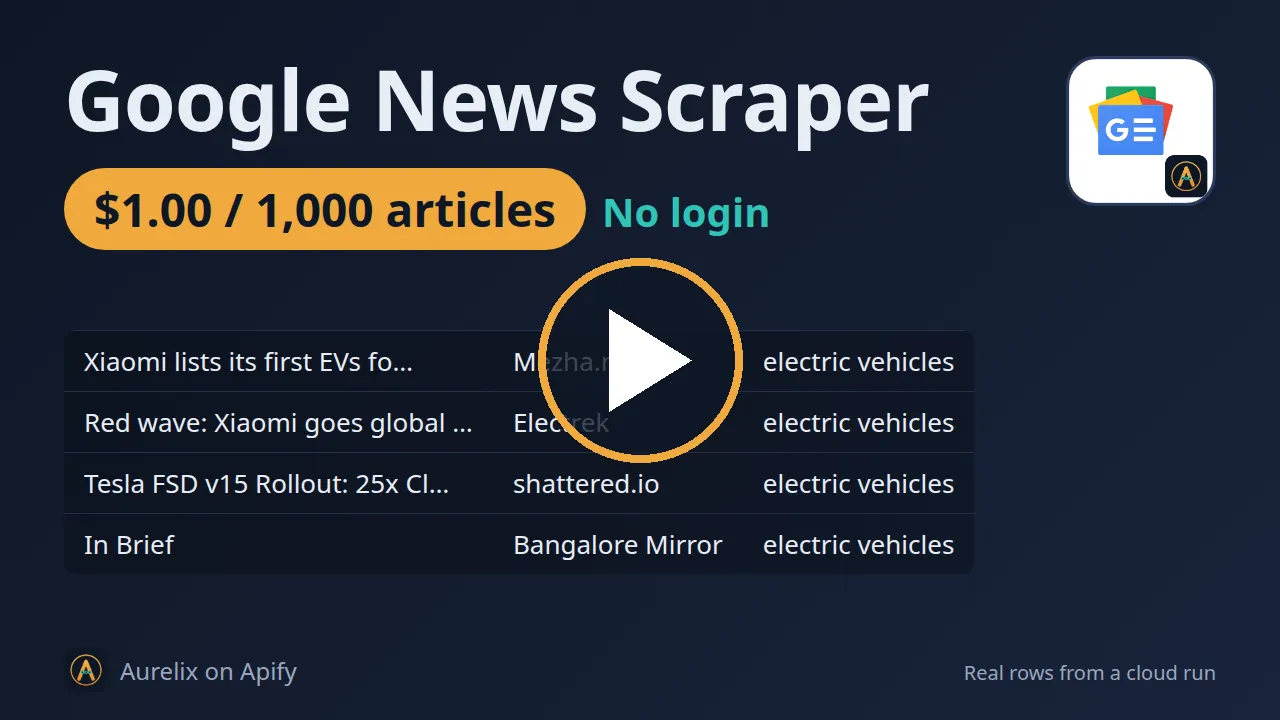
One full article record, exactly as a real run returned it (long text and lists shortened here). From a real run:
Use cases
- Brand and competitor monitoring: a daily or hourly alert of new articles that mention a company or product
- PR and communications teams tracking coverage by publisher, country and language
- Researchers and analysts building news datasets for a topic over a date range
- AI and RAG pipelines that need recent articles with clean full text
- Investors and traders following news on tickers, sectors and central banks
Use-case recipes
Daily brand news alerts in Slack
For PR and marketing teams. Put the brand and product names in queries, set the window to the last day, turn on incremental, give it a stateKey, paste a Slack webhook URL and schedule the task daily. Each run returns only articles not returned before.
A month of coverage for research
For analysts. Pick the last month (or a date range) and set a high per-query maximum: the window is split into smaller date ranges to go past Google's 100-result limit.
Articles with full text for an AI summary
For AI and RAG pipelines. Turn on full text to get each article as Markdown with a word count; pages the publisher does not allow, paywalled pages and pages without text are skipped and not charged.
Input
| Field | Type | What it does | Default |
|---|---|---|---|
queries (Search queries) | array | Keywords or phrases, one per line, e.g. 'electric vehicles' or '"interest rates" -crypto'. | ["electric vehicles", "interest rates"] |
timeWindow (Time window) | string | How far back to look. | "7d" |
maxArticlesPerQuery (Max articles per query) | integer | How many articles to return per query or topic, at most (fewer when Google News has fewer). | 100 |
proxyConfiguration (Proxy) | object | Proxy used to read Google News's RSS feeds. | {"useApifyProxy": true} |
topics (Topics (optional)) | array | Google News topic sections of the chosen edition. | |
sites (Only these sites (optional)) | array | Publisher domains, e.g. reuters.com, bbc.com. |
All 16 fields, with examples: see the Input tab.
Use with AI agents (MCP)
MCP (Model Context Protocol) is the open standard that lets AI assistants such as Claude, ChatGPT and Cursor call outside tools. Apify's hosted MCP server at https://mcp.apify.com/?tools=aurelix/google-news-scraper gives your assistant this Actor only: it fills in the input from your request, runs it and reads the articles back, at the same per-result price as a run started by hand.
Example prompts
- "Find this week's news about electric vehicle sales in Germany from Google News and list the publishers"
- "Get every Google News article mentioning our brand in the last 24 hours with the real article links"
- "Pull 300 Google News articles about interest rates from last month with full text for a summary"
Claude Desktop and claude.ai
Settings > Connectors > Add custom connector, name it Apify, paste https://mcp.apify.com/?tools=aurelix/google-news-scraper, keep the detected OAuth settings, select Add and sign in to Apify.
Claude Code
Cursor and VS Code
Add this to ~/.cursor/mcp.json (Cursor); in VS Code's .vscode/mcp.json put the same entry under "servers" with "type": "http". Sign in to Apify when asked.
ChatGPT
Turn on Developer mode, open Settings > Apps & Connectors > Create, paste the URL above as the MCP server URL, choose OAuth and authorize Apify.
Clients without sign-in send Authorization: Bearer <YOUR_APIFY_TOKEN> instead. No Apify account? This Actor supports Apify's agentic payments: an agent can pay per run with a prepaid, spend-capped token, bought with x402 stablecoin payments.
n8n AI agent
Give an AI Agent node an MCP Client Tool with the endpoint https://mcp.apify.com/?tools=aurelix/google-news-scraper and a Bearer credential holding your Apify token.
Use it from AI agents (MCP), the API or no-code
Copy this to your AI assistant
MCP server URL for this Actor: https://mcp.apify.com/?tools=aurelix/google-news-scraper (setup for each client in the section above).
API
Start a run and read the dataset with Apify's REST API or the Python and JavaScript clients:
Run it daily (no code, 3 steps)
Send the results to Google Sheets, Zapier, Make, n8n, Slack or any webhook URL.
Example: Get every new Google News article about your brand, competitors or market each morning in Slack: enter the keywords, set the window to the last day, turn on Only new articles since last run and add a Slack webhook URL. The digest lists the new articles with links and counts by publisher.
- Fill in the input, then click Save as a new task.
- In the task, click Schedule and pick daily or weekly (Apify Schedules).
- Turn on Only new articles since last run so each run returns only what is new, and paste a Slack or webhook URL into Slack webhook URL / Webhook URL to get a digest of the new items (count plus the top 10) after every run.
Each run's status message says how many items are new since your last run. Google Sheets: add Apify's Google Sheets integration in the task's Integrations tab, or point Webhook URL at an n8n, Make or Zapier flow that appends the rows (the webhook carries datasetUrl, a link to all of the run's results).
Prefer n8n or Make? Ask in the Issues tab and we will share a ready-made workflow for it.
FAQ
Can I scrape Google News without login?
Yes. It never logs in, so you need no Google account, password or cookies; only a free Apify account to run it.
Is there a Google News API?
You can use this Actor as one. Start it with Apify's REST API or the Python and JavaScript clients and read the results as JSON (see the code above), or call it from an AI agent through MCP.
How much does it cost to scrape Google News?
About $1.05 for 1,000 articles on Apify's free plan and from $0.75 on paid plans, start fee included. The free $5 monthly credit covers about 4,700 articles.
Can I export Google News articles to Excel or Google Sheets?
Yes. Download the results as Excel, CSV, JSON, XML or HTML from the run's Storage tab, or send them to Google Sheets with Apify's Google Sheets integration or the API.
Is it legal to scrape Google News?
It reads only public data any logged-out visitor can see: Google News's public RSS feeds and, for full text, publishers' public article pages where their robots.txt allows it. It never logs in, never solves CAPTCHAs and never bypasses a paywall. It returns headlines, publisher names, links, publish times and, on request, article text, in which email addresses, phone numbers and similar contact details are masked. Article text stays the publishers' copyright: use it for analysis, monitoring and research, and check your own use. People can ask for removal of their data by opening an issue on this page. This is not legal advice.
Is this cheaper than the leading Google News scrapers?
Yes: the price in the answer above is cheaper than the leading tools, and decoding the publisher link is included at no extra cost.
Can I send Google News alerts to Slack, Google Sheets, n8n or an AI agent?
Yes: turn on only-new mode and add a Slack or webhook URL for a digest after each run, export to Google Sheets, run it from n8n, Make or Zapier, or call it through Apify's MCP server or API.
How do I get more than 100 results?
Set 'Max articles per query' above 100 and pick a window of a day or more (last day, week, month or a date range). Google answers a multi-day search with a sample of at most 100 articles, so the window is read in date slices, newest first, down to single days, and the results are deduplicated until your number is reached or the single-day searches are exhausted. The status message counts the days that returned 85 or more articles, which may hold more than Google shows; narrow the query to get the rest.
Can I search old news by date?
Yes. Choose 'Date range' and set the from and to dates (UTC: an article counts on the day of its UTC publish time). The range is read with a day of margin on each side, because Google counts days in the edition's time zone, and rows outside your dates are dropped. How far back articles go depends on what Google News has indexed for the query.
Do I get the real article link?
Yes, in url: each Google News link is decoded to the publisher's own article URL, included in the price. The Google News link is kept in google_news_url. If Google does not answer a look-up, the row keeps the Google News link in url and url_resolved is false (the article is still charged, the look-up is not).
Why is there no full text for some articles?
Full text is read from the publisher's own site and only where that site allows it. full_text_status says why it is missing: robots_disallowed (the site's robots.txt disallows it), paywalled (the page says its content is not free), blocked (the site refused the request), no_text (no readable article text, e.g. a video page or a teaser), not_found, timeout or failed. None of these is charged.
Which languages and countries work?
Every Google News edition: set language (hl, e.g. en-US, fr, de, ja) and country (gl, e.g. US, CA, DE, JP). If Google News has no edition for that pair, the run stops at once with a free status row naming the edition Google offers instead.
Limits (stated honestly)
- Google returns at most 100 articles per search; a single day with more articles than that for a query cannot be split further, so narrow the query for those days.
- Last hour and 'any time' are single searches (up to 100 articles each).
- Search feeds carry no article summary: snippet is filled from the article itself when full text is on, and for top stories with Google's related headlines; otherwise it is empty.
- Topic feeds list the section's current articles (about 30 to 80); the time window and site filter are applied after reading.
- Full text works on ordinary article pages; paywalled pages, sites whose robots.txt disallows it and pages built only with JavaScript are skipped.
- If Google refuses the run, it stops with a BLOCKED status rather than retrying without end.
- A search that returns nothing chargeable (no articles, or nothing new in only-new mode) costs $0.0001 beyond the first 10 in a run.
Works great with
- Before this: Google Trends by Region: find which topics are rising, then pull the news behind them
- Then: Merge CSV Files & Datasets: Remove Duplicates, Excel, JSON: merge daily runs into one deduplicated news list
Related Aurelix tools
Public Aurelix Actors, grouped by the data they collect. All are pay-per-result and need no login.
AI, content and SEO
- Google Maps Rank Tracker: Extract Google Maps local rankings on a geo-grid at $1.00 per 1,000 grid points on the free plan: your rank...
- Google Trends by Region: Google Trends interest over time, by region and rising queries for any number of keywords, plus trending searches.
- Google Autocomplete API: Expands seed keywords into hundreds of real Google and YouTube autocomplete phrases, tagged by search intent.
- PDF Table Extraction & PDF to Markdown OCR: Turns linked PDF and Word files into Markdown per page, with tables as JSON rows, RAG chunks and OCR.
- Pinterest Scraper: Exports Pinterest profiles (follower count), boards and pin links with saves and links; keyword search for discovery.
- Podcast Transcript API & Audio to Text: Returns podcast and audio transcripts with timestamps and language from RSS feeds, Apple Podcasts links or audio files, billed per audio minute.
- Website to Knowledge Base Sync: Turns a website into knowledge base chunks with stable IDs, then returns only chunks to upsert or delete.
- Broken Link Crawler & SEO Audit: Audits a whole site: one row per page with SEO checks and broken links, plus a ranked issues summary.
- Threads Scraper: Returns public Threads posts from keyword and #hashtag searches, @profiles and post links, with engagement counts and media.
- TikTok Follower Count Scraper: Returns TikTok profile stats (followers, likes, bio, verified) and the newest videos' views, likes, comments, shares and saves.
- Bulk TikTok Transcripts Scraper: Returns TikTok video transcripts as text, timed segments and SRT, from video links or @profiles' latest videos.
- Website Change Tracker: Re-checks a site and returns only added, changed and deleted pages, with chunks to upsert and IDs to delete.
- Bulk Website Screenshot Tool: Full-page screenshots or PDFs of a list of URLs, cookie banners hidden, lazy images loaded, a public link per image.
- Website to Markdown API: Crawls a site and returns one row of clean main-content Markdown per page, with title, headings and links.
- YouTube Comments Scraper: Returns public YouTube comments and replies from video links and channels, with likes, authors, pinned and hearted flags and publish times.
- YouTube Transcript Scraper: Returns YouTube video transcripts as text, timed segments and AI chunks, from videos, channels, playlists or searches.
- YouTube Video Scraper API: Full details for every YouTube video in a search, channel or playlist: views, likes, comments, tags, publish time.
Jobs and hiring data
- Job Bank Canada Scraper API: Official Job Bank Canada postings by month: NOC and NAICS codes, wages, hours and location.
- Greenhouse Jobs Scraper: Live jobs from a company's Greenhouse, Lever, Ashby or SmartRecruiters board, with salary and Canadian province tags.
- Career Page Monitor: New, removed and reposted roles plus hiring velocity per company, from seven job-board systems including Workday.
- LinkedIn Jobs Country Filter Scraper: Public LinkedIn job postings by keyword and country: title, company, location, seniority, job type, salary text, description.
- Multiple Job Boards Scraper: LinkedIn, about 50 company career sites, Remote OK and We Work Remotely jobs in one deduplicated list.
- Naukri Jobs Scraper: Naukri.com jobs with salary in rupees, experience, skills and posted date, $0.30 per 1,000 on full result pages.
- Remote Job Board Scraper API: Remote OK and We Work Remotely jobs in one deduplicated list with salary, regions and tags.
- Wellfound Jobs API & Scraper: Wellfound startup jobs with salary and equity ranges, company stage and size, $0.50 per 1,000.
- Workday Job Postings Scraper: Jobs from any Workday career site by link or company name, with full descriptions and Canadian province tags.
E-commerce and product data
- AliExpress Scraper API: AliExpress search results by keyword: price, discount, rating, units sold, ship-from country and sponsored flag.
- Amazon Best Sellers & Amazon New Releases: Amazon Best Sellers and New Releases top 100 on 10 marketplaces: rank, ASIN, price, rating, rank change.
- Amazon Product Details Scraper: Amazon product pages by ASIN on 4 marketplaces: price, list price, buy box, stock, BSR, variants.
- Best Buy Canada Scraper API: Best Buy Canada search results: CAD price, sale savings, rating, reviews and seller, plus optional UPC and specs.
- Shopify App Store Scraper API: Shopify App Store apps with pricing plans, ratings, category ranks and reviews; new-app and new-review watch.
- Shopify Product Export Scraper: Every public product of any Shopify store with variants, SKUs, prices, barcodes, stock counts and collections.
- Shopify Best Sellers Tracker: Competitor Shopify stores' best-sellers, new products, price changes, stock-outs and restocks since your last run, plus catalogue summary.
Leads and company data
- Companies House Scraper: Newly incorporated UK companies from Companies House: SIC codes, region, registered office, directors with roles.
- Company Phone Numbers Scraper: Published company emails, phones, addresses, social pages and team members from a list of company websites.
- Decision Maker Finder: Founders, CEOs, VPs and department heads from company team pages, with title, seniority and function.
- FMCSA API: FMCSA carriers by DOT, MC or name, plus daily new-authority leads: contacts, fleet, cargo, insurance, out of service.
- Newly Funded Companies Hiring: Companies that just raised money (SEC Form D), with their open roles and business contacts, as a new-only monitor.
- Google Maps Phone Scraper: Local business lists from Google Maps: phones, websites, ratings, hours, coordinates; optional website emails and socials.
- Google Maps Reviews: Google Maps reviews from many places per run with an only-new daily monitor: rating, text, date, likes, owner reply.
- Liquor License Applications: New liquor license applications and new licenses from California, Texas, New York, Missouri, Washington and Ontario.
- New Business Licenses Scraper: Newly licensed businesses from 11 US and Canadian city open-data portals in one schema, with category, issue date and address.
- Recently Funded Companies API: US companies that just filed an SEC Form D: amount raised, industry, state, executives, confirmed website.
- Tech Stack API: CMS, e-commerce platform, analytics, ad pixels, chat, CDN and email provider for each domain you enter.
- Yellow Pages Canada Scraper: YellowPages.ca businesses by search term and city: phone, website, address, postal code, hours and rating.
Ad intelligence
- Competitor Watch: One report per competitor with only what is new: Meta, TikTok and Google ads, page changes, Shopify products and prices, jobs.
- Facebook Ad Library Search & API: Facebook and Instagram business ads from the Meta Ad Library: copy, creatives, landing pages, dates, optional EU reach.
- TikTok Ads Library API: TikTok Ads Library ads for Europe, UK, Switzerland and Turkey with targeting, reach, ad text and landing pages.
- TikTok Creative Center API: TikTok Creative Center Top Ads with CTR, likes, budget level, objective, industry and video links for 28 countries.
Canada and government data
- Canada Building Permits: Building permits and development applications from 7 Canadian cities: address, type, status, dates, value, applicant, contractor and Toronto planner contact.
- Government Tenders USA Scraper: Open tenders from SAM.gov, CanadaBuys and EU TED in one table: buyer, codes, value, deadline, contact and link.
- New York Building Permits Scraper: Building permits from 12 US city open-data portals in one schema, with value, status, contractor, owner and applicant.
- USPTO Trademark API: US trademark search and watch from USPTO: mark, owner or number lookups, new filings, owner, attorney, goods.
More data tools
- Agoda API (Unofficial): Scrape Agoda guest reviews at $0.50 per 1,000 with this unofficial Agoda API, cheaper than the leading tools: Agoda and...
- Merge CSV Files & Datasets: Remove Duplicates, Excel, JSON: Merges datasets, CSV, JSON and Excel files and removes duplicates with careful URL, email and number matching.
- Polymarket Odds Tracker: Polymarket outcomes with implied probability, bid/ask, volume and results, plus price history and price-move alerts.
- Tennis Betting Odds Scraper: Tennis results and upcoming matches with opening and closing odds per bookmaker and implied probabilities.
Recent changes
- 0.1: First release: Google News searches, topics and site filters for any edition; time windows to the last month and date ranges past 100 results; decoded publisher links; optional full text; only-new mode, Slack/webhook digest.
The full history is on the Changelog tab.
Tested daily
An automated health check runs this Actor every day on a fixed input and checks that at least 4 articles come back with status, title, publisher, url, url_resolved, published_at filled in; a failed check alerts the maintainer straight away.
Was this useful?
- Something went wrong? Open an issue and tell us what you ran: we answer fast and aim to reply within a day.
- It worked? Leave a review: it takes a minute and helps other people find this tool.
- Need a different source, more fields or a custom feed? Open an issue and describe what you need.


