
Google Autocomplete API | YouTube Keyword Ideas, Questions
Pricing
from $0.28 / 1,000 keyword results
Google Autocomplete API | YouTube Keyword Ideas, Questions
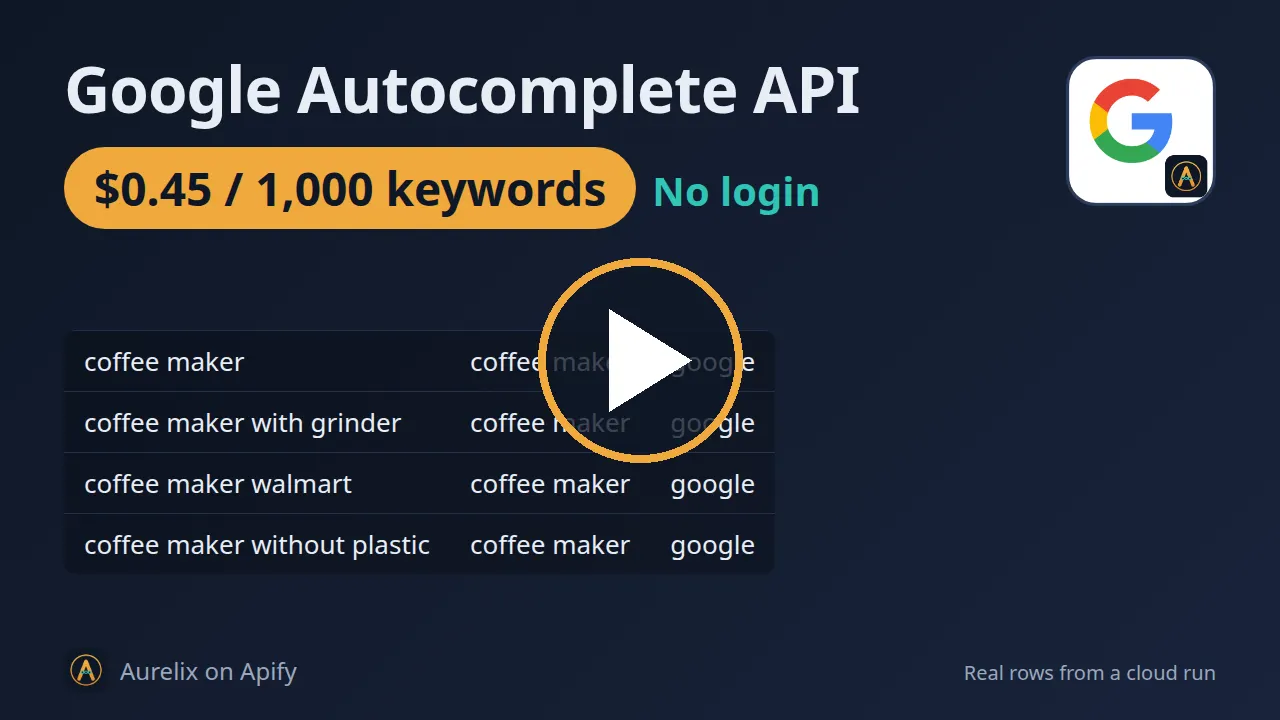
Scrape Google autocomplete (autosuggest) keyword ideas at $0.45 per 1,000 keywords on the free plan, with YouTube suggestions, question modifiers in six languages and intent tags. A-Z and 0-9 modifiers, many countries and languages per run.

What is Google Autocomplete API?
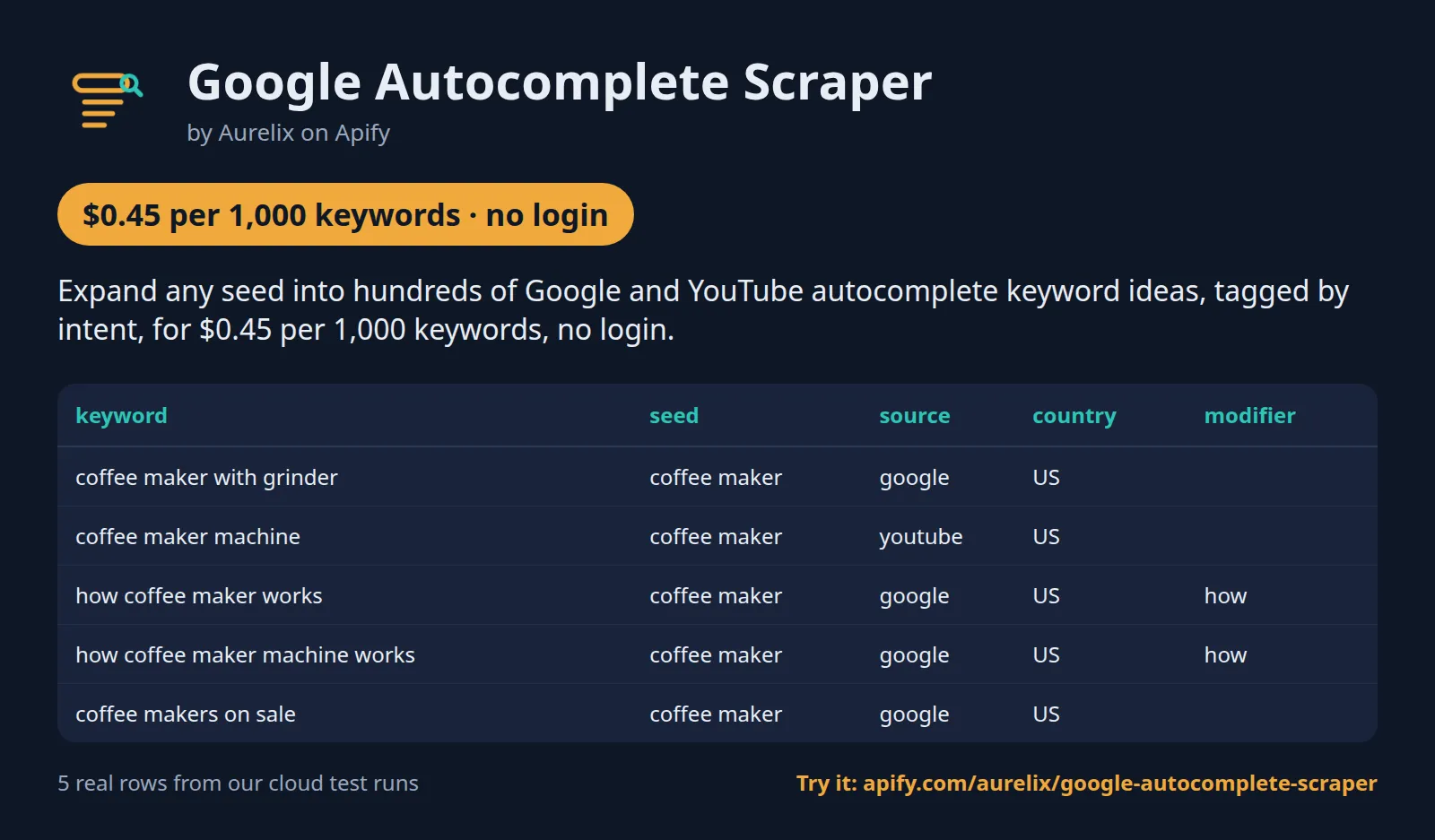
Expand any seed into hundreds of Google and YouTube autocomplete keyword ideas, tagged by intent, for $0.45 per 1,000 keywords, no login.
For SEO and content teams. A-Z, 0-9, question and preposition modifiers in six languages, any country and language grid, and duplicates removed so you pay only for unique keywords. Your first run with the example input costs about $0.0455 (100 keywords in our test run).
| Sources | Google Search and YouTube autocomplete |
| Modifiers | A-Z and 0-9, question words, prepositions and comparisons (EN, ES, FR, DE, PT, IT) |
| Markets | Any country (gl) x language (hl) grid, up to 20 combinations per run |
| Output | 13 fields per keyword with intent tags; JSON, CSV, Excel, API |
| Automate | Schedules, webhooks, Zapier, Make, n8n, Google Sheets, MCP for AI agents |
| Price | $0.45 per 1,000 keywords (from $0.28 per 1,000 keywords on paid Apify plans) |
| Free to try | Runs on Apify's free plan: the $5 monthly credit covers about 11,000 keywords |
| Login needed | No |
Why Google Autocomplete API users pick this one
- Google and YouTube together. Both autocomplete sources in one run, per country and language.
- Six-language modifiers. Question and preposition modifiers in EN, ES, FR, DE, PT, IT.
- Intent on every keyword. Question, commercial, local and comparison tags.
- Unique keywords only. Duplicates per source and market are free.
- Cheaper than the leading tools. $0.45 per 1,000 keywords.
Get started in 3 steps
- Enter one or more seed keywords, e.g. 'coffee maker', and pick Google, YouTube or both.
- Optionally set countries and languages (e.g. us, gb with en), the modifiers, depth 2 for a long-tail tree, and Max keywords.
- Click Start, then download JSON, CSV or Excel, or send the keywords to Google Sheets, Zapier, Make or n8n through the API.
▶ Try it with the example input
The form opens with an example input already filled in: that run costs about $0.0455 on the free plan.
How much does it cost to scrape Google autocomplete?
Price change: From Dec 4, 2026 the per-run start fee becomes $0.004; per-result prices are unchanged.
Pay per event: you pay only for what the run returns, plus a small start fee. Bronze, Silver, Gold and higher Apify plans pay less per result. Paid plans pay $0.35 (Bronze), $0.31 (Silver) and $0.28 (Gold and higher) per 1,000 keywords.
| Keywords | Free plan | Bronze | Silver | Gold |
|---|---|---|---|---|
| 100 | $0.0455 | $0.0355 | $0.0315 | $0.0285 |
| 1,000 | $0.45 | $0.35 | $0.31 | $0.28 |
| 10,000 | $4.50 | $3.50 | $3.10 | $2.80 |
Totals include the $0.0005 start fee per run, rounded to the cent (amounts under $0.10 to four decimals). Apify's free plan includes $5 of credit a month, enough for about 11,000 keywords.
Only unique keywords are charged: a phrase that repeats in the same source, country and language is skipped for free. A seed with no suggestions of its own is not expanded, so nonsense input costs only the $0.0005 start fee.
Billing events
| Event | Free plan | Bronze | Silver | Gold |
|---|---|---|---|---|
keyword-result | $0.45 per 1,000 keywords | $0.35 per 1,000 keywords | $0.31 per 1,000 keywords | $0.28 per 1,000 keywords |
apify-actor-start | $0.0005 per run | $0.0005 per run | $0.0005 per run | $0.0005 per run |
Benchmarks: how we compare
| Test | Input | Result | Run time |
|---|---|---|---|
| First run (prefilled input) | coffee maker, Max keywords 100 | 100 keywords for $0.045 in total | not recorded |
| One seed, defaults | coffee maker, Google and YouTube, US English, all modifiers | 945 to 949 unique keywords from about 122 to 125 requests (3 runs) | 40 to 56 s |
| German market, depth 2 | laufschuhe, Google and YouTube, Germany/German | 800 keywords from 132 requests | 99 s |
| Several markets, depth 2 | 2 seeds, 4 country and language combinations, questions and prepositions | 1,500 keywords from 232 requests | 365 s |
| Nonsense seed | a random string | 0 keywords from 2 requests; modifiers skipped; only the start fee charged | 4 s |
| Throttled by Google | a test where Google answered with rate limits | 384 keywords kept, run stopped early and said so | not timed |
Apify cloud runs at the default 256 MB through the Apify datacenter proxy, one run per row; the throttling row was a local test run of the same code with rate limits injected. Speed depends on how fast the proxy and Google answer.
What data you get
Google Autocomplete API turns each seed keyword into hundreds of real search phrases from Google Search and YouTube autocomplete. It queries the seed on its own and with every modifier you pick (a to z, 0 to 9, question words such as how, what and why, and prepositions such as for, with, near and vs), for every country and language you list, then removes duplicates and tags each phrase's intent: question, commercial, local or comparison. Depth 2 re-queries each new suggestion for a long-tail tree.
- keyword: the suggested phrase as shown, with seed, source (google or youtube), country and language
- modifier and query: what was added to the seed and the exact text sent
- position: rank in the suggestion box (1 = top); depth: 1 from the seed, 2 from a suggestion
- intents: question, commercial, local, comparison (empty = other); word_count
- source_url and scraped_at (ISO 8601 UTC)
| keyword | seed | source | country | modifier | position | intents |
|---|---|---|---|---|---|---|
| coffee maker with grinder | coffee maker | US | 2 | [] | ||
| coffee maker machine | coffee maker | youtube | US | 3 | [] | |
| how coffee maker works | coffee maker | US | how | 1 | ["question"] | |
| how coffee maker machine works | coffee maker | US | how | 2 | ["question"] | |
| coffee makers on sale | coffee maker | US | 5 | ["commercial"] | ||
| coffee maker vs espresso machine | coffee maker | US | v | 1 | ["comparison"] |
One full keyword record, exactly as a real run returned it (long text and lists shortened here). From a real run:
Use cases
- SEO writers building topic clusters and FAQ sections from real question searches
- YouTube creators finding video titles people actually type
- PPC managers collecting commercial and local long-tail phrases per country
- AI agents that need keyword ideas for a brief through MCP
Use-case recipes
Build a content plan from questions people ask
For bloggers and SEO writers. Use only the questions modifiers on your topic. Filter rows where intents contains question, then group by modifier (how, what, why...) to get FAQ sections and article titles.
Find buyer-intent keywords for ads
For PPC managers. Expand your product with all modifiers and keep rows tagged commercial or comparison. Paste the keyword column into your ad platform's keyword planner to check volume and cost, since autocomplete gives no volume.
Plan YouTube video titles
For creators. Read only YouTube's autocomplete, depth 2 for a long-tail tree. Rows with depth 2 and a high word_count are specific titles with less competition; position 1 to 3 are the most-shown phrasings.
Compare what people search in two markets
For international marketers. List two countries and their languages; each combination is queried and kept apart in the country and language columns. Then send the best phrases to Google Trends to see which are rising in each market.
Input
| Field | Type | What it does | Default |
|---|---|---|---|
keywords (Seed keywords) | array | Keywords to expand, e.g. ['coffee maker', 'espresso machine']. | ["coffee maker"] |
maxResults (Max keywords) | integer | Stop after this many unique keywords are returned (and charged), e.g. 1000. | 1000 |
sources (Autocomplete sources) | array | Which suggestion boxes to read: 'google' (Google Search autocomplete) and/or 'youtube' (YouTube search autocomplete). | ["google", "youtube"] |
expansions (Modifiers) | array | Which modifiers to add to each seed: 'alphabet' (seed + a..z and 0..9, 36 queries), 'questions' (how/what/why/... + seed), 'prepositions'... | ["alphabet", "questions", "prepositions"] |
countries (Countries) | array | Two-letter country codes to localise suggestions (Google's gl parameter), e.g. ['us', 'gb', 'ca']. | ["us"] |
languages (Languages) | array | Interface language codes (Google's hl parameter), e.g. ['en'], ['es'], ['fr', 'en'] or ['pt-BR']. | ["en"] |
All 8 fields, with examples: see the Input tab.
Use with AI agents (MCP)
MCP (Model Context Protocol) is the open standard that lets AI assistants such as Claude, ChatGPT and Cursor call outside tools. Apify's hosted MCP server at https://mcp.apify.com/?tools=aurelix/google-autocomplete-scraper gives your assistant this Actor only: it fills in the input from your request, runs it and reads the keywords back, at the same per-result price as a run started by hand.
Example prompts
- "Give me every Google autocomplete suggestion for coffee maker in the US, grouped by question, commercial and comparison intent"
- "Find long-tail YouTube search phrases for sourdough starter in English, depth 2, at most 300 keywords, and list the 20 longest"
- "Expand running shoes into real searches for the UK and Canada in English and show me which phrases only appear in one country"
Claude Desktop and claude.ai
Settings > Connectors > Add custom connector, name it Apify, paste https://mcp.apify.com/?tools=aurelix/google-autocomplete-scraper, keep the detected OAuth settings, select Add and sign in to Apify.
Claude Code
Cursor and VS Code
Add this to ~/.cursor/mcp.json (Cursor); in VS Code's .vscode/mcp.json put the same entry under "servers" with "type": "http". Sign in to Apify when asked.
ChatGPT
Turn on Developer mode, open Settings > Apps & Connectors > Create, paste the URL above as the MCP server URL, choose OAuth and authorize Apify.
Clients without sign-in send Authorization: Bearer <YOUR_APIFY_TOKEN> instead. No Apify account? This Actor supports Apify's agentic payments: an agent can pay per run with a prepaid, spend-capped token, bought with x402 stablecoin payments.
n8n AI agent
Give an AI Agent node an MCP Client Tool with the endpoint https://mcp.apify.com/?tools=aurelix/google-autocomplete-scraper and a Bearer credential holding your Apify token.
Use it from AI agents (MCP), the API or no-code
Copy this to your AI assistant
MCP server URL for this Actor: https://mcp.apify.com/?tools=aurelix/google-autocomplete-scraper (setup for each client in the section above).
API
Start a run and read the dataset with Apify's REST API or the Python and JavaScript clients:
No-code: schedule it in 3 clicks
Send the results to Google Sheets, Zapier, Make, n8n, Slack or any webhook URL.
- Fill in the input, then click Save as a new task.
- In the task, click Schedule and pick daily or weekly (Apify Schedules).
- Open the task's Integrations tab to send every run's results to Slack, Google Sheets, email or any webhook.
Prefer n8n or Make? Ask in the Issues tab and we will share a ready-made workflow for it.
FAQ
Can I scrape Google autocomplete without login?
Yes. It never logs in, so you need no Google account, password or cookies; only a free Apify account to run it.
Is there a Google autocomplete API?
You can use this Actor as one. Start it with Apify's REST API or the Python and JavaScript clients and read the results as JSON (see the code above), or call it from an AI agent through MCP.
How much does it cost to scrape Google autocomplete?
About $0.45 for 1,000 keywords on Apify's free plan and from $0.28 on paid plans, start fee included. The free $5 monthly credit covers about 11,000 keywords.
Can I export Google autocomplete data to Excel or Google Sheets?
Yes. Download the results as Excel, CSV, JSON, XML or HTML from the run's Storage tab, or send them to Google Sheets with Apify's Google Sheets integration or the API.
Is it legal to scrape Google autocomplete?
It reads only public data any logged-out visitor can see: the autocomplete suggestions Google shows in its search boxes. It goes at a polite pace, checks robots.txt, never logs in and never solves CAPTCHAs. It returns suggested search phrases with their source, market and rank; no personal data is extracted. To have a record removed, open an issue on this Actor's Issues tab; if Google formally asks us to stop, this Actor will stop. You are responsible for using the data lawfully, incl. anti-spam and privacy laws; this is not legal advice.
Where do the keywords come from?
From the public autocomplete endpoint that powers the Google Search and YouTube search boxes (suggestqueries.google.com). Each keyword is a suggestion Google returned for the seed or a seed plus modifier.
Does it give search volume?
No. Search volume needs Google Ads Keyword Planner (a login) or a paid data vendor, both outside this tool. Autocomplete order is a rough popularity signal: position 1 is shown first.
What do the intent tags mean?
Simple word rules: question (starts with how, what, why, can, is...), commercial (best, buy, price, cheap, review, deal...), local (near me, nearby, open now...), comparison (vs, versus, or, alternative, better than...). A keyword can carry several tags or none.
Which languages get question and preposition modifiers?
English, Spanish, French, German, Portuguese and Italian. Other languages get the seed and the A-Z/0-9 modifiers.
What happens if Google slows the requests down?
Each request is retried with backoff and a fresh proxy session. If Google keeps refusing, the run stops early, keeps every keyword collected so far, ends SUCCEEDED and says so in the status message.
What am I charged for a seed with no suggestions?
Only one request is made for it: when the plain seed gets no suggestions, its modifiers are skipped, so a run of nonsense seeds costs only the $0.0005 start fee. The status message counts the seed, source and market combinations that had no suggestions.
How does the de-duplication work?
A phrase is kept once per source, country and language, comparing it without case and extra spaces. The same phrase found from another modifier, another seed or at depth 2 in the same market is skipped and not charged. The same phrase in another market or the other source is a separate row.
How many keywords does one seed give?
Usually 300 to 600 unique phrases per source and market with every modifier on. In our test coffee maker gave about 945 keywords over Google and YouTube in the US. Each query returns at most 10 suggestions, so the modifiers set the ceiling.
How long does a run take?
Requests go out at up to 4 a second with up to 4 in flight. One seed on Google and YouTube with every modifier took 40 to 56 seconds in our tests. Depth 2 and more markets multiply the requests, so expect several minutes.
What happens when Google is down or throttles the run?
If the suggest service does not answer at the start, the run ends at once with nothing queried or charged. During a run, failed requests are retried with backoff on a fresh proxy session; after 8 failures in a row the run stops early, keeps every keyword collected so far and says so in the status message.
What do modifier, query and position mean?
modifier is what was added to the seed (a letter, a number, a question word or a preposition; empty for the seed alone), query is the exact text sent to the suggestion box, and position is the phrase's rank in that box, 1 being the top.
Which countries and languages work?
Any two-letter country code and any interface language code Google accepts, such as us, gb or de and en, fr or pt-BR. Every country is combined with every language, up to 20 combinations per run. Question and preposition modifiers exist in English, Spanish, French, German, Portuguese and Italian.
Limits (stated honestly)
- Phrases that contain a phone number or an email address are dropped and not charged.
- No search volume, CPC or difficulty: autocomplete gives phrases and their order only.
- The suggestion box this Actor reads returns at most 10 suggestions per query (Chrome's address bar can show up to 15 from a different Google client, which is not used), so the yield per seed is bounded by the number of modifiers (about 60 queries per seed, source and market at depth 1).
- Suggestions change over time and Google personalises them by location; the country setting localises them, but results from a datacenter IP can differ slightly from what a signed-in user sees.
- Intent tags come from word rules, not a model; rare phrasings can be missed or mis-tagged.
- At most 20 country x language combinations per run, and depth at most 2.
- Speed: about 1 to 3 requests a second through the proxy, roughly 400 to 1,000 keywords a minute; a seed with every modifier on two sources takes about a minute.
- Google can throttle datacenter IPs; the run then stops early with the keywords collected so far.
Works great with
- Then: Google Trends by Region: put the best
keywordvalues into itskeywordsinput to see which are rising
Related Aurelix tools
Public Aurelix Actors, grouped by the data they collect. All are pay-per-result and need no login.
AI, content and SEO
- Google Maps Rank Tracker: Extract Google Maps local rankings on a geo-grid at $1.00 per 1,000 grid points on the free plan: your rank...
- Google News Scraper: Returns Google News articles by keyword, topic or site with decoded publisher links, past the 100-result limit, with optional full text.
- Google Trends by Region: Google Trends interest over time, by region and rising queries for any number of keywords, plus trending searches.
- PDF Table Extraction & PDF to Markdown OCR: Turns linked PDF and Word files into Markdown per page, with tables as JSON rows, RAG chunks and OCR.
- Pinterest Scraper: Exports Pinterest profiles (follower count), boards and pin links with saves and links; keyword search for discovery.
- Podcast Transcript API & Audio to Text: Returns podcast and audio transcripts with timestamps and language from RSS feeds, Apple Podcasts links or audio files, billed per audio minute.
- Website to Knowledge Base Sync: Turns a website into knowledge base chunks with stable IDs, then returns only chunks to upsert or delete.
- Broken Link Crawler & SEO Audit: Audits a whole site: one row per page with SEO checks and broken links, plus a ranked issues summary.
- Threads Scraper: Returns public Threads posts from keyword and #hashtag searches, @profiles and post links, with engagement counts and media.
- TikTok Follower Count Scraper: Returns TikTok profile stats (followers, likes, bio, verified) and the newest videos' views, likes, comments, shares and saves.
- Bulk TikTok Transcripts Scraper: Returns TikTok video transcripts as text, timed segments and SRT, from video links or @profiles' latest videos.
- Website Change Tracker: Re-checks a site and returns only added, changed and deleted pages, with chunks to upsert and IDs to delete.
- Bulk Website Screenshot Tool: Full-page screenshots or PDFs of a list of URLs, cookie banners hidden, lazy images loaded, a public link per image.
- Website to Markdown API: Crawls a site and returns one row of clean main-content Markdown per page, with title, headings and links.
- YouTube Comments Scraper: Returns public YouTube comments and replies from video links and channels, with likes, authors, pinned and hearted flags and publish times.
- YouTube Transcript Scraper: Returns YouTube video transcripts as text, timed segments and AI chunks, from videos, channels, playlists or searches.
- YouTube Video Scraper API: Full details for every YouTube video in a search, channel or playlist: views, likes, comments, tags, publish time.
Jobs and hiring data
- Job Bank Canada Scraper API: Official Job Bank Canada postings by month: NOC and NAICS codes, wages, hours and location.
- Greenhouse Jobs Scraper: Live jobs from a company's Greenhouse, Lever, Ashby or SmartRecruiters board, with salary and Canadian province tags.
- Career Page Monitor: New, removed and reposted roles plus hiring velocity per company, from seven job-board systems including Workday.
- LinkedIn Jobs Country Filter Scraper: Public LinkedIn job postings by keyword and country: title, company, location, seniority, job type, salary text, description.
- Multiple Job Boards Scraper: LinkedIn, about 50 company career sites, Remote OK and We Work Remotely jobs in one deduplicated list.
- Naukri Jobs Scraper: Naukri.com jobs with salary in rupees, experience, skills and posted date, $0.30 per 1,000 on full result pages.
- Remote Job Board Scraper API: Remote OK and We Work Remotely jobs in one deduplicated list with salary, regions and tags.
- Wellfound Jobs API & Scraper: Wellfound startup jobs with salary and equity ranges, company stage and size, $0.50 per 1,000.
- Workday Job Postings Scraper: Jobs from any Workday career site by link or company name, with full descriptions and Canadian province tags.
E-commerce and product data
- AliExpress Scraper API: AliExpress search results by keyword: price, discount, rating, units sold, ship-from country and sponsored flag.
- Amazon Best Sellers & Amazon New Releases: Amazon Best Sellers and New Releases top 100 on 10 marketplaces: rank, ASIN, price, rating, rank change.
- Amazon Product Details Scraper: Amazon product pages by ASIN on 4 marketplaces: price, list price, buy box, stock, BSR, variants.
- Best Buy Canada Scraper API: Best Buy Canada search results: CAD price, sale savings, rating, reviews and seller, plus optional UPC and specs.
- Shopify App Store Scraper API: Shopify App Store apps with pricing plans, ratings, category ranks and reviews; new-app and new-review watch.
- Shopify Product Export Scraper: Every public product of any Shopify store with variants, SKUs, prices, barcodes, stock counts and collections.
- Shopify Best Sellers Tracker: Competitor Shopify stores' best-sellers, new products, price changes, stock-outs and restocks since your last run, plus catalogue summary.
Leads and company data
- Companies House Scraper: Newly incorporated UK companies from Companies House: SIC codes, region, registered office, directors with roles.
- Company Phone Numbers Scraper: Published company emails, phones, addresses, social pages and team members from a list of company websites.
- Decision Maker Finder: Founders, CEOs, VPs and department heads from company team pages, with title, seniority and function.
- FMCSA API: FMCSA carriers by DOT, MC or name, plus daily new-authority leads: contacts, fleet, cargo, insurance, out of service.
- Newly Funded Companies Hiring: Companies that just raised money (SEC Form D), with their open roles and business contacts, as a new-only monitor.
- Google Maps Phone Scraper: Local business lists from Google Maps: phones, websites, ratings, hours, coordinates; optional website emails and socials.
- Google Maps Reviews: Google Maps reviews from many places per run with an only-new daily monitor: rating, text, date, likes, owner reply.
- Liquor License Applications: New liquor license applications and new licenses from California, Texas, New York, Missouri, Washington and Ontario.
- New Business Licenses Scraper: Newly licensed businesses from 11 US and Canadian city open-data portals in one schema, with category, issue date and address.
- Recently Funded Companies API: US companies that just filed an SEC Form D: amount raised, industry, state, executives, confirmed website.
- Tech Stack API: CMS, e-commerce platform, analytics, ad pixels, chat, CDN and email provider for each domain you enter.
- Yellow Pages Canada Scraper: YellowPages.ca businesses by search term and city: phone, website, address, postal code, hours and rating.
Ad intelligence
- Competitor Watch: One report per competitor with only what is new: Meta, TikTok and Google ads, page changes, Shopify products and prices, jobs.
- Facebook Ad Library Search & API: Facebook and Instagram business ads from the Meta Ad Library: copy, creatives, landing pages, dates, optional EU reach.
- TikTok Ads Library API: TikTok Ads Library ads for Europe, UK, Switzerland and Turkey with targeting, reach, ad text and landing pages.
- TikTok Creative Center API: TikTok Creative Center Top Ads with CTR, likes, budget level, objective, industry and video links for 28 countries.
Canada and government data
- Canada Building Permits: Building permits and development applications from 7 Canadian cities: address, type, status, dates, value, applicant, contractor and Toronto planner contact.
- Government Tenders USA Scraper: Open tenders from SAM.gov, CanadaBuys and EU TED in one table: buyer, codes, value, deadline, contact and link.
- New York Building Permits Scraper: Building permits from 12 US city open-data portals in one schema, with value, status, contractor, owner and applicant.
- USPTO Trademark API: US trademark search and watch from USPTO: mark, owner or number lookups, new filings, owner, attorney, goods.
More data tools
- Agoda API (Unofficial): Scrape Agoda guest reviews at $0.50 per 1,000 with this unofficial Agoda API, cheaper than the leading tools: Agoda and...
- Merge CSV Files & Datasets: Remove Duplicates, Excel, JSON: Merges datasets, CSV, JSON and Excel files and removes duplicates with careful URL, email and number matching.
- Polymarket Odds Tracker: Polymarket outcomes with implied probability, bid/ask, volume and results, plus price history and price-move alerts.
- Tennis Betting Odds Scraper: Tennis results and upcoming matches with opening and closing odds per bookmaker and implied probabilities.
Recent changes
- 0.1: Price $0.45 per 1,000 keywords ($0.35 on paid plans), was $0.60 ($0.42); renamed Google Autocomplete Scraper.
The full history is on the Changelog tab.
Tested daily
An automated health check runs this Actor every day on a fixed input and checks that at least 30 keywords come back with keyword, seed, source, country, language, position filled in; a failed check alerts the maintainer straight away.
Was this useful?
- Something went wrong? Open an issue and tell us what you ran: we answer fast and aim to reply within a day.
- It worked? Leave a review: it takes a minute and helps other people find this tool.
- Need a different source, more fields or a custom feed? Open an issue and describe what you need.


