

Threads Posts Scraper: Profile Timelines & Engagement
Pricing
from $1.60 / 1,000 items
Threads Posts Scraper: Profile Timelines & Engagement
Scrape threads posts from public profile timelines by username or profile URL. Export text, timestamps, likes, replies, reposts, quotes, media URLs and author details.
Pricing
from $1.60 / 1,000 items
Rating
0.0
(0)
Developer

GoFetch
Maintained by CommunityActor stats
0
Bookmarked
1
Total users
0
Monthly active users
a day ago
Last modified
Categories
Features
Share
Scrape threads posts from public profile timelines using usernames or profile URLs. This scraper for threads posts returns post text, timestamps, engagement counts, media URLs, permalinks and public author details in a structured dataset. Use it for brand monitoring, content research, reporting and collecting your own public publishing history without a login or account cookies.
What data you get
One output row represents one unique public post from the requested profile's timeline. A timeline page can contain several posts in a thread; each eligible post gets its own row. Repeated posts across pages are saved once per run, including after a restart. Posts by other authors embedded in a timeline are excluded.
The dataset includes:
- The exact post
id, captiontext, UTCtimestampandpermalink. - Public
likeCount,replyCount,repostCountandquoteCountvalues. - A
mediaarray of image or video URLs, including carousel items. - An
authorobject with public profile ID, username, display name and verification status.
Unavailable text or counts are represented by null; an empty media array is valid for a text-only post. Counts are a snapshot of what the public endpoint exposes during collection. They can change between runs.
This actor reads profile timelines. It does not collect the replies beneath an individual post. The separate replies actor takes post URLs; find it in the developer's scraper links below. Follower lists, contact enrichment, private posts and authenticated account data are outside this actor's scope.
How to use it
Apify Console
- Open the actor in Apify Console.
- Enter one or more usernames or profile URLs in Usernames or profile URLs.
- Set Maximum posts per profile and Maximum total results. The supplied example uses NASA and ten posts.
- Keep the default Apify datacenter proxy settings and start the run.
- Open the Dataset tab to inspect the overview and export JSON, CSV, Excel or another supported format.
Use a small first run to confirm the fields meet your needs. For several profiles, maxPostsPerProfile limits each profile separately while maxResults limits the combined dataset. Inputs are processed in order, so an earlier profile can use the remaining global allowance.
API and MCP
Start a run through the API using an Apify token stored in your environment. The asynchronous endpoint returns a run ID; poll the run to completion, then read its default dataset.
Read the Actor API guide for run options and dataset access. The same actor input can be used from an Apify MCP client: ask it to run this actor with a public profile username and a result limit, then retrieve the dataset. Supply explicit limits when an automated assistant chooses the input.
Pricing
Billing uses saved results: one unique post successfully written to the dataset is one result. Duplicate posts and failed requests do not create additional billable rows. There are no start fees or optional charge events in this actor.
| Apify plan | Price per 1,000 results |
|---|---|
| FREE | $2.28 |
| BRONZE | $2.05 |
| SILVER | $1.82 |
| GOLD | $1.60 |
Platinum and Diamond use the Gold rate. At the listed rates, 200 saved posts cost $0.456 on Free, $0.410 on Bronze, $0.364 on Silver or $0.320 on Gold. A ten-post run is $0.0228 at the Free tier or $0.0160 at Gold, before any applicable plan credits. The Free-tier 200-post example requires multiple runs because of the per-run cap. If a source ends after fewer posts, only the saved rows count. A user's maximum charge setting can stop the run before the requested result count.
Is it free?
Apify free plan users can collect up to 100 results per run and make 20 runs per calendar month. These are limits set by this developer, rather than general Apify platform limits. Free-plan credits may cover charges at the Free-tier price above; the actor is priced per result.
The monthly allowance resets at the start of a new UTC calendar month and is shared across this actor's runs for your user account. A run refused because all 20 slots are used ends SUCCEEDED with a clear quota message and makes no scraping requests. Free runs always use Apify Proxy; custom proxy URLs are ignored. Paid plans remove these developer free-plan caps, subject to your input and charge limits.
Input
| Field | Meaning |
|---|---|
usernames | Required array of 1–100 public profile usernames, @handles or Threads profile URLs. Handles are normalized and duplicate inputs removed. |
maxPostsPerProfile | Positive integer from 1 to 10,000. Default 100; the example uses 10. Limits post rows, not thread edges. |
maxResults | Positive integer from 1 to 10,000. Default 100; the example uses 10. Global saved-row cap across all profiles. |
proxyConfiguration | Apify datacenter only, automatic by default. Paid callers may supply their own proxyUrls (their bandwidth) or set useApifyProxy: false for direct access. Free runs always use automatic Apify datacenter. |
Proxy options are limited to useApifyProxy (boolean), proxyUrls (array of proxy URLs), apifyProxyGroups and its SDK alias groups. Group arrays accept BUYPROXIES94952 or SHADER, case-insensitively; an empty array means automatic datacenter. When both aliases are set, a nonempty groups array takes precedence. Unsupported groups, country/subdivision selection, tiered routes and other SDK options fail as invalid: before any proxy request. The JSON editor exposes only this supported configuration; proxy credentials belong only in your own custom URLs. Free runs ignore custom URLs, direct selection and accepted datacenter groups.
Both current threads.com and legacy threads.net profile URLs are accepted. Post URLs are rejected: provide the profile that owns the timeline. No password, session token, login cookie or account connection is needed or accepted as an input field.
The source may expose fewer posts than requested. The 10,000 input limit is a safety bound, not a promise of historical coverage. Pagination follows public cursors, has a finite page bound and stops before the run deadline. There is no date filter or keyword search in this actor; filter exported rows downstream.
Output
The default dataset overview shows the post ID, text, timestamp, engagement counts, media, permalink and author. This is an actual saved post from a public-profile run:
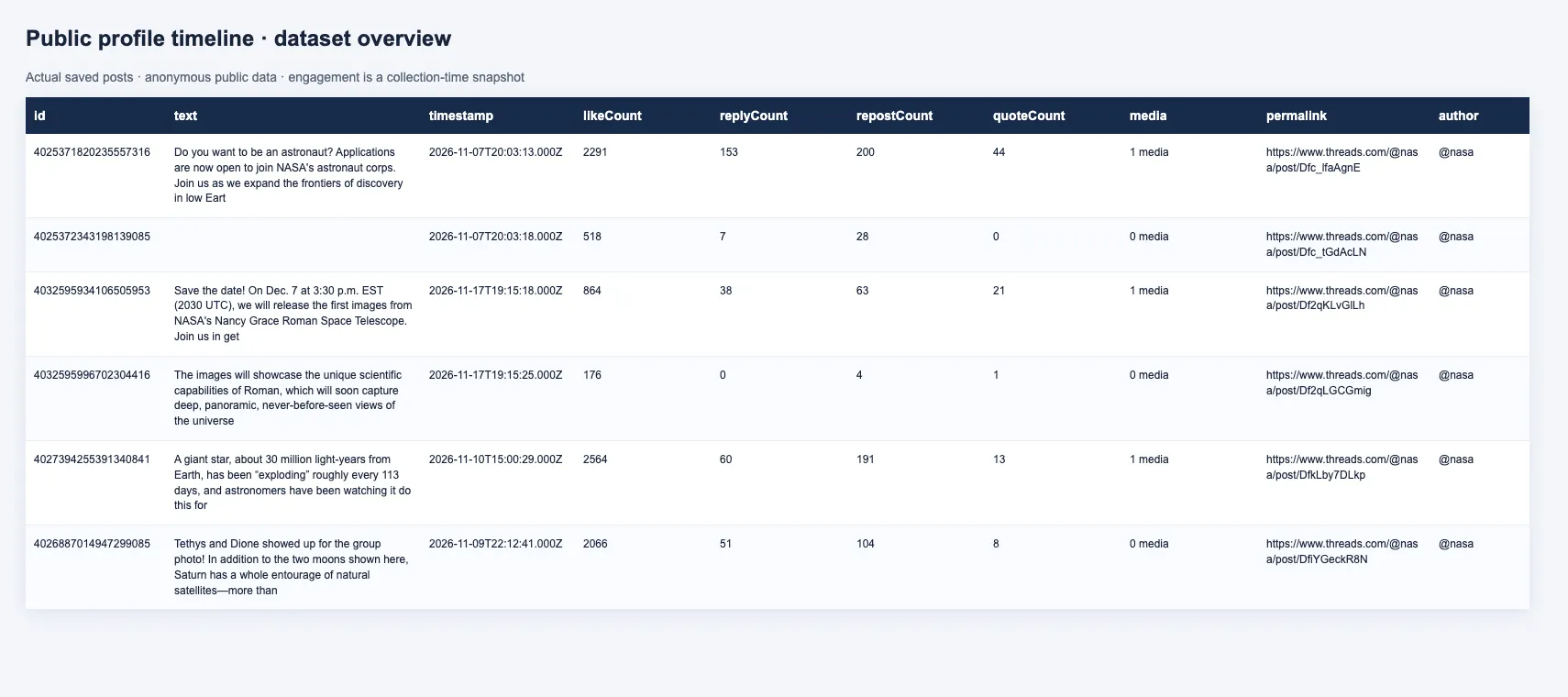
The preview shows the same saved dataset in a compact table. Media URLs point to the source CDN and expire. Download media promptly in your own workflow if you need an archive; storing a CDN URL alone does not preserve the file. The actor exports links rather than downloading image or video files. Nested author and media values are easiest to consume in JSON; select or flatten fields for spreadsheet exports.
Guarantees and failure semantics
Saved rows are deduplicated by exact post ID before writing. On restart, the actor reads existing rows from the default dataset, restores their IDs and counts, and continues within the original limits. Dataset writes are serialized so the charge limit is checked between writes. An append is never retried blindly. If its acknowledgement is lost, collection stops, the actor reconciles saved IDs and per-profile counts against the default dataset, and finishes with the saved output. A resumed run keeps its original monthly admission, including across a UTC month boundary. Changing input limits during a resumed run is not a supported way to extend the original job.
A zero-row run is SUCCEEDED as “no results” only when the source confirms an empty timeline, private profile or missing profile. Private metadata (text_post_app_is_private: true) needs no timeline; STATISTICS.inputs marks it private: true. Missing profiles are marked invalid: true; public timelines with no eligible posts are marked sourceEnd: true. All three have confirmedEmpty: true and no failure reason. A timeline ending with has_next_page=false is a normal source end. A missing profile can mean a renamed or unavailable account; it does not establish whether the account exists for logged-in visitors. A login wall alone confirms none of these states, including for suspended accounts.
A zero-row run is FAILED when the public timeline cannot be answered. Status messages begin with blocked:, network:, timeout:, invalid: or outdated: to distinguish access challenges, transport trouble, deadlines, invalid input and changes to the public data format. The actor discovers the pagination operation from public JavaScript bundles during each run; a previously observed ID is accepted only after a valid pagination response. It does not silently claim success on an unverified first page.
If posts were already saved before a later source error, the run ends SUCCEEDED with partial output. Check STATISTICS in the run's key-value store for per-profile saved counts, failures, source-end flags, answered percentage, request totals and block rate. A successful run does not promise that every requested profile or historical post was available. Repeated or missing cursors stop collection and are recorded as a source-format failure. Access challenges trigger bounded retries with fresh proxy sessions; the actor never switches automatically to a more expensive proxy class.
Integrations
Export datasets through Apify's dataset API or connect a completed run to an Apify integration. Make and n8n workflows can pass a list of profiles, wait for completion and forward selected fields to a spreadsheet or reporting database. Webhooks and schedules can automate recurring collection through your own Apify account.
For recurring monitoring, use the post ID as your downstream key. Deduplication inside this actor covers one run and its restarts; separate daily runs may intentionally return the same post with updated counts. Keep your own observation date when comparing engagement over time. If partial results are unsuitable for a report, inspect STATISTICS before importing the dataset.
More scrapers from this developer
TikTok: TikTok Search Scraper: Videos and creators for any keyword, pay per result · TikTok Profile Scraper (Pay Per Result): Profiles, followers and latest posts by username · TikTok Comments Scraper: Comments and full reply threads from any video · TikTok Hashtag Scraper: Videos for any hashtag, with views, likes and music · TikTok Sound & Music Scraper: Videos that use a sound or song · TikTok Top Ads Scraper: Public Creative Center ad rankings, engagement, media and landing pages
Social & news: Reddit Search Scraper: Posts by keyword, subreddit or author · Google News Scraper: Google News results as clean full-text articles · Threads Replies Scraper: Public post replies, likes, authors and inline nested replies
Instagram: Instagram Reel Scraper: Public profile reels, plays, captions, music and media URLs · Instagram Comment Scraper: Public post and reel comments, likes, timestamps and usernames · Instagram Post Scraper: Public profile posts, likes, captions, locations and media URLs
E-commerce: Prom.ua Product Search Scraper: Prom.ua product search results, no browser needed · Amazon Product Search & Bestsellers Scraper: Search results and product details from Amazon · AliExpress Search Scraper: AliExpress products by keyword with prices, orders and shipping · AliExpress Product Reviews Scraper: Public product reviews, ratings, buyer photos and follow-up feedback
Maps & leads: Google Maps Scraper: Places, leads and emails from Google Maps
Ads: Facebook Ad Library Scraper (Meta Ads Library): Ads from the Meta Ad Library, with EU reach and payers · Google Ads Transparency Scraper: Google ad creatives by advertiser or domain, with regional details
Video: YouTube Transcript Scraper: Transcripts, subtitles and captions from YouTube videos · YouTube Shorts Scraper: Shorts of any channel with exact views, likes and duration · YouTube Channel Scraper: Every video of a channel, with channel stats · YouTube Search Scraper: Search results and videos for any keyword · YouTube Comments Scraper: Comments, replies and likes from any video · Bilibili Comments Scraper: Public hot comments and reply threads by video or keyword
Jobs: SEEK Job Listings Scraper: Public AU/NZ job listings, salaries and redacted descriptions
FAQ
Can it collect replies to a post?
This actor collects a profile's timeline posts. Use the separate replies actor listed above for a post's discussion, supplying post URLs there. The replyCount field here is a public count, not an embedded collection of replies.
Why did I receive fewer posts than requested?
The public timeline may end early, the profile may be private or missing, or your global, per-profile or charge limit may have been reached. Later access errors can also leave a partial dataset. Inspect the run message and STATISTICS before assuming a profile has no more content. Public web endpoints do not guarantee complete historical coverage.
Is it legal to scrape threads posts?
This actor accesses public data only and does not bypass login walls. Your use of collected data must comply with applicable laws, platform terms and privacy obligations, including GDPR and CCPA where relevant. Public availability does not remove responsibilities around personal data, retention or redistribution. Collect only what your purpose requires and obtain qualified advice for your circumstances.
Can media links be used later?
Source CDN URLs expire and may stop working. Fetch files promptly if your workflow requires them, and respect the rights attached to the source material. A later run may provide refreshed URLs for posts that remain publicly available.
Support
Use the actor's Apify Issues tab for reproducible failures or field questions. Include the run ID, approximate run time, the failure token and a minimal public-profile input. Do not share API tokens, proxy credentials or account cookies. A run ID lets support inspect the stored statistics and distinguish an empty source from a transport or format problem.


