

Tencent Scraper | Maps Places, Phones and Ratings
Pricing
from $2.98 / 1,000 places
Tencent Scraper | Maps Places, Phones and Ratings
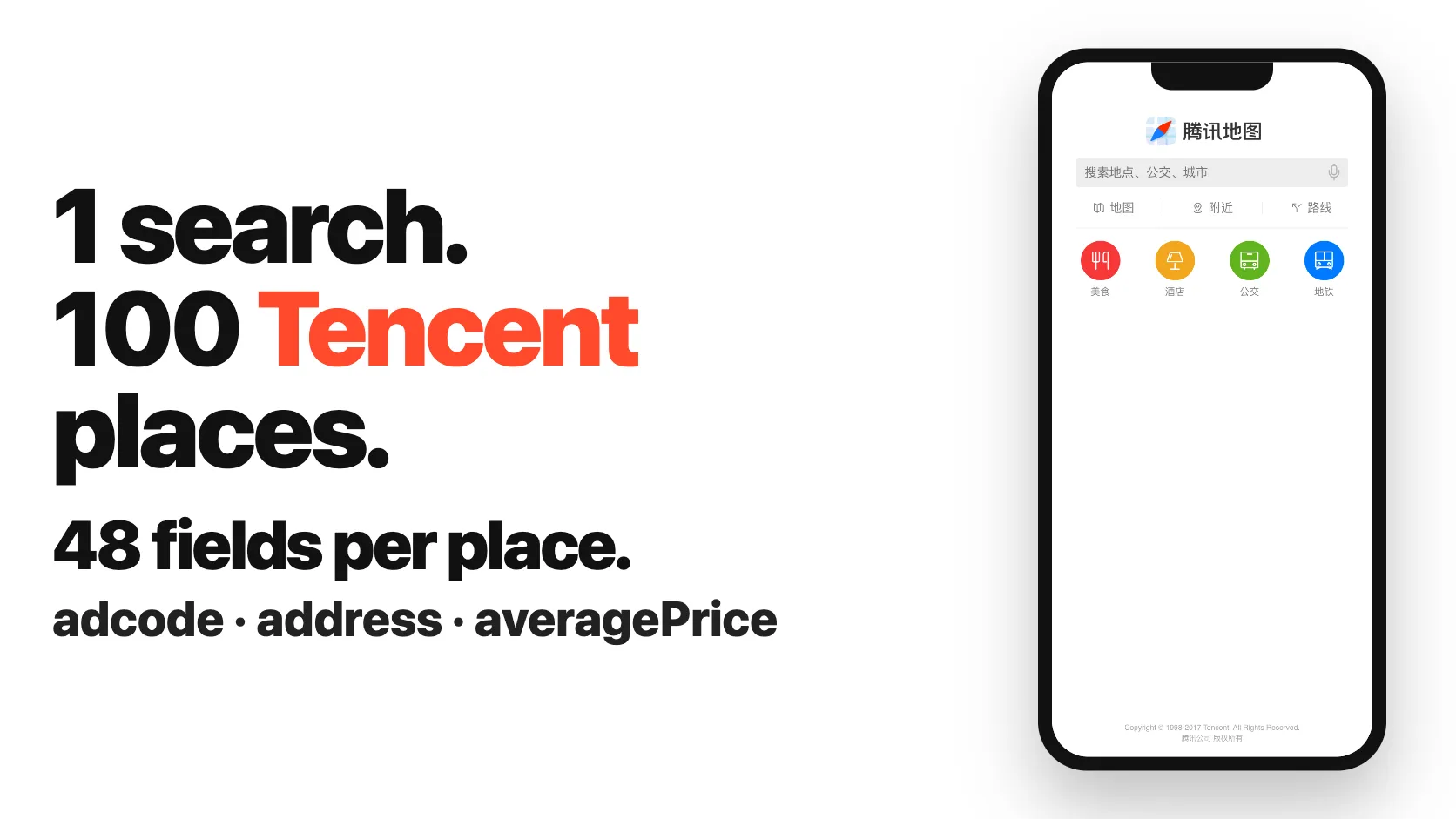
Tencent Maps scraper (腾讯地图, QQ地图) for Chinese businesses: 100 places in 4 seconds, 48 fields each. Get name, category, address, phones, rating, average spend, opening hours, coordinates and Dianping, Amap, Meituan and Ctrip ids, plus photos, menus and reviews. Search in English or Chinese. No login.
Pricing
from $2.98 / 1,000 places
Rating
0.0
(0)
Developer

SilentFlow
Maintained by CommunityActor stats
0
Bookmarked
7
Total users
4
Monthly active users
5 days ago
Last modified
Categories
Share
Tencent Scraper (腾讯地图) | Maps Places, Phones and Ratings (2026)
From SilentFlow. Creators of Pinterest Scraper (#1 for “pinterest pins scraper” in Apify Store search) and Leboncoin Scraper Ppe, with 260,000+ combined lifetime runs.
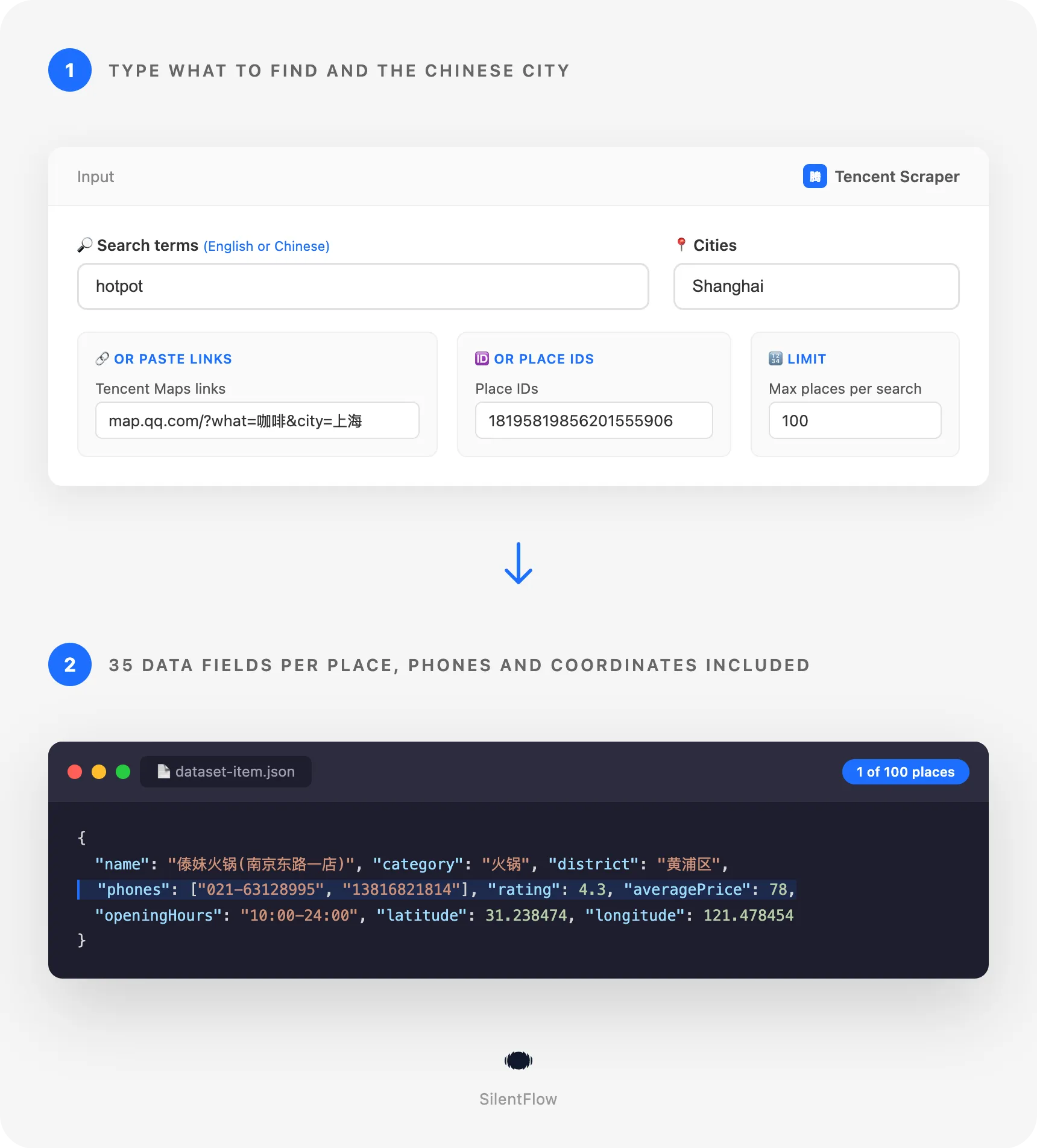
Turn Tencent Maps (腾讯地图, also known as QQ地图 or QQ Maps) into a clean table of Chinese businesses: every restaurant, hotel, shop, clinic or landmark of a city with its category, full address, phone numbers, rating, average spend per person, opening hours, top dishes, district, coordinates you can drop on any map, and its ids on Dianping, Amap, Meituan and Ctrip. Switch on place details and each row also carries its photos, its menu with prices, the visitors' tags and up to 10 reviews. Type hotpot, pick Shanghai, press Start: 100 places in 3 to 5 seconds on our test runs, or 100 places with photos, menus and reviews in 40 seconds. No Tencent account, no API key, and no Chinese needed to ask.
Why choose this actor?
Copying shop names and phone numbers off a Chinese map by hand? Finding that Google Maps knows a tenth of the restaurants on a Shanghai street? Getting stuck because the official map API wants a developer key and a Chinese account before it answers anything?
- Photos, menu and reviews in the same row as the phone number. One switch adds the page of each place. On 100 Shanghai hotpot restaurants (6 October 2026), every row got its main photo and up to 201 photo links, 99 got a ranked menu of 10 dishes (836 of the 965 dishes with their price), 99 got the visitors' tags with their counts (
餐后赠送小零食× 472), and 95 got their reviews: 637 in all, each with author, rating, date and text, up to 10 per place. The whole run took 40 seconds. - Join the map with Dianping, Amap, Meituan, Ctrip, Fliggy and eLong. Every row carries the place's ids on the other Chinese platforms, each in its own column, ready for a join. On 100 Beijing hotels: Dianping and Amap ids on all 100, eLong on 95, Fliggy on 92, Meituan on 89 and Ctrip on 81. Restaurants add their WeChat mini program (68 of 100 Shanghai hotpot places).
- Search, paste a link or refresh by id, in English or Chinese, with nothing required. Search terms, map.qq.com links and place ids mix in one run: 15 Beijing hotels, a place link and a place id came back as 17 rows with their reviews in 11 seconds. The form opens on
hotpotinShanghaiand returns 100 places as it is. Cities and provinces work in English or Chinese (Shanghaior上海,Sichuan), and leaving the city out searches all of China, busiest cities first.

Try your first place list
Paste this input in the JSON tab, or keep the prefilled form and press Start. It lists the first 100 hotpot restaurants Tencent Maps shows for Shanghai, from 傣妹火锅 on Nanjing East Road to a string of 海底捞 branches, each with its phone numbers, rating, spend per person, opening hours, entrance point and coordinates. It took 3 to 5 seconds on our test runs.
Runs on the Apify Free plan: sign up, open the actor, press Start. Each place lands as one row of the dataset, which you can open as a table, download as CSV, Excel or JSON, or read from the API. Change hotpot for any business type, brand or landmark (coffee, 酒店, 海底捞, 医院, 故宫) and Shanghai for any Chinese city or province (Beijing, 成都, Guangdong), and run again. Add "includeDetails": true for photos, menus and visitor tags, and "maxReviews": 10 for reviews too: the same 100 places then take about 40 seconds.
Copy to your AI assistant
Paste this block into Claude, ChatGPT or Cursor to give it the full picture of this scraper before you ask it to write code or plan a dataset:
How to scrape Tencent Maps places, phones and ratings
Three inputs, from the simplest to the richest. Each one runs as it is.
List the hotpot restaurants of Shanghai
The default input: the first 100 hotpot places Tencent Maps shows for Shanghai, in 3 to 5 seconds. On our run every row had a rating, an average spend, opening hours, a top-dish list and a Dianping id; 99 had an Amap id and their hours by day, 96 at least one phone number, 87 the entrance point a driver should be sent to, and 26 a floor inside a mall.
Collect photos, menus and reviews of Shanghai hotpot restaurants
Turn on place details and ask for reviews. 20 places took 9 seconds and came back with 3,982 photo links, 198 menu dishes (173 of them with a price), 100 visitor tags with their counts and 123 reviews, 15 of them with the visitor's own photos.
Match Beijing hotels with their Ctrip, Fliggy and eLong listings
Hotels carry their ids on the booking platforms. 酒店 in Beijing returned 100 hotels in 4 seconds, with a phone number on all of them, an introduction on 94, and their ids on eLong (95), Fliggy (92), Meituan (89) and Ctrip (81) next to Dianping and Amap, so the map's list joins your rate or review data in one step.
Input parameters
| Parameter | Type | Default | What it does |
|---|---|---|---|
searchQueries | array of strings | ["hotpot"] in the form | What to look for, in English or Chinese. Each term is searched in each city. |
cities | array of strings | ["Shanghai"] in the form | Cities or provinces, in English or Chinese. Empty means all of China. |
maxItems | integer | 100 | Places per search, one search being one term in one city. |
startUrls | array of links | none | map.qq.com place links and search links. |
poiIds | array of strings | none | Tencent Maps place ids, one row each. |
includeDetails | boolean | false | Adds photos, the menu with prices and the visitors' tags. |
maxReviews | integer, 0 to 10 | 0 | Reviews per place. Any number above 0 also turns on includeDetails. |
No field is required: any one of searchQueries, startUrls or poiIds is enough to start a run, and the three can be mixed in the same run.
Accepted inputs
- Search terms. Business types, brands, products or landmarks, as you would type them in the map:
hotpot,coffee,hotel,酒店,医院,健身房,海底捞,Starbucks,故宫. Common English words are understood by the map; Chinese terms give the most precise results. Category words return the most places, up to about 800 for a term in a large city. A brand name returns the branches the map chooses to feature for that city, not always every outlet. - Cities and provinces. Chinese names (
上海,上海市,成都,四川省) are passed to the map as they are. English and pinyin names are read for the four municipalities, every provincial capital, about 130 other large cities and all 27 provinces and autonomous regions:Beijing,Shanghai,Guangzhou,Shenzhen,Chengdu,Xi'an,Hangzhou,Suzhou,Qingdao,Sichuan,Guangdong,Inner Mongolia. Case, spaces, apostrophes and a trailingCityorProvincedo not matter. A name the actor cannot read is reported in the log and skipped, never widened to all of China. - A province is searched city by city, the cities with the most results first, until the cap of the search is reached.
- No city searches all of China the same way. A named landmark (
故宫) is searched across the country in one list. - Links. Place links:
https://map.qq.com/m/detail/poi/poid=…(theurlcolumn of a previous run),https://map.qq.com/m/detail/poi?uid=…,https://map.qq.com/m/detail/poi/…,https://map.qq.com/?uid=…,https://apis.map.qq.com/uri/v1/marker?marker=uid:…. Search links:https://map.qq.com/?what=…&city=…(orw,wd,keywordwithc,region), andhttps://apis.map.qq.com/uri/v1/search?keyword=…®ion=…orboundary=region(…). - Place ids are the 9 to 20 digit numbers of the
idcolumn, or thepoidoruidof a place link. A shorter number is read as a search term (711).
Every value is read by its shape, whichever field it was typed in: a link pasted among the search terms is still read as a link, and a place id among the links as an id. A place found by two searches, or by a search and an id, is saved once.
Place details
includeDetails reads the page of each place, the one its share link opens. It adds the main photo (imageUrl) and the photo links of the place (images, up to about 200), the 10 dishes visitors recommend most with their price, number of recommendations and photo (menu), and the visitors' tags with how many gave each one (tags); it also fills the phone numbers, rating, hours and introduction the search left empty. maxReviews adds the reviews the page shows, 10 at most per place. Each place takes about 0.4 seconds more: 100 places run in about 40 seconds instead of 5. A place whose page has nothing to add, or cannot be read in time, is still saved with everything the search gave.
What data can you extract from Tencent Maps?
Each row is one place, with 61 fields: 58 about the place and 3 about the run, grouped the way you read them. On the default run (100 hotpot places in Shanghai), 45 of the 58 were filled on at least half the rows, and 50 with place details on. A hospital search fills fewer (no dishes, no spend, fewer ratings), because the map holds less for those places.
- Identity.
idis the Tencent Maps place id, stable across runs: use it to deduplicate and to refresh a place later.urlis the permanent page of the place on Tencent Maps.nameis the name shown on the map, in Chinese, with the branch in brackets (海底捞火锅(西单店)). - What the place is.
category(火锅,咖啡厅,综合医院),categoryPath(美食 > 火锅),categoryCode(the map's 6-digit category code, handy to filter without reading Chinese),businessStatus(OPERATIONALfor a business the map lists as trading normally),features(明厨亮灶,复古风格),recommendedDishes(the top dishes for restaurants),tips(notices the map pins on a place, such as holiday hours),brandId(the same for every branch of a chain),merchantName(the business's own name on its listing, sometimes longer than the map's), and, for hotels and landmarks, adescription. - Contact.
phoneis the first number,phonesevery number the map lists, landlines with their area code (021-63128995) and mobiles. Phones were on 96% of the default run's rows and 94% of 200 Guangzhou hospitals. - Ratings, prices and popularity.
ratingout of 5,averagePrice(spend per person, incurrencyCNY),popularity(the map's heat score, 热度),reviewsShown(how many Dianping reviews are attached to the listing, fromreviewsSource: a small number, not Dianping's full count),rank(the place's position in the search that found it, 1 for the first), andclickCounts, the map's own usage counters for the place under the names the map gives them (all_click_180_nav,all_click_180_search,city_rank_id: navigation, search and WeChat counters over 90 and 180 days, and ranks). - Place and time.
addressas the map shows it,merchantAddressas the business wrote it (often with the shop unit or the nearest metro exit),district,city,province,adcode(China's 6-digit administrative code of the district),cityCodeandprovinceCode(the same codes one and two levels up),countryCode,openingHours(10:00-24:00, or周一至周五 09:00-17:00; 周六 09:00-16:30),openingHoursSchedule(the same hours by day in English keys,dailyormondaytosunday, each a list ofopen/closespans), andupdatedAt, when Tencent Maps last updated the record. - Inside malls and complexes.
isIndooris true for a place inside a building the map knows, with itsfloorName(F3,B1) andbuildingId.parentPlaceIdis the id of the mall, station or complex the place belongs to, so you can group every shop of one mall.areaSqmis the area in square meters the map gives for larger venues, such as hotels and hospitals. - Coordinates in both systems. Maps of mainland China use GCJ-02, an offset system that lands a few hundred meters off on GPS-based maps.
latitudeandlongitudeare converted to WGS-84, the system of GPS, Google Maps, OpenStreetMap and GIS tools;latitudeGcj02andlongitudeGcj02keep the map's own values for Chinese map tools.navLatitudeandnavLongitude(WGS-84) are the entrance the map routes drivers to, which can sit a street away from the center of a large venue. - Ids on other platforms.
dianpingId(大众点评, on nearly every row),amapId(高德地图),meituanId,ctripId(携程, hotels and attractions),fliggyId(飞猪) andelongId(艺龙) for hotels, andwechatMiniProgramId, the app id of a WeChat mini program attached to the place (the merchant's own, or an ordering or booking service it uses): the keys to join this table with your data from those platforms. - Place details (with
includeDetailsormaxReviews).imageUrlandimages(photo links that open directly as JPEG files),menu(each dish withname,pricein CNY,likesandimageUrl),tags(nameandcount), andreviews(each withauthoras the platform shows it, often masked like兔***,ratingfrom 1 to 5,text,publishedAt, and theimagesthe visitor posted). Without details, these fields arenull. - Run context.
searchQueryandsearchCitysay which of your searches found the place (searchCityis empty for a search across all of China, and both are empty for a place reached by its id),scrapedAtwhen it was collected.
Data is read live from Tencent Maps when the run starts, never from a cache. Dates are RFC 3339 in UTC; a review's publishedAt carries the day it was posted. A value the map does not hold is null, never an empty string.
Output example
One complete row from the default run, as it lands in the dataset:
With place details and reviews on, the same place also carries the fields below (201 photo links, 10 dishes and 7 reviews in the real row, shortened here):
Advanced usage
Six recipes for the cases the examples above do not show. Each input runs as it is.
Compare two drink markets across two cities
Several terms and several cities multiply: each term runs in each city, and a place found twice is saved once. This input returned 165 places in 6 seconds (95 in Guangzhou, 70 in Shenzhen), mostly cafés and cold-drink shops, enough to compare density and spend per person between the two cities.
Search all of China, busiest cities first
Leave cities empty and the actor asks the map which cities hold results, then works through them, the city with the most results first, until each search reaches its cap. Three terms with a cap of 400 each returned 1,200 places in 35 to 39 seconds on our runs, starting with Chengdu and Chongqing for hotpot.
Cover a whole province
A province name works like a short list of cities, searched in order of results. hotel in Sichuan returned 60 places in 5 seconds, all in Chengdu, the city with the most hotels; raise maxItems to reach the next cities of the province.
Build a hospital contact list for Guangzhou
Public services are on the map too. 医院 (hospital) in Guangzhou returned 200 places in 5 seconds: general hospitals, community health centers, maternity, cancer and children's hospitals, with at least one phone number on 189 of them and a district on every one.
Watch the reviews of the places you follow, every week
Keep the ids of the places you follow (competitors, prospects, your own branches) and schedule this input weekly in Apify. Each id returns its current phone numbers, rating, spend and hours with its latest reviews, so a change or a new complaint shows up as a diff between two runs. Three Haidilao branches came back with 30 reviews in 6 seconds on our run.
Turn map.qq.com links into rows
Copy links straight from the browser: a search link returns its results, a place link returns that place. One search link for Beijing hotels and one place link returned 21 rows in 3 seconds, the search capped at 20 by maxItems.
FAQ
What is Tencent Maps? Tencent Maps (腾讯地图, map.qq.com, formerly QQ地图) is the map service of Tencent, the company behind WeChat and QQ. It is one of the three big consumer maps of mainland China with Amap and Baidu Maps, and the map built into WeChat, so its business listings are the ones people see when they share a location or look for a shop inside WeChat.
What does the scraper extract exactly? One row per place: name, category, address, district, city, province and their codes, every phone number, rating out of 5, average spend per person, popularity and usage counters, opening hours as text and by day, top dishes, features, brand id, the floor and mall of indoor places, the entrance point, coordinates in WGS-84 and GCJ-02, and the place's ids on Dianping, Amap, Meituan, Ctrip, Fliggy, eLong and WeChat. With place details on, also its photos, menu with prices, visitor tags and reviews. The full list with types is in the section above.
Do I need a Tencent or WeChat account, an API key, or to read Chinese?
No. The actor reads the public map without any login or key. You can type search terms and cities in English; names, addresses and reviews come back in Chinese, as the map shows them, alongside codes (categoryCode, adcode), numbers and coordinates that need no translation.
Can I get photos, menus and reviews?
Yes: switch on includeDetails for photos, the menu with prices and the visitors' tags, and set maxReviews (up to 10) for reviews. On 100 Shanghai hotpot restaurants, every place had photos, 99 a menu and visitor tags, and 95 at least one review, 7 per place in the middle of the range. Details add about 0.4 seconds per place, so leave them off when you only need contacts and locations.
Why 10 reviews at most per place?
The page of a place on Tencent Maps shows up to 10 visitor reviews, some of them signed by Tencent Maps users (腾讯地图用户), and the actor returns those. They are a recent sample of what visitors say, not the full review history of the place; rating and the visitor tags with their counts summarize the rest.
How many places can one search return?
The map lists up to about 800 places for one term in one city, which is where a search stops: 餐厅 (restaurants) in 深圳 returned 762 places in 21 seconds on our run. maxItems sets the cap per search, and a search across all of China or a province moves on to the next city when one city runs out, so it can go beyond 800: 酒店 with no city and a cap of 1,000 returned 1,000 places in 47 seconds on our run. Use several terms (火锅, 串串, 麻辣烫) to widen a sweep: a place found by two of them is saved once.
Why does a brand search return fewer branches than the brand has?
Tencent Maps shows a selection of branches for a brand name: 海底捞 returned 44 branches in Beijing in 2 seconds on our run, every one with its phone numbers, hours, spend per person and the same brandId, and the map features only a few for some chains. A category word (hotpot, coffee) in the same city returns hundreds of places, branches of the brand included; filter on brandId or the name afterwards.
Can I search several terms and several cities in one run?
Yes. Each term runs in each city: 2 terms and 2 cities make 4 searches, each capped by maxItems. Links and place ids can sit in the same run, and a place reached twice is saved once.
Which coordinates should I use?
latitude and longitude (WGS-84) for anything outside the Chinese map ecosystem: Google Maps, OpenStreetMap, QGIS, Kepler, Tableau. latitudeGcj02 and longitudeGcj02 for Chinese map tools and APIs, which expect the offset system. navLatitude and navLongitude when you route people or deliveries to the door rather than to the middle of a building.
How do I join this table with Dianping, Amap or Ctrip data?
Use the id columns: dianpingId, amapId, meituanId, ctripId, fliggyId and elongId hold the place's own id on each platform, the way that platform writes it (B0FFKJTCUP on Amap, 1285447 on Ctrip). Hotels carry the most of them; restaurants usually carry Dianping, Amap and Meituan.
What does reviewsShown mean, and why is it small?
It is the number of Dianping (大众点评) reviews Tencent Maps attaches to the listing, usually between 0 and a few dozen. It is not the place's full review count on Dianping, and it can be smaller than the number of reviews in reviews, which also holds reviews left on the map. rating and popularity are the better signals of how well known a place is.
How fresh is the data, and are the links permanent?
Every run reads the map live. updatedAt tells when Tencent Maps last updated the record. id and url are permanent for a place; a place id the map no longer knows is reported in the log and skipped. Photo links open directly as image files; download the ones you want to keep.
Does it cover Hong Kong, Macau and Taiwan? Tencent Maps search lists places in mainland China. A search in 香港 (Hong Kong), 澳门 (Macau) or a city of Taiwan comes back empty, and the run ends with a message saying nothing was found rather than failing. Their English names are not in the city list, so the run asks you to type the city in Chinese.
Is it legal to scrape Tencent Maps? The actor collects business listings and reviews that Tencent Maps shows publicly to anyone, without login. Business phone numbers and addresses are business contact data, and review authors appear as the platform shows them, often masked; you remain responsible for how you use them, see the Legal compliance section below.
More SilentFlow scrapers
🛒 E-commerce
 Pinterest - Pinterest Scraper | Pins, Boards and Profiles
 Leboncoin Ppe - Leboncoin Scraper Ppe
 Back Market - Back Market Scraper | Refurbished Prices
 Leboncoin - Leboncoin Ad Details Scraper
 1688 Wholesale - 1688 Wholesale Scraper
 TikTok Shop - TikTok Shop Scraper
 Udemy Course - Udemy Course Scraper
 ImportYeti - US Customs Records, Suppliers & Trade Data - ImportYeti Scraper - US Customs Records, Suppliers & Trade Data
 Bring a Trailer - Bring a Trailer Scraper
 Store Leads - Store Leads Scraper | Shopify Data
 Naver - Naver Products Scraper | Shopping Prices, Sellers and Ratings
 Naver - Naver Scraper | Shopping Products, Prices and Reviews
 Taobao - Taobao Scraper | Products, Prices and Sellers
 Vinted Marketplace - Vinted Marketplace Scraper
 Walmart - Walmart Product Scraper
 Agoda - Agoda Scraper | Hotel Prices and Guest Ratings
 Alibaba - Alibaba Products Scraper | Wholesale Prices and MOQ
 AliExpress - AliExpress Reviews Scraper | Feedback, Ratings and Photos
 AliExpress - AliExpress Scraper | Products, Prices and Sales
 Allegro - Allegro Scraper | Products, Prices and Sellers
 Amazon Seller - Amazon Seller Scraper | Emails, Phones and Ratings
 CARFAX - CARFAX Scraper | Used Cars, Prices and History
 Coupang - Coupang Detail Scraper | Product Prices and Options
 Europages - Europages Scraper | Suppliers and B2B Companies
 Google Hotels - Google Hotels Scraper | Prices, Offers and Ratings
 Homedepot - Homedepot Reviews Scraper | Customer Reviews and Ratings
 Lowes - Lowes Products Scraper | Prices, Stock and Specs
 Mobile.de - Mobile.de Scraper
 Naver - Naver Reviews Scraper | Shopping Product Reviews
 Alibaba - Alibaba Scraper | Products, Prices and Suppliers
 Amazon Marketplace - Amazon Marketplace Scraper
 AutoScout24 - AutoScout24 Scraper
 Avito - Avito Scraper | Listings, Prices and Sellers
 Ctrip - Ctrip Scraper | Attractions, Tickets and Reviews
 eBay Listings - eBay Listings Scraper
 Mercari - Mercari Scraper | Listings, Sold Prices and Sellers
 Trip - Trip Scraper | Hotels, Prices and Reviews
💼 Jobs
 ZipRecruiter - ZipRecruiter Jobs Scraper | Salary, Company & Location Filters
 Indeed - Indeed Company Reviews Scraper
 Multi Board - Multi Board Job Scraper
 Glassdoor Job Listings - Glassdoor Job Listings Scraper
 LinkedIn Job Search - LinkedIn Job Search Scraper | Salaries & Seniority
 ATS - ATS Jobs Scraper | Greenhouse, Lever and Ashby
 🔥 Glassdoor - 🔥 Glassdoor Scraper
 Indeed Jobs Ppr - Indeed Jobs Scraper Ppr
 Jora - Jora Jobs Scraper
 Malt - Malt Scraper | Freelance Profiles
 Welcome to the Jungle - Welcome to the Jungle Job Scraper
 Arbeitsagentur - Arbeitsagentur Jobs Scraper
 Dice Tech - Dice Tech Jobs Scraper
 Naukri & NaukriGulf - Naukri & NaukriGulf Jobs Scraper
 Seek - Seek Job Scraper
 StepStone - StepStone Scraper
🏠 Real estate
 SeLoger - SeLoger Scraper | Real Estate Listings
 Realtor Rental Listings - Realtor Rental Listings Scraper
 Zillow - Zillow Scraper
 Airbnb Pro Host Contact & - Airbnb Pro Host Contact & Email Scraper
 Bien'ici - Bien'ici Scraper | Property Listings
 Rightmove - Rightmove Scraper
 Trulia Rental Listings - Trulia Rental Listings Scraper
 Airbnb Search - Airbnb Search Scraper
 Anjuke - Anjuke Scraper | Rental Listings, Prices and Agents
 Idealista - Idealista Scraper
 Realestate.com.au - Realestate.com.au Scraper
📣 Social media
 Facebook Search - Facebook Search Scraper
 LinkedIn Post Search - LinkedIn Post Search Scraper | Keywords, Hashtags & Profiles
 LinkedIn Leads - LinkedIn Leads Scraper | Sales Navigator Export
 OnlyFans - OnlyFans Profile Scraper
 Instagram Engagement - Instagram Engagement Scraper
 Instagram - Instagram Story Scraper | Stories & Highlights
 TikTok - TikTok Scraper
 Meta Ad Library - Meta Ad Library Scraper
 YouTube - YouTube Channel Scraper | Videos, Shorts and Views
 Skool Community - Skool Community Scraper
 Facebook Search - Facebook Search Profiles Scraper | People by Name or Keyword
 Kuaishou - Kuaishou Scraper | Videos, Comments and Creator Stats
 Reddit - Posts, Comments, Communities & - Reddit Scraper - Posts, Comments, Communities & Users
 TikTok Trend - TikTok Trend Scraper | Trending Hashtags and Videos
 Weibo - Weibo Scraper | Posts, Profiles and Engagement
 Bilibili - Bilibili Scraper
 Discord - Discord Scraper | Servers, Member Counts and Invites
 Facebook Business Page - Facebook Business Page Scraper
 Snapchat - Snapchat Ads Scraper | Ad Library, Impressions & Targeting
 YouTube - YouTube Transcript Scraper
🏢 Business data
 LinkedIn People Search - LinkedIn People Search Scraper | Profiles & Companies
 Company Data - Company Data Scraper | Emails, Phones and Tech Stack
 Justdial - Justdial Companies Scraper | Business Leads, Phones and Emails
 OpenTable - OpenTable Reviews Scraper | Restaurant Reviews and Ratings
 Teachable - Courses, Prices & Instructors - Teachable Scraper - Courses, Prices & Instructors
 Trustpilot - Trustpilot Enricher
 Website Tech Stack - Website Tech Stack Scraper
✈️ Travel
 Google Maps - Google Maps Scraper
 Booking.com Hotel - Booking.com Hotel Scraper
 Flight Price - Flight Price Scraper
 Trip - Trip Reviews Scraper | Hotel Reviews and Ratings
🎯 Lead generation
 Northdata - Northdata Company Scraper
 Dealroom - Dealroom Scraper | Companies and Investors
 SIRET - SIRET Company Enricher
 ZocDoc - Pay Per Result - ZocDoc Scraper - Pay Per Result
 Google Ads Transparency - Google Ads Transparency Scraper
 UK Companies House - UK Companies House Enricher
 BuiltWith - BuiltWith Scraper | Tech Stacks and Top Sites
 CNPJ Brazilian - CNPJ Brazilian Company Enricher
 Domain - Domain Enricher
 French Company Prospector - French Company Prospector
 SEC - SEC Scraper | EDGAR Filings and Company Data
 ThomasNet Suppliers - ThomasNet Suppliers Scraper
 USPTO - USPTO Scraper | Trademark Search and Status
 Clutch Agency - Clutch Agency Scraper
 G2 - G2 Reviews Scraper
 PagesJaunes - PagesJaunes Business Scraper
🔎 SEO
 Similarweb - Similarweb Scraper | Website Traffic, Rankings and Competitors
 Google News - Google News Scraper
 Apple - Apple Scraper | App Store Apps, Ratings and Charts
📈 Marketing
 Pexels -
 🧰 More tools
 Apple -
 Support
Need something this scraper doesn't do yet? We ship features fast.
- Feature requests go straight to our backlog
- Enterprise needs? We do custom integrations and high-volume plans
- Pricing questions? Check the Monetization tab on the actor page
Response time: usually under 24 hours.
Legal compliance
This Actor extracts publicly available data from Tencent Maps (腾讯地图). It does not bypass any login, paywall or CAPTCHA. Users are responsible for complying with Tencent's terms of service and applicable data protection laws (GDPR in the European Union, CCPA in California, and PIPL in China where relevant). Rows describe businesses and public places; some phone numbers listed by small businesses are personal mobile numbers, and reviews carry the author name the platform shows (often masked), so handle them as personal data when you contact or store them, and respect China's rules on unsolicited marketing. The data returned is informational: phone numbers, hours and prices change, so verify them before a regulated use.
Tencent Scraper by SilentFlow: every place of a Chinese city, with its phone, rating, coordinates, photos and reviews, in one table.


