

AliExpress Scraper | Products, Prices and Sales
Pricing
from $2.93 / 1,000 products
AliExpress Scraper | Products, Prices and Sales
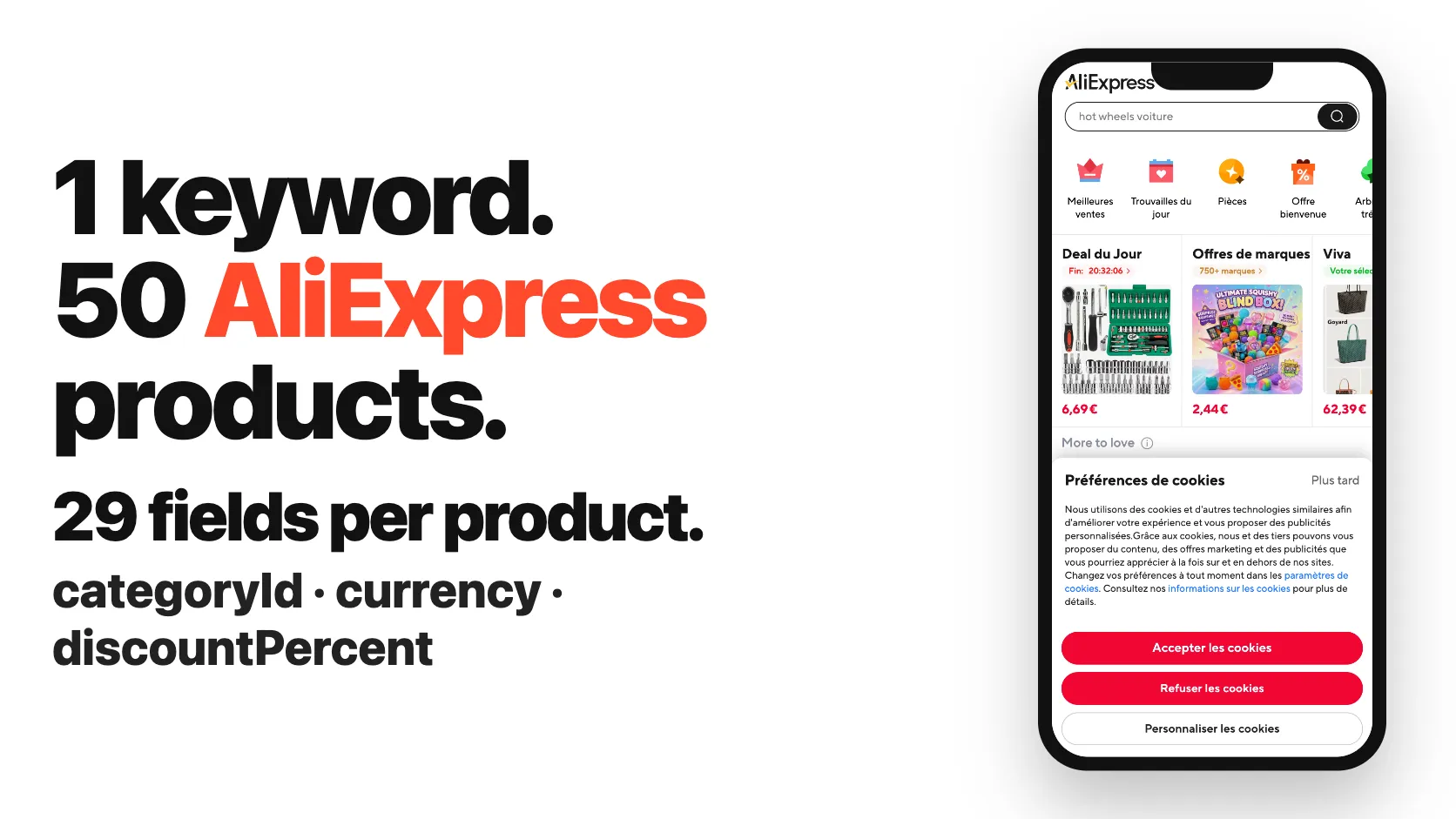
AliExpress scraper (速卖通, 全球速卖通) that turns a keyword, search link, product link or product ID into clean product data: 50 products in 2 seconds, 29 fields each. Card price, seller price, discount, exact units sold, rating, Choice badge, category, listing date, delivery days and images. No account.
Pricing
from $2.93 / 1,000 products
Rating
0.0
(0)
Developer

SilentFlow
Maintained by CommunityActor stats
1
Bookmarked
1
Total users
1
Monthly active users
7 days ago
Last modified
Categories
Share
AliExpress Scraper (速卖通) | Products, Prices, Discounts and Exact Units Sold (2026)
From SilentFlow. Creators of Pinterest Scraper and Leboncoin Scraper, with 420,000+ combined lifetime runs.
Turn an AliExpress search, a keyword, a product link or a product ID into a table of products you can sort: the price on the card, the seller's own price, the discount, the exact number of units sold, the rating, the Choice badge and every image. 50 products in 2 seconds on the prefilled input, no AliExpress account needed.
Why choose this actor?
Picking products on a rounded "10,000+ sold" label? Building a margin on a new-shopper price that your second order will never get? Copying the AliExpress search you already ran in your browser into a spreadsheet, one card at a time?
- 29 fields per product, and they are filled. On the prefilled run (keyword
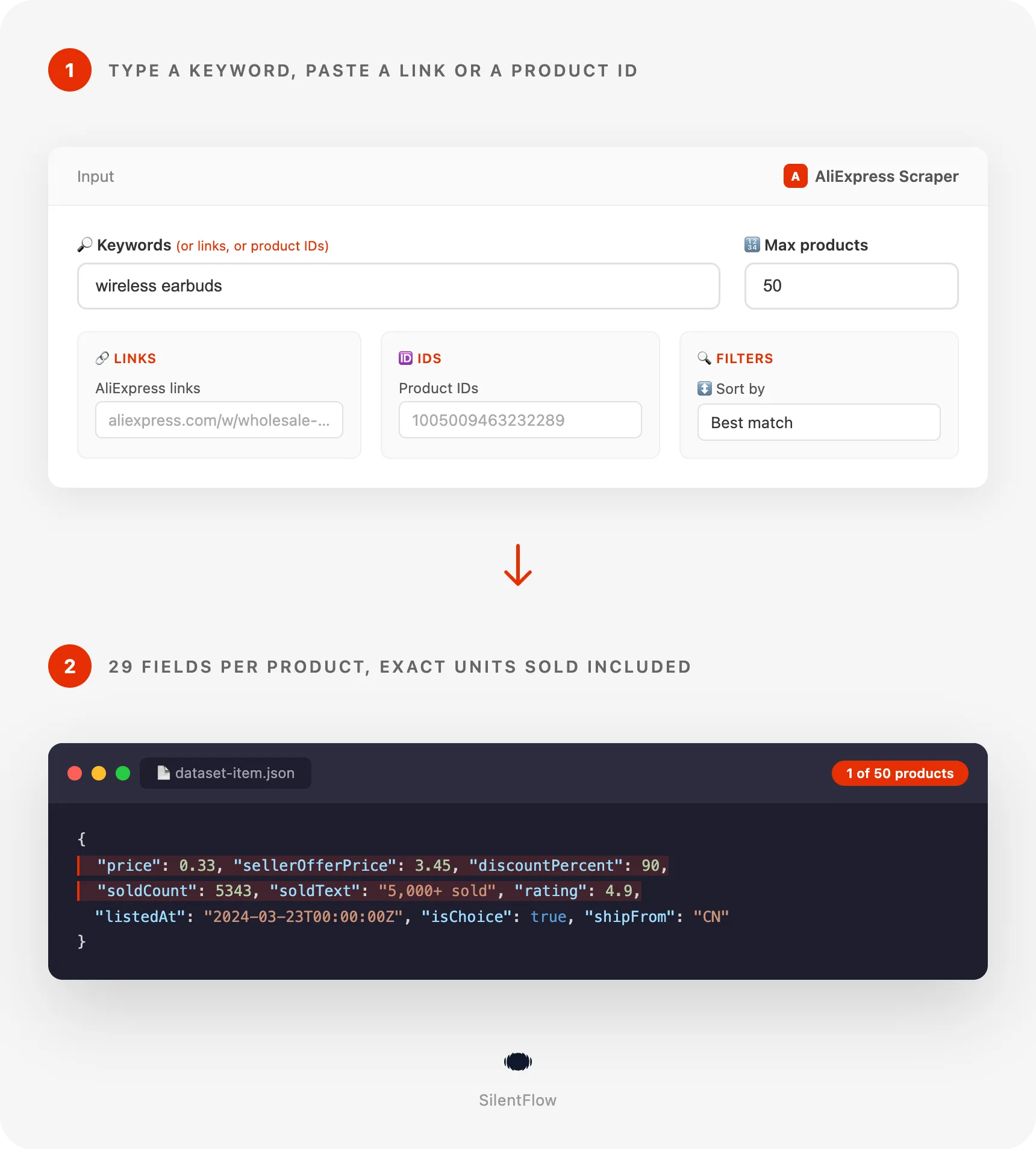
wireless earbuds, 50 products, measured on 29 Sep 2026) all 29 fields were filled on at least half of the rows, 24 of them on every row. Beyond title, price and rating you get the exact units sold (soldCount: 5,343 where the card says "5,000+ sold"), the seller's own price next to the card price, the listing date, the category, the Choice badge, the ship-from country and the delivery window. The most used AliExpress scraper returns 20 fields. - Keywords, AliExpress links and product IDs in the same run. Type what you would type in the AliExpress search bar, paste a search or category link from your browser with its sort and price filters, paste a product link from aliexpress.com, aliexpress.us or a regional site, or list product IDs. Three kinds of input with no mode to pick, where the most used AliExpress scraper takes keywords only. In our test a sorted search link, a product link and a product ID returned 30 rows in 11 seconds, both products found.
- A form of 7 fields, none of them required. The most used AliExpress scraper asks for 9 settings and will not start without keywords. Here the keyword is prefilled: press Start and 50 products come back in 2 seconds. One cap,
maxItems, is shared evenly across every keyword and search link you enter.

Try your first AliExpress product list
Paste this input into the Input tab (JSON view) and press Start. It is the prefilled input of the form: the first 50 products AliExpress shows for wireless earbuds, in the order shoppers see them.
Runs of this size fit easily in the Apify Free plan, so you can try the actor on your own product ideas before scheduling anything. Each product is one row of the dataset; export it as JSON, CSV, Excel or HTML from the Storage tab, or read it from the API. The Products view shows image, title, price, discount, units sold, rating, listing date and link; the Product research view lines up keyword, rank, units sold, card price, seller price and the Choice badge.
| SilentFlow · AliExpress suite | |
 AliExpress Reviews Scraper AliExpress Reviews ScraperFeedback, Ratings and Photos |  AliExpress Scraper AliExpress ScraperYou are here |
Copy to your AI assistant
Paste this block into Claude, ChatGPT or Cursor to give it full context about this actor:
How to scrape AliExpress product data
Three runs, from the simplest to the most filtered. Each JSON is a complete input: paste it into the JSON view of the Input tab.
Get the first 100 products for a product idea
One keyword, 100 products, two pages of AliExpress results in the order shoppers see them.
Turn the search you ran in your browser into a spreadsheet
Sort a search by orders on AliExpress, copy the address and paste it as a link. The sort and any price filter in the link are kept, and every product comes back with its exact units sold. In our test the yoga mat search sorted this way opened on a mat with 12,893 units sold.
Find the bestsellers of two niches inside a price range
Two keywords, most sold first, cards priced from 2 to 10 US dollars. In our test this input returned 130 rows over 4 pages, every price inside the range, and the first LED strip had 64,260 units sold.
Input parameters
| Field | Type | Default | Description |
|---|---|---|---|
keywords | array of strings | prefilled ["wireless earbuds"] | Searches as you would type them on AliExpress. English keywords match best. 60 products per page, in the order shoppers see them. |
startUrls | array of links | none | AliExpress search result pages, category pages or product pages. See the accepted formats below. |
productIds | array of strings | none | AliExpress product IDs, one per line. One row each. |
maxItems | integer | 50 | Rows for the whole run. Products asked for by link or ID are served first, then the rest is shared evenly across keywords and search links. |
sort | string | default | default (best match), orders (most sold first), price_asc, price_desc. |
minPrice | number | none | Lowest card price in US dollars a search result may have. |
maxPrice | number | none | Highest card price in US dollars a search result may have. |
No field is required: a run needs at least one keyword, one AliExpress link or one product ID, and the form comes with a keyword prefilled.
Accepted formats
- Keywords: plain words, one per line (
wireless earbuds,yoga mat,stainless steel water bottle). The same keyword typed twice runs once. - Search result links:
https://www.aliexpress.com/w/wholesale-yoga-mat.html?SearchText=yoga+matwith whatever AliExpress added to it:SortType=total_tranpro_desc(most sold),SortType=price_asc,minPrice=5,maxPrice=20. Those settings are kept; the sort and price range of the form only fill in what the link does not set. - Category pages:
https://www.aliexpress.com/category/<id>/<name>.html, read page by page like a search. - Product pages:
https://www.aliexpress.com/item/1005009463232289.html, the same address onwww.aliexpress.us,fr.aliexpress.com,m.aliexpress.comand the other regional hosts. The long IDs AliExpress uses on some pages (starting with 3256) are turned into the product's own ID. - Product IDs: the number in a product link, such as
1005009463232289or older ones like4000094150291. A product ID or a product link typed among the keywords is read as a product. - Links to aliexpress.ru (a separate shop with its own catalogue) and to other sites are skipped and named in the log.
What data can you extract from AliExpress?
Every row describes one product, with the same 29 fields in the same order, null when AliExpress shows no value:
| Group | Fields |
|---|---|
| Identity | id, url, title |
| Content | categoryId, isChoice, isSponsored, tags, skuId |
| Measures | price, originalPrice, discountPercent, sellerOfferPrice, currency, formattedPrice, rating, soldCount, soldText |
| Place and time | shipFrom, deliveryDaysMin, deliveryDaysMax, listedAt |
| Media | imageUrl, images |
| Meta | keyword, page, position, totalResults, searchUrl, scrapedAt |
A few facts that help when you use the data:
idis AliExpress's own product ID and never changes;urlis the permanent product page built from it, without tracking parameters.priceis the price the search card shows. For many products that is a deal for new shoppers;sellerOfferPriceis the price the seller asks everyone else, the one to use for a margin after the first order.originalPriceis the struck-through price anddiscountPercentthe discount the card prints.soldCountis the exact number of units sold that AliExpress keeps behind its rounded label;soldTextis the label itself.listedAtis the date the product was put on sale, in RFC 3339, so you can spot new products that already sell.positionis the rank in the search across pages,pagethe result page, andtotalResultsthe number of products AliExpress reports for the search, a quick measure of how crowded a niche is (14,107 forwireless earbudson 29 Sep 2026).
Output example
The first row of the prefilled run, 29 Sep 2026:
Advanced usage
Track a list of products every week
List the products you sell or watch and schedule the run weekly in the Schedules tab. Each ID comes back as one row with this week's card price, seller price and units sold, so the difference between two runs is the week's sales.
Map a niche across several keywords
Six keywords of the same niche, 100 products each, most sold first. Deduplicate on id in your spreadsheet (the actor already does it inside a run) and you have the bestsellers of the whole niche with their listing dates.
Find cheap products that already sell
Most sold first, card price under 5 US dollars: the classic dropshipping shortlist. Compare price with sellerOfferPrice before you set your own price.
Re-run a search you set up on AliExpress
Set the sort and price range on the AliExpress search page, copy the address and paste it. The link keeps its own settings, and the form's sort and price range only fill in what it leaves out. Adding a product link to the same run puts that product first.
Rank products by units sold in Python
Call the actor from your own code, then keep the products listed in the last year and rank them by units sold.
FAQ
What does this actor return? One row per AliExpress product, with 29 fields: the product (id, link, title, category, Choice badge, sponsored slot, promotion tags, SKU), the prices (card price, original price, discount, the seller's own price, currency), the rating, the exact units sold, the ship-from country, the delivery window, the listing date, the images, and where the product stood in the search.
Do I need an AliExpress account? No. The actor reads what any visitor of AliExpress sees without logging in. There is no login, no API key and nothing to install.
Which inputs can I give it? Keywords, AliExpress search result and category links, product links and product IDs, all in the same run. Search and category links run page by page with their own sort and price filters; product links and IDs give one row each.
Why are there two prices?
The price on an AliExpress card is often a deal for new shoppers. price is that card price, the one AliExpress sorts and filters on; sellerOfferPrice is the seller's own price, what a returning buyer pays. On the prefilled run a pair of earbuds showed 0.33 USD on the card and 3.45 USD as the seller's price.
Is soldCount exact?
It is the unit count AliExpress keeps behind the rounded label on the card: 5,343 where the card prints "5,000+ sold". The label itself is in soldText. A product nobody bought yet has null for both.
Are prices in US dollars?
Yes. The run reads the US site in USD, so every price is in US dollars with currency set to USD in its own field, and titles are in English.
How fresh is the data?
Live. Every run reads AliExpress at the moment it runs; nothing comes from a cache. AliExpress re-ranks results all the time, so position and page move while id stays the same.
How many products can one keyword return?
AliExpress lists 60 products per page, and the actor reads up to 60 pages per search, so a single keyword can give up to 3,600 products. maxItems sets how many rows you want, and it is shared evenly across your keywords and search links: 100 with four keywords saves up to 25 products each.
Do the filters combine?
Yes. sort set to orders with minPrice 2 and maxPrice 10 lists the bestsellers whose card price is between 2 and 10 US dollars. In our test that input returned 130 rows, every price inside the range. The filters never remove a product you asked for by its link or ID.
What happens to a product link that search does not show?
A product link or ID is found through the AliExpress search of its own title; in our tests 2 of 2 were found. When search does not show it, the row still ships with its title, main image and gallery, and price and sales left null. A product that no longer exists is skipped and named in the log.
Why are some fields null?
AliExpress does not show every value on every card. A new product nobody rated has a null rating, a product without a promotion has no tags, and the delivery window appears only when AliExpress prints one. Now and then AliExpress serves a lighter version of a results page that carries only title, image and price; the actor reads such a page again to get the full cards, and if the lighter version comes back again, those rows still ship with what the page showed.
What is AliExpress? AliExpress (全球速卖通, 速卖通 for short) is Alibaba Group's international retail marketplace, where sellers, most of them in China, ship single items to buyers worldwide. It is the consumer counterpart of Alibaba.com, which sells wholesale, and a common source for dropshipping stores.
Are the links and images permanent?
url is the permanent product page, built from the product ID, without tracking parameters. searchUrl is the search page the row came from. Image links point to the full-size files on AliExpress's own image servers and keep working as long as the seller keeps the photo.
More SilentFlow scrapers
🛒 E-commerce
 Pinterest - Pinterest Scraper | Pins, Boards and Profiles
 Leboncoin - Leboncoin Scraper | Classified Ads, Prices and Sellers
 Leboncoin - Leboncoin Ad Details Scraper
 Back Market - Back Market Scraper | Refurbished Prices
 ImportYeti - US Customs Records, Suppliers & Trade Data - ImportYeti Scraper - US Customs Records, Suppliers & Trade Data
 TikTok Shop - TikTok Shop Scraper | Products, Sellers and Creator Videos
 1688 Wholesale - 1688 Wholesale Scraper
 Naver - Naver Scraper | Shopping Products, Prices and Reviews
 Udemy Course - Udemy Course Scraper
 JD - JD Products Scraper | Prices, Brands and Barcodes
 Store Leads Ecommerce - Store Leads Ecommerce Scraper
 Amazon Seller - Amazon Seller Scraper | Emails, Phones and Ratings
 Naver - Naver Reviews Scraper | Shopping Product Reviews
 Bring a Trailer - Bring a Trailer Scraper
 Lowes - Lowes Products Scraper | Prices, Stock and Specs
 Store Leads - Store Leads Scraper | Shopify Data
 Avito - Avito Scraper | Listings, Prices and Sellers
 Leboncoin - Leboncoin Scraper
 Mobile.de - Mobile.de Scraper
 Naver - Naver Products Scraper | Shopping Prices, Sellers and Ratings
 Taobao - Taobao Scraper | Products, Prices and Sellers
 Udemy - Udemy Scraper
 Agoda - Agoda Scraper | Hotel Prices and Guest Ratings
 Alibaba - Alibaba Products Scraper | Wholesale Prices and MOQ
 Allegro - Allegro Scraper | Products, Prices and Sellers
 Avito - Avito Profiles Scraper | Sellers, Ratings and Reviews
 Back Market - Back Market Scraper | Refurbished Electronics Prices
 BAUHAUS - BAUHAUS Scraper | Product Prices, EAN and Specs
 CARFAX - CARFAX Scraper | Used Cars, Prices and History
 Coupang - Coupang Detail Scraper | Product Prices and Options
 Ctrip - Ctrip Scraper | Attractions, Tickets and Reviews
 eBay Marketplace - eBay Marketplace Scraper
 Europages - Europages Scraper | Suppliers and B2B Companies
 Eventim - Eventim Scraper | Events, Ticket Prices and Venues
 GasBuddy - GasBuddy Scraper | Gas Prices by Station
 Google Hotels - Google Hotels Scraper | Prices, Offers and Ratings
 Homedepot - Homedepot Reviews Scraper | Customer Reviews and Ratings
 Leboncoin - Leboncoin Details Scraper | Full Ad Data and Sellers
 Mercari - Mercari Scraper | Listings, Sold Prices and Sellers
 Vinted Marketplace - Vinted Marketplace Scraper
 Walmart - Walmart Product Scraper
 Alibaba - Alibaba Scraper | Products, Prices and Suppliers
 Amazon - Amazon Product Scraper
 Amazon Marketplace - Amazon Marketplace Scraper
 AutoScout24 - AutoScout24 Scraper
 eBay Listings - eBay Listings Scraper
 Europages Deep Dive Extractor - Europages Deep Dive Extractor | VAT, Decision Makers, ISO Certs
 Pinterest - Pinterest Scraper
 Trip - Trip Scraper | Hotels, Prices and Reviews
 Vinted - Vinted Scraper
 Walmart - Walmart Scraper | Prices, Reviews, Sellers, Availability
💼 Jobs
 ZipRecruiter - ZipRecruiter Jobs Scraper | Salary, Company & Location Filters
 Indeed - Indeed Company Reviews Scraper
 Multi Board - Multi Board Job Scraper
 Glassdoor Job Listings - Glassdoor Job Listings Scraper
 🔥 Glassdoor - 🔥 Glassdoor Scraper
 LinkedIn Job Search - LinkedIn Job Search Scraper | Salaries & Seniority
 ATS - ATS Jobs Scraper | Greenhouse, Lever and Ashby
 Dice Tech - Dice Tech Jobs Scraper
 iimjobs - iimjobs Scraper | Jobs, Companies and Recruiters
 Jora - Jora Jobs Scraper
 Malt Freelancer - Malt Freelancer Scraper
 Malt - Malt Scraper | Freelance Profiles
 Welcome to the Jungle - Welcome to the Jungle Job Scraper
 All - All Jobs Scraper
 Arbeitsagentur - Arbeitsagentur Jobs Scraper
 Cutshort - Cutshort Jobs Scraper | Salaries, Skills and Companies
 Dice - Dice Jobs Scraper | US Tech Jobs, Salaries, Skills
 Glassdoor - Glassdoor Jobs Scraper
 Indeed - Indeed Jobs Scraper | Job Listings in 73 Countries
 Jora - Jora Scraper | Jobs in Australia, New Zealand, Singapore
 StepStone - StepStone Scraper
 YCombinator - YCombinator Jobs Scraper | Startup Jobs, Salaries and Founders
 Arbeitsagentur - Arbeitsagentur Scraper | German and Austrian Job Board
 Indeed - Indeed Companies Scraper | Reviews, Salaries, Interviews
 Indeed - Indeed Jobs Scraper | NLP Skills
 LinkedIn - LinkedIn Jobs Scraper
 Naukri & NaukriGulf - Naukri & NaukriGulf Jobs Scraper
 Seek - Seek Job Scraper
 Welcome to the Jungle - Welcome to the Jungle Scraper | Jobs and Company Data
 Ziprecruiter - Ziprecruiter Scraper
🏠 Real estate
 SeLoger - SeLoger Scraper | Real Estate Listings
 Anjuke - Anjuke Scraper | Rental Listings, Prices and Agents
 Realtor Rental Listings - Realtor Rental Listings Scraper
 Airbnb Pro Host Contact & - Airbnb Pro Host Contact & Email Scraper
 Bien'ici - Bien'ici Scraper | Property Listings
 Rightmove - Rightmove Scraper
 Trulia Rental Listings - Trulia Rental Listings Scraper
 Airbnb Professional Host - Airbnb Professional Host Scraper | Emails, Phones, SIRET
 Airbnb Search - Airbnb Search Scraper
 Bienici - Bienici Scraper
 Idealista - Idealista Scraper
 Realestate.com.au - Realestate.com.au Scraper
 SeLoger - SeLoger Scraper | French Property Listings and Agencies
 Zillow - Zillow Scraper
 Airbnb Search - Airbnb Search Scraper | Prices, Fees, Amenities, Hosts
 Idealista - Idealista Scraper
 Realtor Rental - Realtor Rental Scraper
 Trulia Rental - Trulia Rental Scraper | US Rentals, Prices, Pet Policy
📣 Social media
 LinkedIn Post Search - LinkedIn Post Search Scraper | Keywords, Hashtags & Profiles
 Facebook Search - Facebook Search Scraper
 Instagram - Instagram Story Scraper | Stories & Highlights
 LinkedIn Leads - LinkedIn Leads Scraper | Sales Navigator Export
 TikTok - TikTok Scraper
 YouTube - YouTube Channel Scraper | Videos, Shorts and Views
 Instagram Engagement - Instagram Engagement Scraper
 Facebook Search - Facebook Search Profiles Scraper | People by Name or Keyword
 Meta Ad Library - Meta Ad Library Scraper
 OnlyFans - OnlyFans Profile Scraper
 TikTok Trend - TikTok Trend Scraper | Trending Hashtags and Videos
 OnlyFans - OnlyFans Creator Scraper
 Skool Community - Skool Community Scraper
 Bilibili - Bilibili Scraper
 Facebook Thread - Facebook Thread Profiles Scraper | Followers, Bios & Engagement
 Kuaishou - Kuaishou Scraper | Videos, Comments and Creator Stats
 LinkedIn Event - LinkedIn Event Scraper
 Reddit - Reddit Scraper | Posts, Comments and Subreddits
 Reddit - Reddit Scraper | Comments, Posts and Users
 Snapchat - Snapchat Contacts Scraper | Phones, Emails and Websites
 Weibo - Weibo Scraper | Posts, Profiles and Engagement
 Xigua - Xigua Scraper | Videos, Creators and Downloads
 Discord - Discord Scraper | Servers, Member Counts and Invites
 Facebook - Facebook Company Scraper | Emails, Phones, Ratings
 Facebook Business Page - Facebook Business Page Scraper
 Kwai - Kwai Scraper | Videos, Creators and Hashtags
 LinkedIn Ads Library - No Cookies - LinkedIn Ads Library Scraper - No Cookies
 LinkedIn Hashtag & - LinkedIn Hashtag & Post Scraper | No Cookies
 Skool Group - Skool Group Scraper
 Snapchat - Snapchat Ads Scraper | Ad Library, Impressions & Targeting
 YouTube - YouTube Transcript Scraper
🏢 Business data
 Tencent - Tencent Scraper | Maps Places, Phones and Ratings
 LinkedIn People Search - LinkedIn People Search Scraper | Profiles & Companies
 LinkedIn Company Search - LinkedIn Company Search Scraper | Profiles & Firmographics
 Company Data - Company Data Scraper | Emails, Phones and Tech Stack
 FanDuel - FanDuel Scraper | Odds, Spreads and Player Props
 ForexFactory - ForexFactory Scraper | Economic Calendar and Forecasts
 Justdial - Justdial Companies Scraper | Business Leads, Phones and Emails
 Kakao - Kakao Scraper | Map Places, Reviews and Phones
 OpenTable - OpenTable Reviews Scraper | Restaurant Reviews and Ratings
 SoftwareAdvice - SoftwareAdvice Scraper | Reviews, Ratings and Pros & Cons
 Teachable Course - Teachable Course Scraper
 Zomato - Zomato Reviews Scraper | Restaurant Ratings and Replies
 2GIS - 2GIS Reviews Scraper | Ratings, Photos and Owner Replies
 LinkedIn Sales Navigator - LinkedIn Sales Navigator Scraper
 Teachable - Courses, Prices & Instructors - Teachable Scraper - Courses, Prices & Instructors
 Trustpilot - Trustpilot Scraper | Reviews, Ratings and Company Contacts
 Website Tech Stack - Website Tech Stack Scraper
✈️ Travel
 Google Maps - Google Maps Scraper
 Booking.com Hotel - Booking.com Hotel Scraper
 Flight Price - Flight Price Scraper
 Trip - Trip Reviews Scraper | Hotel Reviews and Ratings
 Booking - Booking Scraper | Hotel Prices, Photos, Availability
🎯 Lead generation
 Northdata - Northdata Company Scraper
 ZocDoc - ZocDoc Scraper | Doctors, Reviews and Availability
 UK Companies House - UK Companies House Enricher
 Dealroom - Dealroom Scraper | Companies and Investors
 CNPJ Brazilian - CNPJ Brazilian Company Enricher
 Google Ads Transparency - Google Ads Transparency Scraper
 SIRET - SIRET Company Enricher
 BuiltWith - BuiltWith Scraper | Tech Stacks and Top Sites
 Domain - Domain Enricher
 French Company Prospector - French Company Prospector
 SEC - SEC Scraper | EDGAR Filings and Company Data
 USPTO - USPTO Scraper | Trademark Search and Status
 ZocDoc - ZocDoc Scraper
 Clutch - Clutch Scraper | Agencies, Reviews, Ratings, Services
 Clutch Agency - Clutch Agency Scraper
 Dealroom Startup Data - Dealroom Startup Data Scraper
 G2 - G2 Reviews Scraper
 PagesJaunes - PagesJaunes Scraper | French Business Emails and SIRET
 PagesJaunes - PagesJaunes Business Scraper
 SIRET French - SIRET French Company Enricher
 ThomasNet Suppliers - ThomasNet Suppliers Scraper
🔎 SEO
 Similarweb - Similarweb Scraper | Website Traffic, Rankings and Competitors
 Google News - Google News Scraper
 Apple - Apple Scraper | App Store Apps, Ratings and Charts
📈 Marketing
 Pexels -
 🧰 More tools
 PrizePicks - PrizePicks Scraper | Player Props, Lines and Projections
 Apple - Apple Reviews Scraper | App Store Reviews and Ratings
Support
Need something this scraper doesn't do yet? We ship features fast.
- Feature requests go straight to our backlog
- Enterprise needs? We do custom integrations and high-volume plans
- Pricing questions? Check the Monetization tab on the actor page
Response time: usually under 24 hours.
Legal compliance
This actor extracts publicly available data from AliExpress. It does not bypass any login, paywall or CAPTCHA. Users are responsible for complying with AliExpress's terms of service and applicable data protection laws (GDPR, CCPA, and PIPL for data about companies and people in China). The rows describe products and their listings, not private individuals; if you combine them with personal data, handle it accordingly. The data returned is informational; verify prices and availability on AliExpress before you buy or resell.
Built by SilentFlow for dropshippers, sellers and analysts who would rather compare products than copy them.


