

FT Scraper | Financial Times Articles, Authors and Topics
Pricing
from $4.17 / 1,000 articles
FT Scraper | Financial Times Articles, Authors and Topics
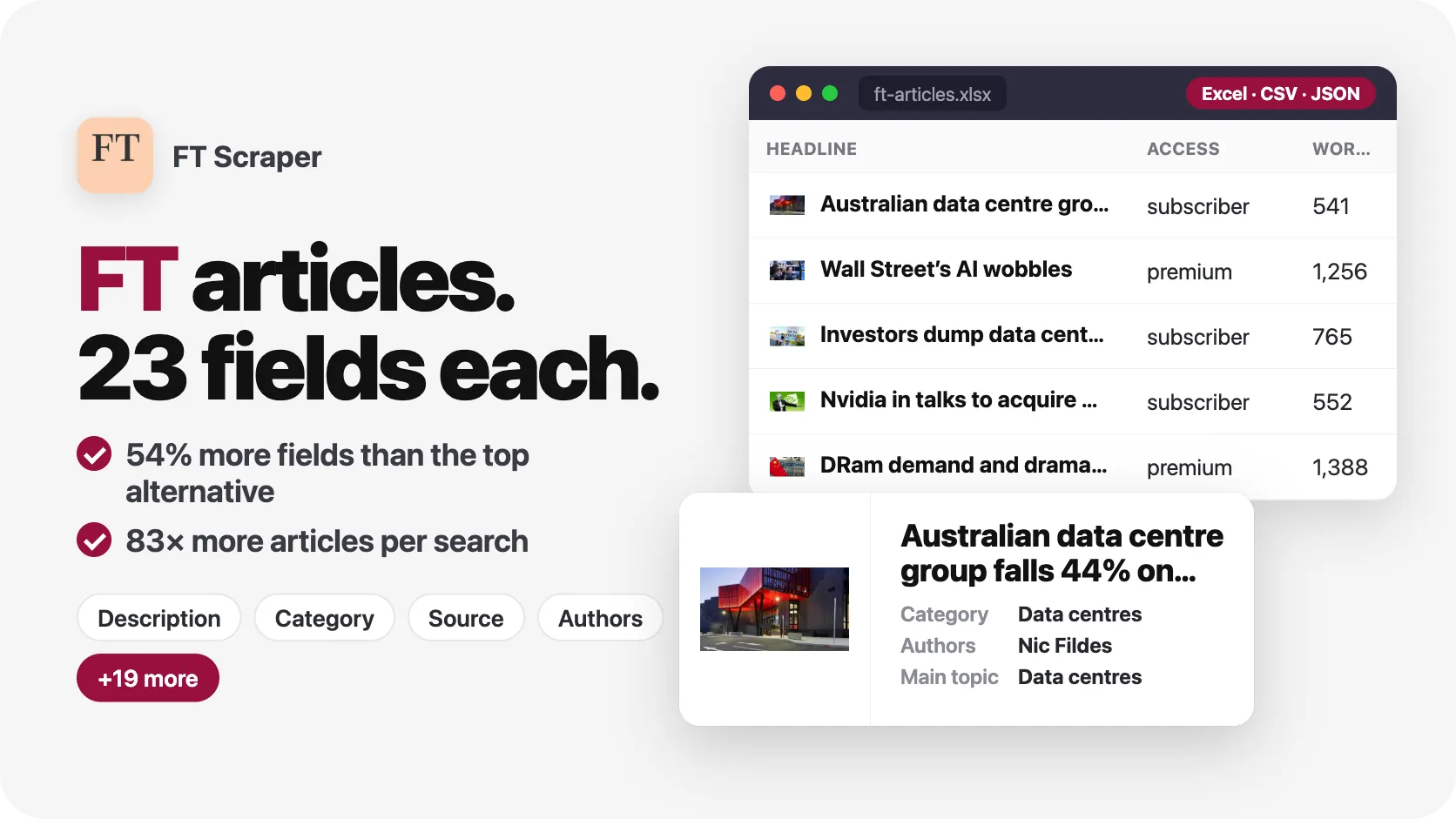
FT Scraper for Financial Times (ft.com) articles by keyword, topic, section, author or URL. Get headline, summary, authors, topics, word count, access level, dates, image and the full text of free articles. 20 articles in 14 seconds, 23 fields each. No FT login or subscription needed in 2026.
Pricing
from $4.17 / 1,000 articles
Rating
0.0
(0)
Developer

SilentFlow
Maintained by CommunityActor stats
0
Bookmarked
2
Total users
1
Monthly active users
2 days ago
Last modified
Share
FT Scraper | Financial Times Articles, Authors and Topics (2026)
From SilentFlow. Creators of Facebook Search Scraper and Pinterest Scraper, with 600,000+ combined lifetime runs.
Turn the Financial Times into a table: every FT article about a company, a person or a theme, with its headline, summary, authors, main topic, topic tags, word count, access level, publication and update dates and image, plus the full text when the article is free to read. Our test run for the keyword nvidia returned 20 complete articles in 14 seconds, with no FT account and no subscription.
Why choose this actor?
Reading FT.com tab after tab to see what it wrote about your company this week? Copying headlines into a spreadsheet by hand? Using a tool that only works once you already have the list of article links?
- 20 fields filled on every article, not 13. In our run for
nvidia, each of the 20 rows carried the same 20 data fields: id, link, headline, summary, content type, category, main topic with its FT link, every topic tag, word count, access level, free-to-read flag, publication and update dates, image link with its size, language and source. Authors and the image caption came on 15 of the 20 rows, the comment count and full text where FT shows them. The output example of the most used FT actor on the Store has 13 keys, two of them empty. - 1,000 articles from one keyword, not 12 headlines. Type
Nvidia,private creditorChristine Lagardeand get the matching FT articles, newest first or most relevant first. In our test, the keywordoilreturned 1,000 different articles in 29 seconds with listing fields only. The most used FT actor on the Store takes article links, and finds new articles only through FT's front-page feed, which held 12 headlines when we checked on 23 October 2026. Here you can paste article links too. - Follow a topic, a section or a journalist. Paste an ft.com topic, company, section or author page and the actor reads it page after page, newest first, and stops at your date window. In our test,
https://www.ft.com/artificial-intelligencewithdateFromset to14 daysgave 30 articles in 22 seconds, all published inside the window.

Try your first 20 articles
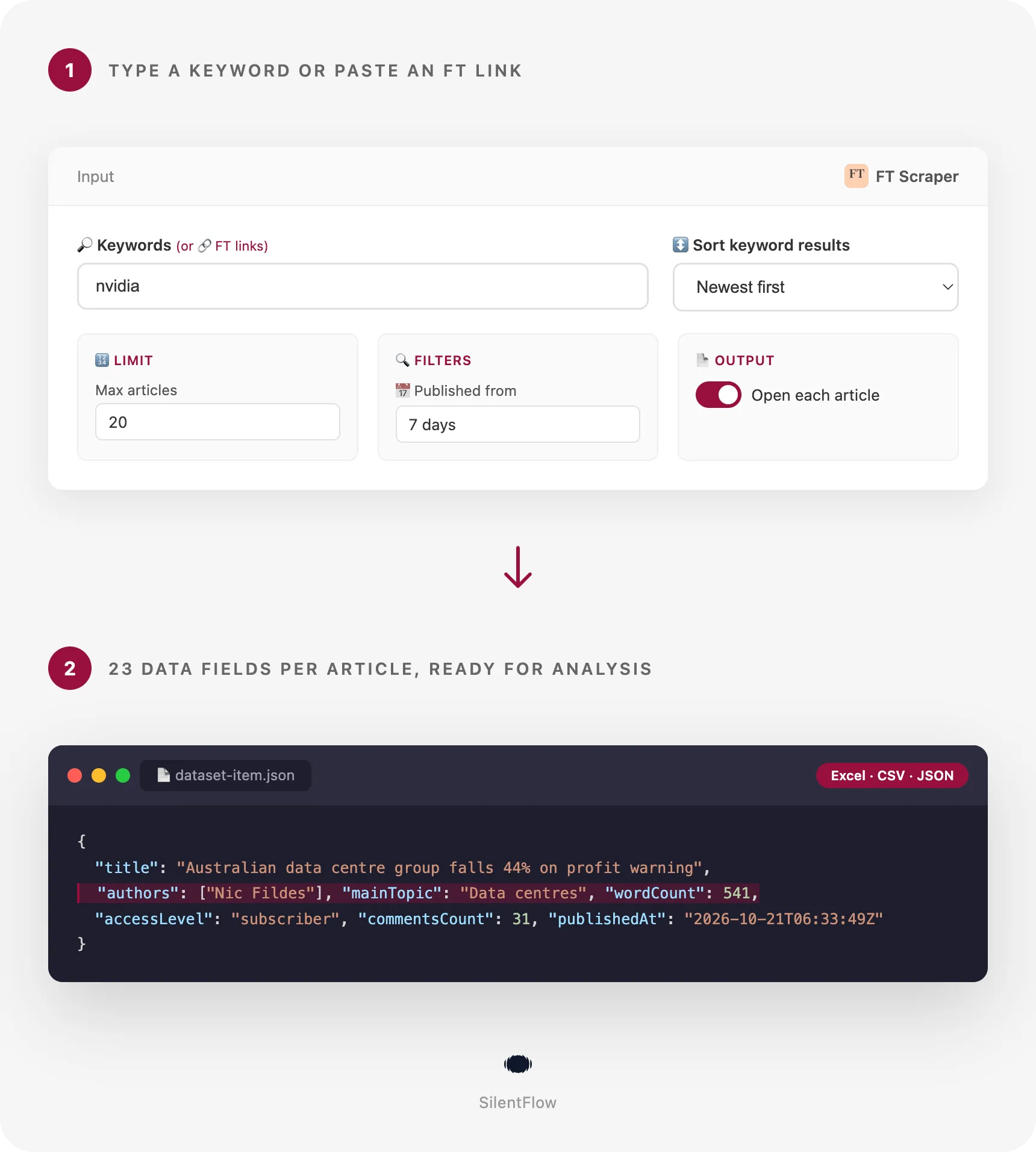
Paste this input in the JSON tab of the Input page and press Start. It looks for nvidia on FT and opens each article, until it has 20 different articles. In our test it took 14 seconds.
Raise maxItems to 100 or more for a full coverage report. It runs on the Apify Free plan. Each article becomes one row of your dataset: open the Output tab to see the table with headlines, authors, topics and dates, or export the rows as JSON, CSV or Excel.
Copy to your AI assistant
Paste this block into Claude, ChatGPT or Cursor to give it the full picture of this scraper:
How to scrape Financial Times articles
Three inputs, from the simplest to the most complete. Each one runs as is.
Get the latest FT articles about Nvidia
The prefilled search, newest first. Each row is one FT article with its authors, main topic, topic tags, word count and access level, ready to sort by date or by topic.
Pull a month of FT coverage on private credit
A date window turns a keyword into a monthly report. In our test with listing fields only, every row came back dated between 3 and 28 September 2026. Leave the dates empty to get every article FT has for the keyword.
Follow two FT topics and a few articles you already have
Topic and section pages are read page after page, newest first, and the run stops at the first article older than dateFrom. Article links are always read in full: this one is free to read, so its row carries the whole text.
Input parameters
| Parameter | Type | Default | What it does |
|---|---|---|---|
searchQueries | array of strings | prefilled ["nvidia"] | Keywords to look for on FT, one per line. Up to 1,000 articles per keyword. |
startUrls | array of {url} | empty | ft.com links: articles, topics, companies, sections, authors, stream or search pages. |
maxItems | integer | 100 (20 in the form) | Max articles for the whole run, across all keywords and links. |
sort | date or relevance | date | Order of keyword results: newest first, or best match first. |
dateFrom | date or span | empty | Keep articles published on or after this day. |
dateTo | date or span | empty | Keep articles published on or before this day. |
includeDetails | boolean | true | Open each article for authors, topics, counts, access level and free text. |
debugMode | boolean | false | Detailed log, for troubleshooting only. |
No field is required. The form comes prefilled with a keyword that returns rows; an input with neither a keyword nor a link stops at once and says why.
Accepted links. Article pages (https://www.ft.com/content/66933e51-e06d-475c-aed2-f808f9443dea, with or without https:// or www.), topic and company pages (https://www.ft.com/nvidia, https://www.ft.com/us-interest-rates), section pages (https://www.ft.com/technology, https://www.ft.com/markets), stream and author pages (https://www.ft.com/stream/{uuid}) and FT search pages (https://www.ft.com/search?q=oil&sort=relevance, whose keyword, sort and dates are kept). Links to other websites, or to FT pages that list no article, are skipped with a message in the log.
Accepted dates. A day such as 2026-10-01, a full timestamp such as 2026-10-01T08:00:00Z (its UTC day is kept), today, yesterday, or a span back from now such as 7 days, 2 weeks, 3 months or 1 year. The form's date picker writes these for you. Spans make scheduled runs easy: a daily run with dateFrom set to 1 day always reads the last day.
What data can you extract from the Financial Times?
Every row has 25 fields, in the same order, with null when FT shows nothing for a field.
| Group | Fields |
|---|---|
| Identity | id (FT article uuid), url (permanent link), title |
| Content | description (standfirst), content (full text of free-to-read articles), contentType, category, categoryUrl, mainTopic, mainTopicUrl, topics |
| Author | authors |
| Measures and access | wordCount, commentsCount, accessLevel, isAccessibleForFree |
| Time | publishedAt, modifiedAt |
| Media | imageUrl, imageCaption, imageWidth, imageHeight |
| Meta | language, source, scrapedAt |
A few facts that help you use the data:
idis FT's own article uuid and never changes;urlis the permanenthttps://www.ft.com/content/{id}link, without tracking parameters. Both are safe keys for deduplication across runs.publishedAt,modifiedAtandscrapedAtare RFC 3339 timestamps in UTC (2026-10-21T06:33:49Z).accessLeveltells who can read the article on FT:free(anyone),registered(a free FT account),subscriberorpremium.isAccessibleForFreeis the same answer as a true or false flag.topicslists the main topic first, then every topic FT tags the article with.mainTopicUrlis the FT page of that topic, which you can paste back as a link to follow it.contentTypecomes from the listing:article,opinion,podcastorvideo.imageUrlpoints to FT's image service;imageWidthandimageHeightare the size of the original picture.
Output example
A complete row from our test run for nvidia (a subscriber article, so content is null):
On a free-to-read article, content holds the whole text with paragraphs separated by blank lines, and accessLevel is free.
Advanced usage
Five recipes for needs the examples above do not show. Each input runs as is.
Watch your company every morning
Save this input as a task and schedule it daily in Apify Schedules. Each run returns only what FT published since yesterday, so your Slack channel, sheet or CRM gets the new coverage and nothing else.
Build a fast headline feed without opening articles
With includeDetails off, each row comes from the listing alone: headline, summary, category, date, image and caption. In our test, a 200-article run with listing fields only took 10 seconds. Turn it back on when you need authors, topics and counts.
Collect a journalist's articles
Every FT author has a stream page; open an author's name on any FT article to find it. The run reads it newest first, which is a clean way to track a reporter on your beat or to build a byline dataset.
Get the best matches of a theme, whatever their age
Relevance sort brings FT's best matches first instead of the latest ones. Several keywords share the same maxItems, and an article found by both keywords is returned once.
Enrich a list of FT links you already have
Paste links from a newsletter, a research note or an old spreadsheet and get each article back with its authors, topics, word count, comment count, access level and dates. Export the dataset as CSV and join it to your sheet on url or id.
FAQ
What is the Financial Times? The Financial Times (FT, ft.com) is a London-based business and economics newspaper, read worldwide for its coverage of companies, markets, central banks and politics. Most of its articles are for subscribers; some are free to read, and some need a free FT account.
What does this actor return exactly? One row per FT article, with 25 fields: identity, content, authors, measures, access level, dates, image and language. See the table in "What data can you extract".
Do I get the full text of every article?
You get the full text of articles FT makes free to read. For subscriber and premium articles you get everything FT shows to a visitor who is not signed in: headline, summary, topics, word count, dates and image, plus authors and comment count on most of them. The paywalled body is never returned: content is null on those rows and accessLevel tells you why.
Do I need an FT account or subscription? No. The actor reads public FT pages without signing in. No FT account, no subscription, no login details to provide.
How do keyword searches work?
A keyword returns the FT articles that match it, newest first or most relevant first, up to 1,000 per keyword. When FT search is busy, the actor reads the FT topic page that matches your keyword (for nvidia, the Nvidia topic page) and says so in the log, so the run still delivers articles.
How fresh is the data? Live. Every run reads FT at that moment, so an article published a minute ago can appear. Nothing is cached between runs.
How many articles can I get?
maxItems caps the run, 100 by default. A keyword gives up to 1,000 articles (FT's own limit for one search); a topic or section page is read up to 100 pages deep, newest first. Several keywords and links add up, with duplicates removed.
Can I combine keywords, links and dates?
Yes. Keywords and links run in the same input and share maxItems; the date window applies to all of them. For example searchQueries: ["oil"] with dateFrom: "2026-10-01" and sort: "date" returns this month's FT oil coverage, newest first.
Why do some rows have no authors or no comment count?
FT does not show authors on some premium articles, editorials and podcast transcripts, and comments are closed on many pieces. In our nvidia run, 15 of 20 rows had authors. Fields FT does not show are null, never invented.
Are the links permanent?
Yes. url and mainTopicUrl are permanent FT links and id never changes. Image links point to FT's image service; keep your own copy of a picture if you archive it.
Is it legal to scrape the Financial Times? The actor collects data FT shows publicly to any visitor and does not get around FT's paywall or sign-in. Article text is copyrighted by the FT: use the data for research, monitoring and analysis, and check FT's terms before republishing anything.
More SilentFlow scrapers
🛒 E-commerce
 JD - JD Products Scraper | JD.com Prices, Brands and Barcodes
 Pinterest - Pinterest Scraper | Pins, Boards and Profiles
 Leboncoin - Leboncoin Scraper | Classified Ads, Prices and Sellers
 TikTok Shop - TikTok Shop Scraper | Products, Sellers and Creator Videos
 Leboncoin - Leboncoin Ad Details Scraper
 Back Market - Back Market Scraper | Refurbished Prices
 ImportYeti - US Customs Records, Suppliers & Trade Data - ImportYeti Scraper - US Customs Records, Suppliers & Trade Data
 Naver - Naver Scraper | Shopping Products, Prices and Reviews
 Udemy Course - Udemy Course Scraper
 Naver - Naver Products Scraper | Shopping Prices, Sellers and Ratings
 1688 - 1688 Scraper | Products, Details, Wholesale Prices, Suppliers
 Amazon Seller - Amazon Seller Scraper | Emails, Phones and Ratings
 Naver - Naver Reviews Scraper | Shopping Product Reviews
 Store Leads Ecommerce - Store Leads Ecommerce Scraper
 Store Leads - Store Leads Scraper | Shopify Data
 Allegro - Allegro Scraper | Products, Prices and Sellers
 Leboncoin - Leboncoin Scraper
 Lowes - Lowes Products Scraper | Prices, Stock and Specs
 Mobile.de - Mobile.de Scraper
 Taobao - Taobao Scraper | Products, Details, Prices and Sellers
 Agoda - Agoda Scraper | Hotel Prices and Guest Ratings
 Alibaba - Alibaba Products Scraper | Wholesale Prices and MOQ
 Avito - Avito Scraper | Listings, Prices and Sellers
 Bring a Trailer - Bring a Trailer Scraper
 Coupang - Coupang Detail Scraper | Product Prices and Options
 Eventim - Eventim Scraper | Events, Ticket Prices and Venues
 Homedepot - Homedepot Reviews Scraper | Customer Reviews and Ratings
 Pinterest - Pinterest Scraper
 Udemy - Udemy Scraper
 Alibaba - Alibaba Scraper | Products, Supplier Companies and Prices
 AliExpress - AliExpress Reviews Scraper | Feedback, Ratings and Photos
 AliExpress - AliExpress Scraper | Products, Prices and Sales
 Avito - Avito Profiles Scraper | Sellers, Ratings and Reviews
 Back Market - Back Market Scraper | Refurbished Electronics Prices
 BAUHAUS - BAUHAUS Scraper | Product Prices, EAN and Specs
 CARFAX - CARFAX Scraper | Used Cars, Prices and History
 eBay Marketplace - eBay Marketplace Scraper
 Google Hotels - Google Hotels Scraper | Prices, Offers and Ratings
 Leboncoin - Leboncoin Details Scraper | Full Ad Data and Sellers
 Mafengwo - Mafengwo Scraper | Attractions, Ratings and Tickets
 Mercari - Mercari Scraper | Listings, Sold Prices and Sellers
 Trip - Trip Scraper | Hotels, Prices and Reviews
 Vinted Marketplace - Vinted Marketplace Scraper
 Webmotors - Webmotors Scraper | Car Listings, Prices and FIPE
 Woolworths - Woolworths Products Scraper | Prices, Specials and Nutrition
 Amazon - Amazon Product Scraper
 Amazon Marketplace - Amazon Marketplace Scraper
 AutoScout24 - AutoScout24 Scraper
 eBay Listings - eBay Listings Scraper
 Europages Deep Dive Extractor - Europages Deep Dive Extractor | VAT, Decision Makers, ISO Certs
 Europages - Europages Scraper | Suppliers and B2B Companies
 GasBuddy - GasBuddy Scraper | Gas Prices by Station
 Goofish - Goofish Detail Scraper | Listings, Prices and Sellers
 Vinted - Vinted Scraper
 Walmart - Walmart Scraper | Prices, Reviews, Sellers, Availability
 Walmart - Walmart Product Scraper
💼 Jobs
 ZipRecruiter - ZipRecruiter Jobs Scraper | Salary, Company & Location Filters
 Indeed - Indeed Company Reviews Scraper
 Multi Board - Multi Board Job Scraper
 Jobright - Jobright Scraper | Jobs, Salaries and H1B Sponsors
 Jora - Jora Jobs Scraper
 LinkedIn Job Search - LinkedIn Job Search Scraper | Salaries & Seniority
 Malt - Malt Scraper | Freelance Profiles
 Glassdoor Job Listings - Glassdoor Job Listings Scraper
 🔥 Glassdoor - 🔥 Glassdoor Scraper
 Malt Freelancer - Malt Freelancer Scraper
 ATS - ATS Jobs Scraper | Greenhouse, Lever and Ashby
 Glassdoor - Glassdoor Jobs Scraper
 Arbeitsagentur - Arbeitsagentur Jobs Scraper
 Cutshort - Cutshort Jobs Scraper | Salaries, Skills and Companies
 Dice - Dice Jobs Scraper | US Tech Jobs, Salaries, Skills
 Dice Tech - Dice Tech Jobs Scraper
 iimjobs - iimjobs Jobs Scraper | MBA, Finance and Hirist Tech Jobs
 Indeed - Indeed Jobs Scraper | Job Listings in 73 Countries
 Instahyre - Instahyre Jobs Scraper | Companies, Recruiters and Ratings
 Jora - Jora Scraper | Jobs in Australia, New Zealand, Singapore
 StepStone - StepStone Scraper
 Welcome to the Jungle - Welcome to the Jungle Job Scraper
 YCombinator - YCombinator Jobs Scraper | Startup Jobs, Salaries and Founders
 All - All Jobs Scraper
 Arbeitsagentur - Arbeitsagentur Scraper | German and Austrian Job Board
 iimjobs - iimjobs Scraper | Jobs, Companies and Recruiters
 Indeed - Indeed Companies Scraper | Reviews, Salaries, Interviews
 Indeed - Indeed Jobs Scraper | NLP Skills
 LinkedIn - LinkedIn Jobs Scraper
 Naukri & NaukriGulf - Naukri & NaukriGulf Jobs Scraper
 Seek - Seek Job Scraper
 Welcome to the Jungle - Welcome to the Jungle Scraper | Jobs and Company Data
 Ziprecruiter - Ziprecruiter Scraper
🏠 Real estate
 SeLoger - SeLoger Scraper | Real Estate Listings
 Realtor Rental Listings - Realtor Rental Listings Scraper
 Airbnb Professional Host - Airbnb Professional Host Scraper | Emails, Phones, SIRET
 Airbnb Pro Host Contact & - Airbnb Pro Host Contact & Email Scraper
 Trulia Rental Listings - Trulia Rental Listings Scraper
 Bien'ici - Bien'ici Scraper | Property Listings
 Rightmove - Rightmove Scraper
 SeLoger - SeLoger Scraper | French Property Listings and Agencies
 Airbnb Search - Airbnb Search Scraper
 Bienici - Bienici Scraper
 Idealista - Idealista Scraper
 Realestate.com.au - Realestate.com.au Scraper
 Airbnb Search - Airbnb Search Scraper | Prices, Fees, Amenities, Hosts
 Anjuke - Anjuke Scraper | Rental Listings, Prices and Agents
 Idealista - Idealista Scraper
 Realtor Rental - Realtor Rental Scraper
 Trulia Rental - Trulia Rental Scraper | US Rentals, Prices, Pet Policy
 Zillow - Zillow Scraper
📣 Social media
 LinkedIn Post Search - LinkedIn Post Search Scraper | Keywords, Hashtags & Profiles
 Facebook Search - Facebook Search Scraper
 Instagram - Instagram Story Scraper | Stories & Highlights
 LinkedIn Leads - LinkedIn Leads Scraper | Sales Navigator Export
 Facebook Search - Facebook Search Profiles Scraper | People by Name or Keyword
 YouTube - YouTube Channel Scraper | Videos, Shorts and Views
 TikTok - TikTok Scraper
 Instagram Engagement - Instagram Engagement Scraper
 TikTok Trend - TikTok Trend Scraper | Trending Hashtags and Videos
 Discord - Discord Scraper | Servers, Member Counts and Invites
 Douyin - Douyin Comments Scraper | Comments, Likes and IP Regions
 Likee - Likee Scraper | Videos, Hashtags and Creators
 Meta Ad Library - Meta Ad Library Scraper
 OnlyFans - OnlyFans Creator Scraper
 OnlyFans - OnlyFans Profile Scraper
 Reddit - Reddit Scraper | Posts, Comments and Subreddits
 Skool Community - Skool Community Scraper
 Bandsintown - Bandsintown Scraper | Concerts and Tour Dates
 Discord - Discord Profiles Scraper | Users, Badges and Server Tags
 Facebook Thread - Facebook Thread Profiles Scraper | Followers, Bios & Engagement
 Kuaishou - Kuaishou Scraper | Videos, Comments and Creator Stats
 LinkedIn Ads Library - No Cookies - LinkedIn Ads Library Scraper - No Cookies
 LinkedIn Event - LinkedIn Event Scraper
 LinkedIn Hashtag & - LinkedIn Hashtag & Post Scraper | No Cookies
 Pinterest - Pinterest Ads Scraper | Ad Library, Reach & Targeting
 Pinterest - Pinterest Profiles Scraper | Followers, Emails and Bios
 Pinterest - Pinterest Videos Scraper | Video Downloader, MP4 Links, Stats
 Reddit - Reddit Comments Scraper | Search, Threads and Replies
 Reddit - Reddit Profiles Scraper | User Karma, Activity and Communities
 Reddit - Reddit Scraper | Comments, Posts and Users
 RedNote - RedNote Videos Scraper | Downloader, Transcripts and Stats
 Snapchat - Snapchat Contacts Scraper | Phones, Emails and Websites
 Snapchat - Snapchat Videos Scraper | Spotlight Videos, MP4 and Stats
 TikTok Creative - TikTok Creative Ads Scraper | Top Ads, Landing Pages & Metrics
 TikTok Lookalike - TikTok Lookalike Scraper | Influencers, Emails and Engagement
 Xigua - Xigua Scraper | Videos, Creators and Downloads
 YouTube Autocomplete - YouTube Autocomplete Scraper | Keyword Suggestions
 Facebook - Facebook Company Scraper | Emails, Phones, Ratings
 Facebook Business Page - Facebook Business Page Scraper
 Kwai - Kwai Scraper | Videos, Creators and Hashtags
 RedNote - RedNote Detail Scraper | Xiaohongshu Details, Images, Videos
 Skool Group - Skool Group Scraper
 Snapchat - Snapchat Ads Scraper | Ad Library, Impressions & Targeting
 TwitchTracker - TwitchTracker Scraper | Twitch Streamer Stats and Rankings
 Weibo - Weibo Scraper | Posts, Profiles and Engagement
 YouTube - YouTube Transcript Scraper
🏢 Business data
 Tencent - Tencent Scraper | Maps Places, Phones and Ratings
 LinkedIn Company Search - LinkedIn Company Search Scraper | Profiles & Firmographics
 LinkedIn People Search - LinkedIn People Search Scraper | Profiles & Companies
 LinkedIn Sales Navigator - LinkedIn Sales Navigator Scraper
 Bilibili - Bilibili Scraper | Videos, Profiles, Comments, Danmaku
 Ctrip - Ctrip Scraper | Attractions, Tickets and Reviews
 SoftwareAdvice - SoftwareAdvice Scraper | Reviews, Ratings and Pros & Cons
 Teachable Course - Teachable Course Scraper
 Website Tech Stack - Website Tech Stack Scraper
 Zomato - Zomato Reviews Scraper | Restaurant Ratings and Replies
 2GIS - 2GIS Reviews Scraper | Ratings, Photos and Owner Replies
 Teachable - Courses, Prices & Instructors - Teachable Scraper - Courses, Prices & Instructors
 Trustpilot - Trustpilot Scraper | Reviews, Ratings and Company Contacts
✈️ Travel
 Google Maps - Google Maps Scraper
 Flight Price - Flight Price Scraper
 Booking.com Hotel - Booking.com Hotel Scraper
 Kakao - Kakao Scraper | Map Places, Reviews and Phones
 OpenTable - OpenTable Reviews Scraper | Restaurant Reviews and Ratings
 TheFork - TheFork Scraper | Restaurants, Menus and Ratings
 Trip - Trip Reviews Scraper | Hotel Reviews and Ratings
 Booking - Booking Scraper | Hotel Prices, Photos, Availability
🎯 Lead generation
 Northdata - Northdata Company Scraper
 Dealroom - Dealroom Scraper | Companies and Investors
 ZocDoc - ZocDoc Scraper | Doctors, Reviews and Availability
 UK Companies House - UK Companies House Enricher
 CNPJ Brazilian - CNPJ Brazilian Company Enricher
 Google Ads Transparency - Google Ads Transparency Scraper
 PagesJaunes - PagesJaunes Scraper | French Business Emails and SIRET
 BuiltWith - BuiltWith Scraper | Tech Stacks and Top Sites
 Company Data - Company Data Scraper | Emails, Phones and Tech Stack
 Dealroom Startup Data - Dealroom Startup Data Scraper
 Domain - Domain Enricher
 French Company Prospector - French Company Prospector
 G2 - G2 Reviews Scraper
 Justdial - Justdial Companies Scraper | Business Leads, Phones and Emails
 KVK - KVK Scraper | Dutch Companies and SBI Codes
 PagesJaunes - PagesJaunes Business Scraper
 SEC - SEC Scraper | EDGAR Filings and Company Data
 SIRET - SIRET Company Enricher
 SpyFu - SpyFu Scraper | SEO, PPC and Competitor Data
 Sunbiz - Sunbiz Companies Scraper | New Florida Business Leads
 Sunbiz - Sunbiz Scraper | Florida Companies and Officers
 USPTO - USPTO Scraper | Trademark Search and Status
 Clutch - Clutch Scraper | Agencies, Reviews, Ratings, Services
 Clutch Agency - Clutch Agency Scraper
 SIRET French - SIRET French Company Enricher
 ThomasNet Suppliers - ThomasNet Suppliers Scraper
 ZocDoc - ZocDoc Scraper
🔎 SEO
 Similarweb - Similarweb Scraper | Website Traffic, Rankings and Competitors
 Apple - Apple Reviews Scraper | App Store Reviews and Ratings
 Apple - Apple Scraper | App Store Apps, Ratings and Charts
 Bing - Bing Enricher Scraper | Mobile Friendly Test and Indexing
 Google News - Google News Scraper
 Scribd - Scribd Scraper | Documents, Authors and Views
📈 Marketing
 Douyin -
🎬 Video
 Pexels -
📰 News
 ForexFactory - ForexFactory Scraper | Economic Calendar and Forecasts
🧰 More tools
 FanDuel - FanDuel Scraper | Odds, Spreads and Player Props
 PrizePicks - PrizePicks Scraper | Player Props, Lines and Projections
Support
Need something this scraper doesn't do yet? We ship features fast.
- Feature requests go straight to our backlog
- Enterprise needs? We do custom integrations and high-volume plans
- Pricing questions? Check the Monetization tab on the actor page
Response time: usually under 24 hours.
Legal compliance
This Actor extracts publicly available data from ft.com. It does not bypass any login, paywall or CAPTCHA, and it never returns the body of a subscriber-only article. Users are responsible for complying with the Financial Times terms of service, copyright law and applicable data protection laws (GDPR, CCPA, and PIPL where relevant). The output contains the names of journalists as published in FT bylines; handle them as personal data where those laws apply. The data returned is informational; verify accuracy for regulated use cases.
Built by SilentFlow for analysts, researchers and data teams who read the Financial Times for a living.


