

OpenAI Scraper | News, Blog Posts and Research
Pricing
from $0.68 / 1,000 articles
OpenAI Scraper | News, Blog Posts and Research
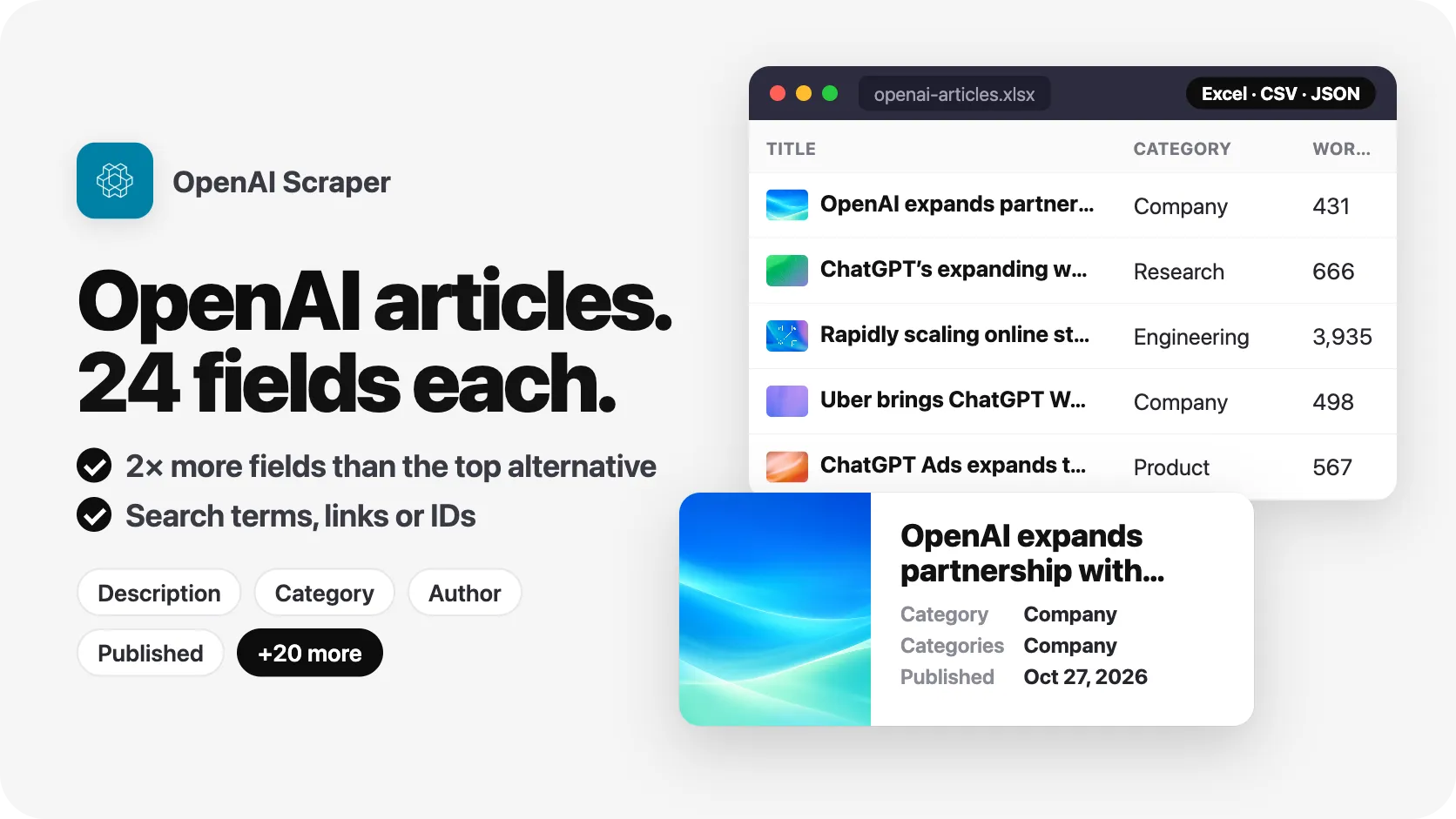
OpenAI scraper for openai.com news, blog posts and research: full article text, author, category, tags, publication date, section headings and images. 20 ChatGPT articles in 5 seconds, 24 fields each. Search by keyword, paste newsroom links or article slugs. No login, no API key. Updated 2026.
Pricing
from $0.68 / 1,000 articles
Rating
0.0
(0)
Developer

SilentFlow
Maintained by CommunityActor stats
0
Bookmarked
3
Total users
2
Monthly active users
3 days ago
Last modified
Share
OpenAI Scraper | News, Blog Posts and Research (2026)
From SilentFlow. Creators of Facebook Search Scraper and JD Products Scraper (#1 for “jd scraper” in Apify Store search), with 850,000+ combined lifetime runs.
Turn everything OpenAI publishes on openai.com into a dataset you can search, diff and feed to a model: every news post, blog post, research paper, product release, safety and security update, with its full text, section headings, author, category, tags and exact publication date on one row. The prefilled form returned 20 ChatGPT articles with their full text in 7 seconds. No OpenAI account, no API key.
Why choose this actor?
Refreshing openai.com/news to catch the next model launch? Copying an announcement paragraph by paragraph into a doc, then losing the date and the author? Running a website crawler that hands back the menu, the share buttons and the footer mixed into the text?
- The whole article, not a headline. Each row carries up to 25 fields, and 22 of them were filled on at least half of the rows when the actor listed the 50 latest articles (measured on 31 Oct 2026): the full text (61,723 words across those 50 posts), the section headings, the word count and reading time, the author or authors, the category and tags, the summary, the cover and social images, the links cited in the body and the related articles OpenAI suggests.
- Start from what you have. Type a keyword (
ChatGPTmatched 106 articles,codex45), paste an openai.com link (one article, a newsroom section such as/news/research/, the research index, or a tag page like/news/?tags=system-cards), or list article slugs such asintroducing-gpt-6-1-terra. All three work in the same run, and duplicates are removed. - Nothing to fill in before the first run. No field is required. Leave the form empty and the run returns the 50 latest OpenAI articles across all 21 categories, with their full text, in 11 seconds. Add a category, a date or an order only when you need one.

Try your first OpenAI article export
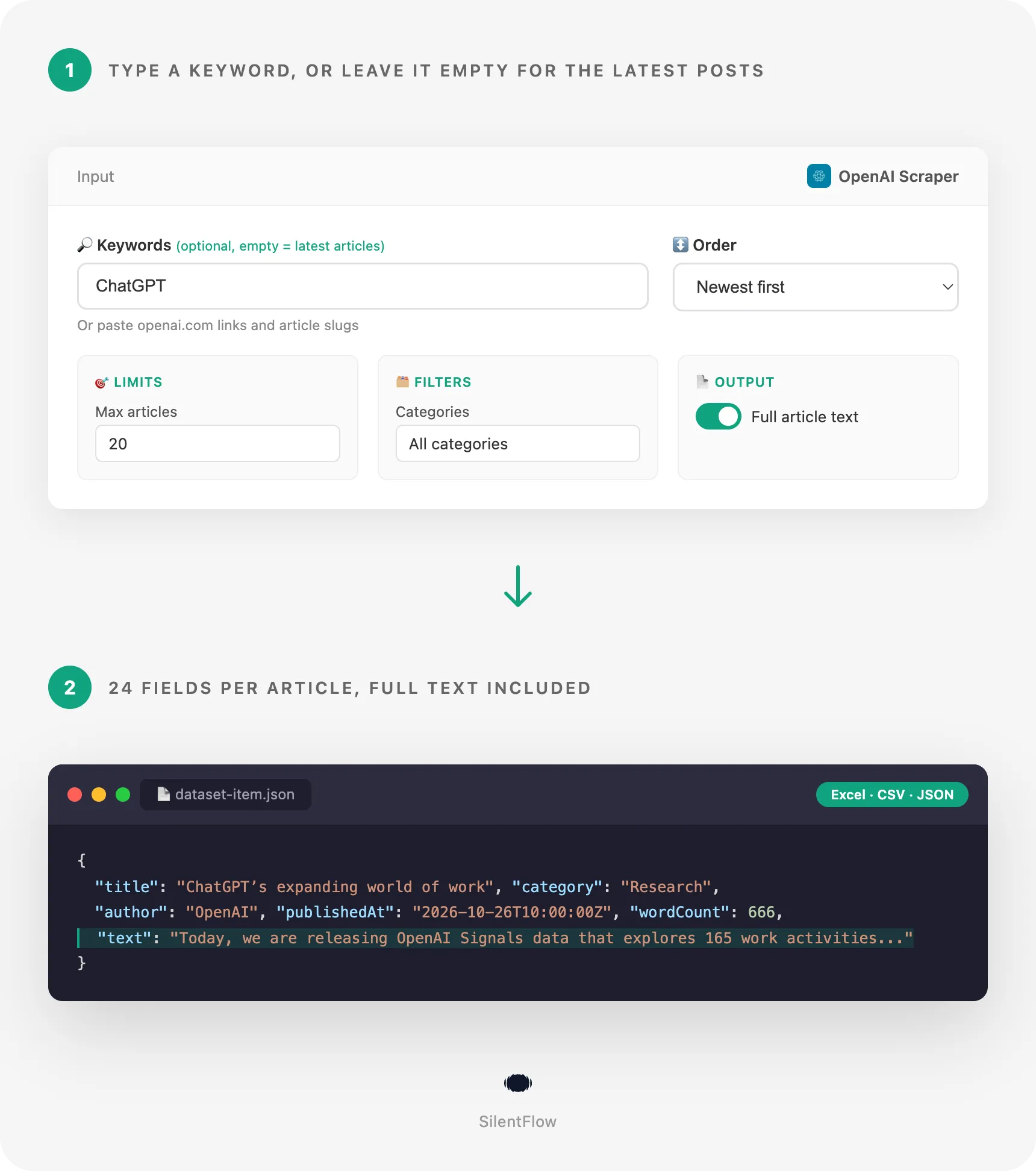
Paste this input into the Input tab (JSON view) and press Start. It is the prefilled input of the form: the 20 newest articles that mention ChatGPT, each with its full text.
Runs of this size fit easily in the Apify Free plan, so you can try the actor on your own keywords before scheduling anything. Each article is one row of the dataset; export it as JSON, CSV, Excel or HTML from the Storage tab, or read it from the API. The Articles view shows the title, category, author, publication date, word count, tags and link at a glance; the Full text view shows the subtitle, reading time, section headings and the text itself.
Copy to your AI assistant
Paste this block into Claude, ChatGPT or Cursor to give it full context about this actor:
How to scrape OpenAI news and research articles
Three inputs, from the simplest to the most targeted. Each one runs as is.
Get the latest OpenAI announcements
An empty input lists the newest articles of every category, newest first. This run returned 50 articles in 11 seconds, from a 30 Oct 2026 policy post back to late September.
Pull every research post published this year
Paste the research section of the newsroom and keep only what came out since January. The section holds 343 articles in total; this input returned the newest 15 in 5 seconds.
Refresh a reading list of specific articles
List the articles you already follow by slug or link. Each comes back with its full text and its listing data (exact publication time, category, cover). This run returned 4 articles in 10 seconds, reported the slug that does not exist, and skipped a link that was not on openai.com.
Input parameters
| Field | Type | Default | What it does |
|---|---|---|---|
searchQueries | array of strings | prefilled ["ChatGPT"] | Keywords searched across every OpenAI article. |
startUrls | array of {url} | none | openai.com links: an article, a newsroom section, the research index or a tag page. |
articleSlugs | array of strings | none | Article slugs (introducing-gpt-6-1-terra, index/sora) or pasted article links. |
maxItems | integer | 50 (prefilled 20) | Maximum number of articles saved by the run, across all inputs. |
categories | array | all | Newsroom categories to keep, for keywords and for the latest-articles list. |
publishedAfter | string | none | Keep articles published on or after a date or within a period. |
sort | string | newest | newest or oldest first. |
includeContent | boolean | true | Open each article for its text, headings, author, links and related articles. |
debugMode | boolean | false | Detailed logs. |
Accepted formats
- Keywords: any word or phrase, as you would type it in the newsroom search (
Codex,system card,model spec,Stargate). - Article links:
https://openai.com/index/{slug}/, business guides underhttps://openai.com/business/..., global affairs posts underhttps://openai.com/global-affairs/.... A language prefix such as/ja-JP/is removed. Old/blog/...and/research/...links are followed to the article they point to today. - Section links:
https://openai.com/news/(every category),/news/company-announcements/,/news/research/,/news/product-releases/,/news/safety-alignment/,/news/engineering/,/news/security/,/news/global-affairs/,/research/index/and itspublication,milestone,releaseandconclusionpages,/business/learn/. - Tag pages:
https://openai.com/news/?tags=system-cards,?tags=gpt,?tags=alignment, any tag shown at the foot of an article. - Slugs: the end of an article link, with or without
index/. A full link pasted here works too. - Dates:
2026-01-01,2026-10-01T08:30:00Z,October 1, 2026, or a period back from today:30 days,7d,2 weeks,6 months,1 year. - Categories:
company,research(research, publications, milestones, releases, conclusions),product,release,publication,safety,security,engineering,global-affairs,ai-adoption,applied-ai,guides(business guides and webinars).
What data can you extract from openai.com?
One row is one article. The 25 fields fall into six groups:
| Group | Fields |
|---|---|
| Identity | id, url, slug, title, subtitle |
| Content | description, text, headings, wordCount, readingTimeMinutes |
| Classification | category, categories, tags, contentType |
| People and time | author, authors, publishedAt |
| Media and links | imageUrl, imageAlt, socialImageUrl, links, relatedArticles, externalUrl, hasAudio |
| Meta | scrapedAt |
A few facts that help when you use the data:
idis OpenAI's own article id and does not change when a title is edited;urlis the permanent article link, without tracking parameters or language prefix.publishedAtis RFC 3339 in UTC. OpenAI gives most posts a time of day; posts dated by day only carryT00:00:00Z.textkeeps the article's paragraphs, list items and section headings in reading order, separated by blank lines. Menus, share and listen buttons, the table of contents, footnotes and the related cards are left out; the related cards are inrelatedArticles.authoris the byline as printed (OpenAI, or names such asRitendra Datta, Karthik Gopalratnamon engineering and research posts);authorssplits it into a list.- Image links point to OpenAI's image host and are the ones the site itself serves.
- System cards published on OpenAI's deployment safety site ship with
contentType: "external", their title, date, category, tags and link, and notext.
Output example
A real row, from the run of 31 Oct 2026:
Advanced usage
Archive every OpenAI article since 2015
Read the whole catalog from the first post onwards. openai.com lists 1,060 articles across 21 categories, the oldest from 11 December 2015, so a cap of 1,100 covers all of them.
Use it once to build a research archive or a retrieval index, then keep it fresh with the weekly recipe below.
Get a weekly digest of launches
Keep only product posts and releases of the last 7 days, and schedule the run every Monday from the Schedules page. Each row carries the full text, ready for a summary or a Slack message.
The date filter stops reading the list as soon as older articles start, so the run only opens this week's posts.
Collect every system card and safety publication
Tag pages turn into lists. This input returns every article tagged System Cards, including the system cards hosted on OpenAI's deployment safety site (those rows carry the link and the metadata, without body text).
Swap the tag for alignment, gpt or any tag printed at the foot of an article.
Build a headline feed for a dashboard
Turn off the full text when only the metadata matters: title, summary, date, category, tags, cover image and link. This run listed 40 security articles in 2 seconds.
Ground an assistant on OpenAI's own words about one topic
Combine several keywords with a date and a category to build a focused corpus, then export the Full text view or the text and headings fields to your vector store.
An article found by two keywords is saved once.
FAQ
What does this actor extract? Every article published on openai.com: news, blog posts, research, product releases, safety and security posts, engineering posts, global affairs, business guides and system cards. One row per article with up to 25 fields, including the full text, section headings, author, category, tags and publication date.
Do I need an OpenAI account or an API key? No. The actor reads the public pages of openai.com. There is nothing to sign in to and nothing to paste besides your keywords, links or slugs.
Which ways can I choose articles? Three, usable together: keywords (searched across every article), openai.com links (an article, a newsroom section, the research index or a tag page) and article slugs. With no input at all, you get the latest articles of every category. Categories, a date and an order then narrow any of them.
How fresh is the data? Live. Each run reads openai.com at the moment it runs, so a new post is in the next run as soon as the newsroom lists it. Schedule the actor daily or weekly to follow new posts.
How many articles can I get?
As many as openai.com lists, 1,060 on 31 Oct 2026, back to December 2015. There is no fixed limit in the actor: maxItems caps the run, across all keywords, links and slugs.
Do filters combine?
Yes. categories, publishedAfter and sort apply together to keywords and to the latest-articles list. For example searchQueries: ["Codex"] with categories: ["engineering"] and publishedAfter: "6 months" returns the engineering posts of the last six months that mention Codex.
Why do some rows have no text?
System cards hosted on OpenAI's deployment safety site are listed by the newsroom but live outside openai.com. They ship with their title, date, category, tags and link, with contentType set to external and no text. If an article page cannot be read during a run, its row still ships with the listing data, and the log says how many.
Is the author always a person?
No. Most posts are signed OpenAI. Engineering and research posts often name their authors, and a few older pages have no byline at all; then author is absent.
Are the links permanent?
url is the permanent article link and id is OpenAI's own article id, both stable over time. Image links are the ones openai.com serves; they last as long as OpenAI keeps the image.
Can I get articles in another language?
The actor reads the English edition of the newsroom. A localized link such as /ja-JP/index/... is read as its English article.
Is it legal to scrape openai.com? The actor reads publicly available articles, the same pages anyone can open in a browser. Read the Legal compliance section below and OpenAI's terms for your use case.
More SilentFlow scrapers
🛒 E-commerce
- JD - JD Products Scraper | JD.com Prices, Brands and Barcodes
- Pinterest - Pinterest Scraper | Pins, Boards and Profiles
- TikTok Shop - TikTok Shop Scraper | Products, Sellers and Creator Videos
- Leboncoin - Leboncoin Scraper | Classified Ads, Prices and Sellers
- Back Market - Back Market Scraper | Refurbished Prices
- Naver - Naver Scraper | Shopping Products, Prices and Reviews
- ImportYeti - ImportYeti Scraper | Suppliers, Importers and Bills of Lading
- Leboncoin - Leboncoin Ad Details Scraper
- Udemy Course - Udemy Course Scraper
- Allegro - Allegro Scraper | Products, Prices and Sellers
- Amazon Seller - Amazon Seller Scraper | Emails, Phones and Ratings
- Naver - Naver Products Scraper | Shopping Prices, Sellers and Ratings
- Naver - Naver Reviews Scraper | Shopping Product Reviews
- 1688 - 1688 Scraper | Products, Reviews, Details, Wholesale Prices
- Coupang - Coupang Detail Scraper | Product Prices and Options
- Store Leads Ecommerce - Store Leads Ecommerce Scraper
- Store Leads - Store Leads Scraper | Shopify Data
- Avito - Avito Scraper | Listings, Prices and Sellers
- Lowes - Lowes Products Scraper | Prices, Stock and Specs
- Pinterest - Pinterest Scraper
- Taobao - Taobao Scraper | Products, Details, Prices and Sellers
- Bring a Trailer - Bring a Trailer Scraper
- Eventim - Eventim Scraper | Events, Ticket Prices and Venues
- Leboncoin - Leboncoin Scraper
- Mobile.de - Mobile.de Scraper
- Alibaba - Alibaba Products Scraper | Wholesale Prices and MOQ
- Avito - Avito Profiles Scraper | Sellers, Ratings and Reviews
- Leboncoin - Leboncoin Details Scraper | Full Ad Data and Sellers
- Udemy - Udemy Scraper
- Vinted Marketplace - Vinted Marketplace Scraper
- Agoda - Agoda Scraper | Hotel Prices and Guest Ratings
- Alibaba - Alibaba Scraper | Products, Supplier Companies and Prices
- AliExpress - AliExpress Reviews Scraper | Feedback, Ratings and Photos
- AliExpress - AliExpress Scraper | Products, Prices and Sales
- Back Market - Back Market Scraper | Refurbished Electronics Prices
- BAUHAUS - BAUHAUS Scraper | Product Prices, EAN and Specs
- CARFAX - CARFAX Scraper | Used Cars, Prices and History
- Che168 - Che168 Scraper | Used Car Listings and Prices
- Coles - Coles Products Scraper | Prices, Specials and Nutrition
- eBay Marketplace - eBay Marketplace Scraper
- Europages - Europages Scraper | Suppliers and B2B Companies
- Google Hotels - Google Hotels Scraper | Prices, Offers and Ratings
- Homedepot - Homedepot Reviews Scraper | Customer Reviews and Ratings
- Judge - Judge Scraper | Reviews, Ratings and Store Profiles
- Keepa - Keepa Scraper | Amazon Price History and Offers
- MakersRow - MakersRow Scraper | Manufacturers, Capabilities and Reviews
- Mercari - Mercari Scraper | Listings, Sold Prices and Sellers
- RA - RA Scraper | Events, Lineups and Tickets
- Sahibinden - Sahibinden Scraper | Real Estate and Car Listings
- Ticombo - Ticombo Scraper | Ticket Prices and Listings
- Trip - Trip Scraper | Hotels, Prices and Reviews
- VividSeats - VividSeats Scraper | Tickets, Prices and Events
- Walmart - Walmart Scraper | Prices, Reviews, Sellers, Availability
- Webmotors - Webmotors Scraper | Car Listings, Prices and FIPE
- Woolworths - Woolworths Products Scraper | Prices, Specials and Nutrition
- Amazon - Amazon Product Scraper
- Amazon Marketplace - Amazon Marketplace Scraper
- AutoScout24 - AutoScout24 Scraper
- eBay Listings - eBay Listings Scraper
- Europages Deep Dive Extractor - Europages Deep Dive Extractor | VAT, Decision Makers, ISO Certs
- GasBuddy - GasBuddy Scraper | Gas Prices by Station
- Goofish - Goofish Detail Scraper | Listings, Prices and Sellers
- Mafengwo - Mafengwo Scraper | Attractions, Ratings and Tickets
- Vinted - Vinted Scraper
- Walmart - Walmart Product Scraper
💼 Jobs
- ZipRecruiter - ZipRecruiter Jobs Scraper | Salary, Company & Location Filters
- Jobright - Jobright Scraper | Jobs, Salaries and H1B Sponsors
- Multi Board - Multi Board Job Scraper
- Indeed - Indeed Company Reviews Scraper
- Malt Freelancer - Malt Freelancer Scraper
- Glassdoor - Glassdoor Jobs Scraper
- Malt - Malt Scraper | Freelance Profiles
- Glassdoor Job Listings - Glassdoor Job Listings Scraper
- Jora - Jora Jobs Scraper
- LinkedIn Job Search - LinkedIn Job Search Scraper | Salaries & Seniority
- 🔥 Glassdoor - 🔥 Glassdoor Scraper
- ATS - ATS Jobs Scraper | Greenhouse, Lever and Ashby
- Dice - Dice Jobs Scraper | US Tech Jobs, Salaries, Skills
- Dice Tech - Dice Tech Jobs Scraper
- Gupy - Gupy Jobs Scraper | Brazil Jobs and Employers
- iimjobs - iimjobs Jobs Scraper | MBA, Finance and Hirist Tech Jobs
- Instahyre - Instahyre Jobs Scraper | Companies, Recruiters and Ratings
- Jora - Jora Scraper | Jobs in Australia, New Zealand, Singapore
- StepStone - StepStone Scraper
- Welcome to the Jungle - Welcome to the Jungle Job Scraper
- YCombinator - YCombinator Jobs Scraper | Startup Jobs, Salaries and Founders
- Zhaopin - Zhaopin Scraper | Jobs, Salaries and Companies
- All - All Jobs Scraper
- Arbeitsagentur - Arbeitsagentur Scraper | German and Austrian Job Board
- Arbeitsagentur - Arbeitsagentur Jobs Scraper
- Cutshort - Cutshort Jobs Scraper | Salaries, Skills and Companies
- iimjobs - iimjobs Scraper | Jobs, Companies and Recruiters
- Indeed - Indeed Companies Scraper | Reviews, Salaries, Interviews
- Indeed - Indeed Jobs Scraper | NLP Skills
- Indeed - Indeed Jobs Scraper | Job Listings in 73 Countries
- LinkedIn - LinkedIn Jobs Scraper
- Naukri & NaukriGulf - Naukri & NaukriGulf Jobs Scraper
- Seek - Seek Job Scraper
- Welcome to the Jungle - Welcome to the Jungle Scraper | Jobs and Company Data
- Ziprecruiter - Ziprecruiter Scraper
🏠 Real estate
- SeLoger - SeLoger Scraper | Real Estate Listings
- Realtor Rental Listings - Realtor Rental Listings Scraper
- Airbnb Professional Host - Airbnb Professional Host Scraper | Emails, Phones, SIRET
- Airbnb Pro Host Contact & - Airbnb Pro Host Contact & Email Scraper
- Bien'ici - Bien'ici Scraper | Property Listings
- Idealista - Idealista Scraper
- SeLoger - SeLoger Scraper | French Property Listings and Agencies
- Trulia Rental Listings - Trulia Rental Listings Scraper
- Realestate.com.au - Realestate.com.au Scraper
- Rightmove - Rightmove Scraper
- Bienici - Bienici Scraper
- Domclick - Domclick Scraper | Real Estate Listings
- Realtor - Realtor Detail Scraper | Property Details and Price History
- Zapimoveis - Zapimoveis Scraper | Real Estate Listings and Prices
- Zillow - Zillow Scraper
- Airbnb Search - Airbnb Search Scraper | Prices, Fees, Amenities, Hosts
- Airbnb Search - Airbnb Search Scraper
- Anjuke - Anjuke Scraper | Rental Listings, Prices and Agents
- Idealista - Idealista Scraper
- Realtor Rental - Realtor Rental Scraper
- Trulia Rental - Trulia Rental Scraper | US Rentals, Prices, Pet Policy
📣 Social media
- Facebook Search - Facebook Search Scraper
- LinkedIn Post Search - LinkedIn Post Search Scraper | Keywords, Hashtags & Profiles
- Instagram - Instagram Story Scraper | Stories & Highlights
- Facebook Search - Facebook Search Profiles Scraper | People by Name or Keyword
- LinkedIn Leads - LinkedIn Leads Scraper | Sales Navigator Export
- TikTok Trend - TikTok Trend Scraper | Trending Hashtags and Videos
- YouTube - YouTube Channel Scraper | Videos, Shorts and Views
- Reddit - Reddit Scraper | Posts, Comments and Subreddits
- TikTok Creative - TikTok Creative Ads Scraper | Top Ads, Landing Pages & Metrics
- TikTok - TikTok Scraper
- LinkedIn Sales Navigator - LinkedIn Sales Navigator Scraper
- Pinterest - Pinterest Ads Scraper | Ad Library, Reach & Targeting
- Snapchat - Snapchat Videos Scraper | Spotlight Videos, MP4 and Stats
- Discord - Discord Profiles Scraper | Users, Badges and Server Tags
- Discord - Discord Scraper | Servers, Member Counts and Invites
- Kwai - Kwai Scraper | Videos, Creators and Hashtags
- Likee - Likee Scraper | Videos, Hashtags and Creators
- LinkedIn Event - LinkedIn Event Scraper
- LinkedIn Hashtag & - LinkedIn Hashtag & Post Scraper | No Cookies
- LinkedIn People Search - LinkedIn People Search Scraper | Profiles & Companies
- Meta Ad Library - Meta Ad Library Scraper
- Snapchat - Snapchat Contacts Scraper | Phones, Emails and Websites
- TwitchTracker - TwitchTracker Scraper | Twitch Streamer Stats and Rankings
- Bandsintown - Bandsintown Scraper | Concerts and Tour Dates
- Bilibili - Bilibili Scraper | Videos, Profiles, Comments, Danmaku
- Facebook Business Page - Facebook Business Page Scraper
- Facebook Thread - Facebook Thread Profiles Scraper | Followers, Bios & Engagement
- Instagram Engagement - Instagram Engagement Scraper
- Kuaishou - Kuaishou Scraper | Videos, Comments and Creator Stats
- LinkedIn Ads Library - No Cookies - LinkedIn Ads Library Scraper - No Cookies
- OnlyFans - OnlyFans Profile Scraper
- Pinterest - Pinterest Profiles Scraper | Followers, Emails and Bios
- Pinterest - Pinterest Videos Scraper | Video Downloader, MP4 Links, Stats
- Reddit - Reddit Comments Scraper | Search, Threads and Replies
- Reddit - Reddit Profiles Scraper | User Karma, Activity and Communities
- RedNote - RedNote Videos Scraper | Downloader, Transcripts and Stats
- TikTok Lookalike - TikTok Lookalike Scraper | Influencers, Emails and Engagement
- Xigua - Xigua Scraper | Videos, Creators and Downloads
- YouTube Autocomplete - YouTube Autocomplete Scraper | Keyword Suggestions
- Douyin - Douyin Comments Scraper | Comments, Likes and IP Regions
- Facebook - Facebook Company Scraper | Emails, Phones, Ratings
- OnlyFans - OnlyFans Creator Scraper
- Reddit - Reddit Scraper | Comments, Posts and Users
- RedNote - RedNote Detail Scraper | Xiaohongshu Details, Images, Videos
- Skool Group - Skool Group Scraper
- Skool Community - Skool Community Scraper
- Snapchat - Snapchat Ads Scraper | Ad Library, Impressions & Targeting
- Weibo - Weibo Scraper | Posts, Profiles and Engagement
- X Timeline - X Timeline Scraper | Tweets and Engagement Stats
- YouTube - YouTube Transcript Scraper
🏢 Business data
- LinkedIn Company Search - LinkedIn Company Search Scraper | Profiles & Firmographics
- Ctrip - Ctrip Scraper | Attractions, Tickets and Reviews
- Teachable Course - Teachable Course Scraper
- Website Tech Stack - Website Tech Stack Scraper
- Teachable - Courses, Prices & Instructors - Teachable Scraper - Courses, Prices & Instructors
- Trustpilot - Trustpilot Scraper | Reviews, Ratings and Company Contacts
✈️ Travel
- Tencent - Tencent Scraper | Maps Places, Phones and Ratings
- Flight Price - Flight Price Scraper
- Zomato - Zomato Reviews Scraper | Restaurant Ratings and Replies
- 2GIS - 2GIS Reviews Scraper | Ratings, Photos and Owner Replies
- Booking.com Hotel - Booking.com Hotel Scraper
- Despegar - Despegar Reviews Scraper | Hotel Reviews and Ratings
- Google Maps - Google Maps Scraper
- Kakao - Kakao Scraper | Map Places, Reviews and Phones
- OpenTable - OpenTable Reviews Scraper | Restaurant Reviews and Ratings
- TheFork - TheFork Scraper | Restaurants, Menus and Ratings
- Viator - Viator Reviews Scraper | Tour Reviews and Ratings
- Booking - Booking Scraper | Hotel Prices, Photos, Availability
- Trip - Trip Reviews Scraper | Hotel Reviews and Ratings
🎯 Lead generation
- Northdata - Northdata Company Scraper
- Dealroom - Dealroom Scraper | Companies and Investors
- ZocDoc - ZocDoc Scraper | Doctors, Reviews and Availability
- BuiltWith - BuiltWith Scraper | Tech Stacks and Top Sites
- PagesJaunes - PagesJaunes Scraper | French Business Emails and SIRET
- UK Companies House - UK Companies House Enricher
- CNPJ Brazilian - CNPJ Brazilian Company Enricher
- Justdial - Justdial Companies Scraper | Business Leads, Phones and Emails
- PagesJaunes - PagesJaunes Business Scraper
- SIRET - SIRET Company Enricher
- ThomasNet Suppliers - ThomasNet Suppliers Scraper
- Company Data - Company Data Scraper | Emails, Phones and Tech Stack
- Dealroom Startup Data - Dealroom Startup Data Scraper
- Delaware - Delaware Scraper | Corporations, LLCs and Registered Agents
- French Company Prospector - French Company Prospector
- G2 - G2 Reviews Scraper
- Pappers - Pappers Scraper | French Companies, Directors & Financials
- SEC - SEC Scraper | EDGAR Filings and Company Data
- SoftwareAdvice - SoftwareAdvice Scraper | Reviews, Ratings and Pros & Cons
- Sunbiz - Sunbiz Companies Scraper | New Florida Business Leads
- Sunbiz - Sunbiz Scraper | Florida Companies and Officers
- USPTO - USPTO Scraper | Trademark Search and Status
- Clutch - Clutch Scraper | Agencies, Reviews, Ratings, Services
- Clutch Agency - Clutch Agency Scraper
- Domain - Domain Enricher
- Google Ads Transparency - Google Ads Transparency Scraper
- KVK - KVK Scraper | Dutch Companies and SBI Codes
- SIRET French - SIRET French Company Enricher
- ZocDoc - ZocDoc Scraper
🔎 SEO
- Similarweb - Similarweb Scraper | Website Traffic, Rankings and Competitors
- Scribd - Scribd Scraper | Documents, Authors and Views
- SpyFu - SpyFu Scraper | SEO, PPC and Competitor Data
- Apple - Apple Reviews Scraper | App Store Reviews and Ratings
- Apple - Apple Scraper | App Store Apps, Ratings and Charts
- Bing - Bing Enricher Scraper | Mobile Friendly Test and Indexing
- Google News - Google News Scraper
- Yandexsearch - Yandexsearch Scraper | Search Results and Rankings
📈 Marketing
🎬 Video
📰 News
- ForexFactory - ForexFactory Scraper | Economic Calendar and Forecasts
🧰 More tools
- PrizePicks - PrizePicks Scraper | Player Props, Lines and Projections
- Maersk - Maersk Scraper | Vessel Schedules and Port Calls
- FanDuel - FanDuel Scraper | Odds, Spreads and Player Props
Support
Need something this scraper doesn't do yet? We ship features fast.
- Feature requests go straight to our backlog
- Enterprise needs? We do custom integrations and high-volume plans
- Pricing questions? Check the Monetization tab on the actor page
Response time: usually under 24 hours.
Legal compliance
This actor extracts publicly available articles from openai.com. It does not bypass any login, paywall or CAPTCHA. Users are responsible for complying with OpenAI's terms of use and applicable data protection laws (GDPR, CCPA, and PIPL where relevant). Rows can contain the names of article authors as printed in the byline: handle them accordingly. Article texts are OpenAI's copyrighted content; quote, summarize and index them within the limits of fair use and your own agreements. The data returned is informational: check the original article before relying on a figure it quotes.
Built by SilentFlow for analysts, editors and AI teams who would rather read what OpenAI ships than copy it.


