

Bloomberg Scraper | News Articles and Full Text
Pricing
from $0.64 / 1,000 articles
Bloomberg Scraper | News Articles and Full Text
Bloomberg scraper for news articles by keyword, ticker, section, topic or date. Each article comes with its full text, AI summary, authors, brand, tickers, companies, topics, publish times, lead image and audio link. 20 articles in 6 seconds, 27 fields each, in 2026. No Bloomberg account needed.
Pricing
from $0.64 / 1,000 articles
Rating
0.0
(0)
Developer

SilentFlow
Maintained by CommunityActor stats
0
Bookmarked
2
Total users
1
Monthly active users
18 hours ago
Last modified
Features
Share
Bloomberg News Scraper | Articles, Full Text, AI Summaries and Tickers by Keyword, Section or Date (2026)
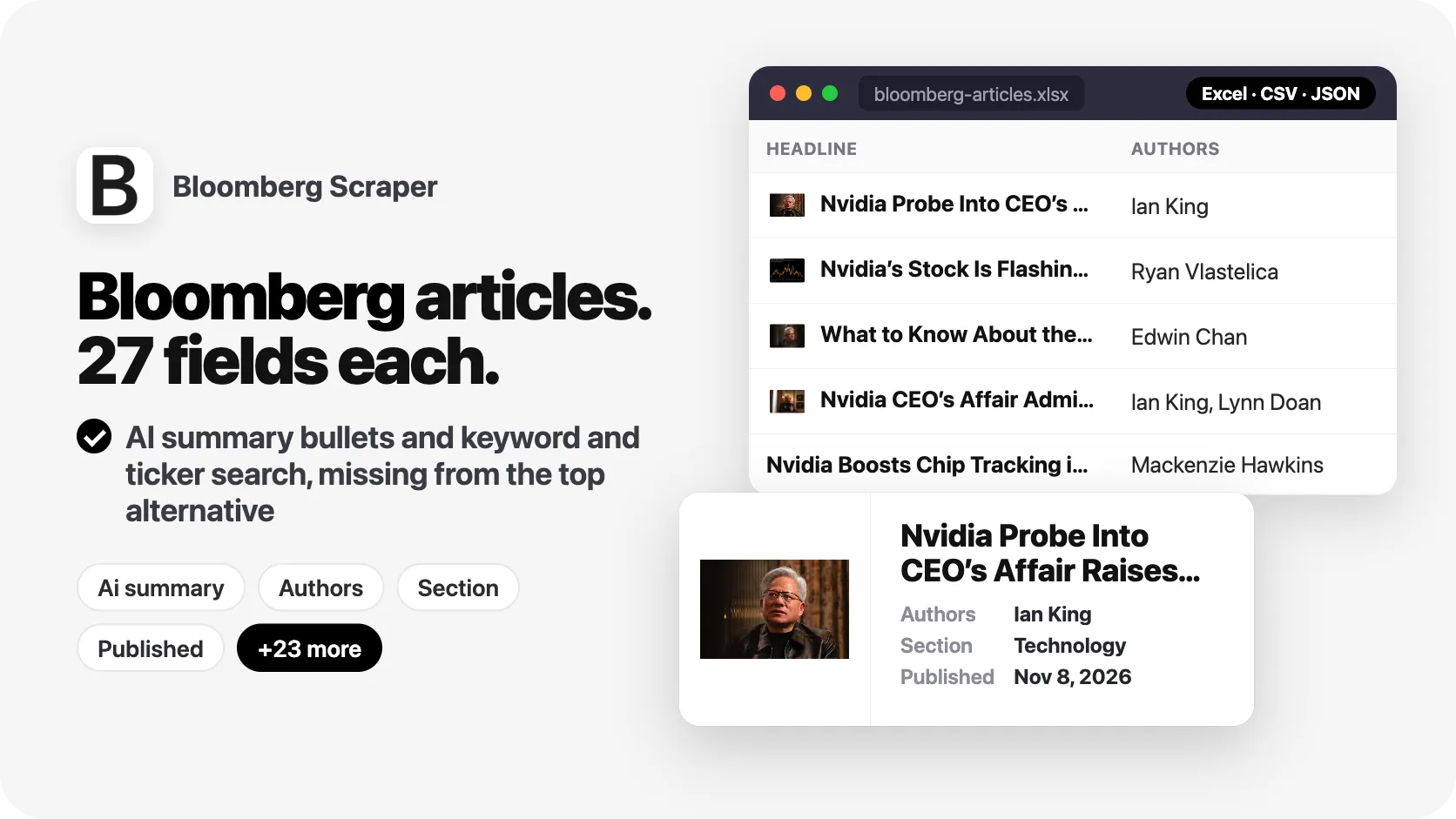
From SilentFlow. Creators of Facebook Search Scraper and JD Products Scraper (#1 for “jd scraper” in Apify Store search), with 940,000+ combined lifetime runs.
Turn Bloomberg news into a clean dataset: find articles by keyword, ticker, section, topic, link or date, and get each one read in full with its authors, times, tickers and topics. 20 articles in 7 seconds in our test.
Why choose this actor?
Still pasting Bloomberg links into a spreadsheet one by one? Need every story about a company, but only have a ticker? Want last month's coverage of a theme for a backtest, not just today's front page?
- Search Bloomberg by keyword or ticker, no links needed. Type
nvidia,TSLA:USorfederal reserveand the actor finds the stories for you. In our test, Bloomberg's search returned 21 readable articles for "nvidia" and the actor read 20 of them in full in 7 seconds. - Pull a whole date window from the archive. Set a start and end date and leave everything else empty: the actor reads every Bloomberg article published in that window, newest first. For 1 to 3 October 2026 it listed 640 articles; the archive goes back to 1991 and holds about 7,000 articles a month.
- Get the gist and the audio, not just the text. Bloomberg's AI summary bullets came back on 16 of 20 rows of our keyword test, and the audio narration link on 19 of 20, so you can triage, quote or listen without opening a single page. Section fronts work the same way: pick Markets, Technology, Crypto or any of 19 sections.

Try your first article
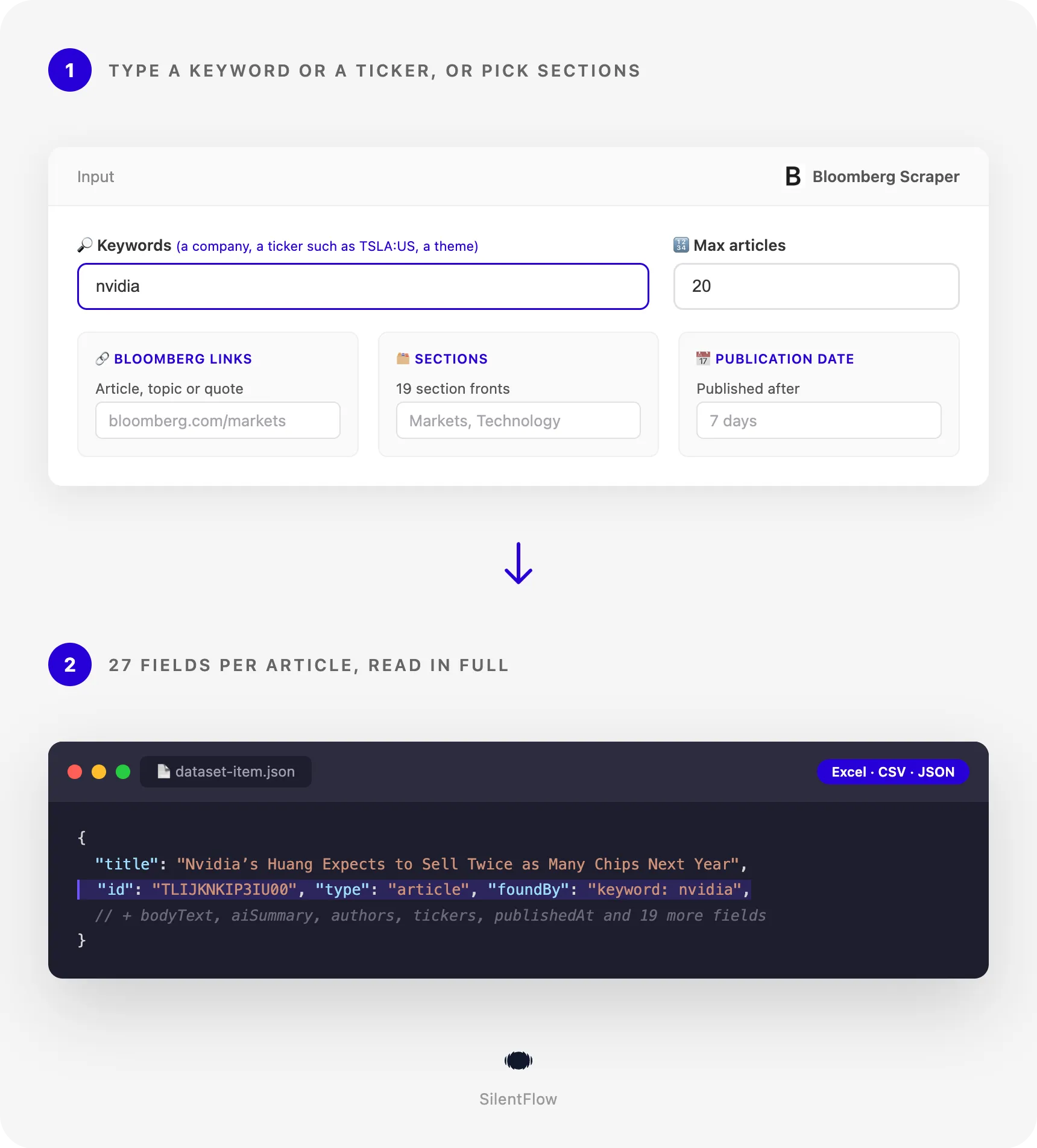
Paste this input and press Start. It searches Bloomberg for "nvidia" and reads the 20 most relevant articles in full.
The Apify Free plan is enough to try it: a run like this one finishes in seconds and gives you a table you can download as JSON, CSV or Excel.
Copy to your AI assistant
Paste this block into Claude, ChatGPT or Cursor so it knows how to use this actor:
How to scrape Bloomberg news articles
Get every Bloomberg story about a company
One keyword, the stories Bloomberg ranks most relevant, each read in full.
Follow the Markets and Technology fronts
Pick sections from the list. Each section gives the stories Bloomberg shows on that front today, from about 15 on Deals to over 100 on India. In our test, Markets listed 34 articles.
Track several tickers over the last week
Keywords and tickers combine with a date window: only the articles published in the last 7 days are kept.
Input parameters
| Parameter | Type | Default | What it does |
|---|---|---|---|
searchQueries | array of strings | none (prefilled with nvidia) | Keywords, company names, people or tickers. Bloomberg returns its 25 most relevant stories per keyword. |
startUrls | array of links | none | Bloomberg article links, section fronts, topic pages and quote pages. |
sections | array of section names | none | Section fronts to read, from Latest to Work Shift (19 in total). |
dateFrom | date or span | none | Keep articles published on or after this day, such as 2026-10-01 or 7 days. |
dateTo | date or span | none | Keep articles published on or before this day, included. |
maxItems | integer | 100 | Total articles for the run, across every keyword, link, section and date. |
Links the actor understands
- Articles:
https://www.bloomberg.com/news/articles/...,/news/features/...,/opinion/articles/...,/news/newsletters/.... Tracking parameters such as?srnd=are dropped. - Section fronts:
https://www.bloomberg.com/markets,/technology,/ai,/crypto,/markets/fixed-incomeand every other section of the list. - Topic pages:
https://www.bloomberg.com/topics/hedge-funds,/topics/artificial-intelligence. A topic gives about 40 stories, the articles among them are read. - Quote pages:
https://www.bloomberg.com/quote/NVDA:USis read as a search for that ticker. - Video and podcast pages have no text to read: the run log names them and moves on.
Dates
dateFrom and dateTo take a day (2026-10-01), a full timestamp, or a span back from now (24 hours, 7 days, 3 months, 1 year). Times are UTC. With a keyword, link or section, the dates filter what those sources list. With dates alone, the actor reads the archive of that window, newest first, as deep as maxItems allows.
What data can you extract from Bloomberg?
Every row is one article, with 28 fields grouped the way you read a story:
- Identity:
id(Bloomberg's own story id, stable across runs and the best key to de-duplicate),url(the permanent article link),title,type(article, feature, opinion or newsletter). - Content:
summary(the dek when Bloomberg gives one),aiSummary(Bloomberg's AI summary bullets),bodyText(the full text, one paragraph per block, sub-headings and list items kept),section,brand,topics. - Markets:
tickers(every Bloomberg ticker attached to the story),companies(each listed company the text links to, with its ticker and name),contentTags(Bloomberg's subject tags: companies, people, places, topics and commodities, each with a relevance score, highest first). - Authors:
bylineas printed, andauthorssplit into names. - Measures:
wordCount,audioDurationSeconds. - Time and place:
publishedAt,updatedAtin RFC 3339 UTC,regionwhere the story was written (AMER, EMEA, APAC or Global). - Media:
imageUrlof the lead picture (or the first picture of the story),imageCaption,imageCredit,audioUrlof the narrated version. - Meta:
isPremium,hasFullText,foundBy(which keyword, section, topic, link or archive found the row),scrapedAt.
Absent values are null, never an empty string, so filters and joins behave.
Output example
Text fields are shortened here.
Two views are ready in the dataset: Articles (headline, authors, section, published, words, tickers, link) and Full text (headline, summary, AI summary, article text, topics, link).
Advanced usage
Build a dated corpus for a backtest
Dates alone read the archive. This pulls up to 2,000 articles of the third quarter of 2026, newest first, with their text, tickers and tags, ready for sentiment or event studies.
Watch a portfolio every morning
Schedule this input daily in Apify. Each run keeps only the last 24 hours, so you get the fresh Bloomberg coverage of your holdings and nothing twice from the window.
Feed a headline channel from section fronts
Read the Latest front with Markets and Crypto, and send the dataset to Slack, a Google Sheet or your BI tool with an Apify integration. Stories listed by two sections are delivered once.
Mix links, topics and keywords in one run
Paste a few articles you already have, add a topic page and a theme keyword. Every source is read in order and the run total stays at maxItems.
Ground an AI assistant in Bloomberg's coverage of a theme
Pull a month of one topic, then chunk bodyText by paragraph and keep aiSummary, tickers and publishedAt as metadata in your vector store.
FAQ
What does this actor extract from Bloomberg? News articles. Each row has the headline, the full text, Bloomberg's AI summary bullets when the story has them, authors, publish and update times, section, topics, tickers, the companies the text links to, subject tags, word count, the lead picture with its caption and credit, and the narrated audio link.
Do I need a Bloomberg account or a Terminal? No. The actor reads what Bloomberg serves to any reader, without signing in. It does not give Terminal data such as prices or filings: it is a news actor.
What about subscriber-only stories?
Some Bloomberg stories, mostly paid newsletters, are reserved for subscribers. The actor respects that: their row still ships with the headline, authors, times, topics and tickers, with isPremium: true, and bodyText and aiSummary left null. In our 30-article archive test, 1 story was subscriber-only and 29 came with their full text.
How many articles does a keyword give? Bloomberg's search returns its 25 most relevant stories per keyword, recent ones first; videos among them are skipped, so expect 15 to 25 articles (21 for "nvidia" and 16 for "TSLA:US" in our tests). For more depth, add related keywords and tickers, or use a date window, which reads the full archive.
How far back can I go?
To 1991. A date window with no keyword reads every article published in it, newest first, about 7,000 a month (7,053 in October 2026). Set maxItems to the volume you need.
Can I run several keywords, sections and links at once?
Yes. All sources run in one go, in the order links, keywords, sections. An article found by two sources is delivered once, and maxItems is the total for the run.
How fresh is the data?
Every run reads Bloomberg live. Section fronts change through the day; updatedAt tells you when a story was last edited, and id is Bloomberg's own story id, so you can match a story across runs and update its row instead of adding a second one.
Which links stay valid?
url is Bloomberg's permanent article address. imageUrl and audioUrl point to files in Bloomberg's media library, which Bloomberg controls: if you archive results, keep your own copy of the media you need.
Why is section or summary sometimes null?
Bloomberg does not set them on every story. Rows found from a section front or a topic page carry the section label and dek that page shows; rows found by keyword or link carry what the story itself gives.
What is Bloomberg? Bloomberg is a global business and financial news organization, publishing several thousand stories a month on markets, companies, economics, politics, technology and wealth, alongside its Businessweek, Green, CityLab and Pursuits brands.
More SilentFlow scrapers
🛒 E-commerce
- JD - JD Products Scraper | JD.com Prices, Brands and Barcodes
- Pinterest - Pinterest Scraper | Pins, Boards and Profiles
- Udemy Course - Udemy Course Scraper
- TikTok Shop - TikTok Shop Scraper | Products, Sellers and Creator Videos
- Leboncoin - Leboncoin Scraper | Classified Ads, Prices and Sellers
- Back Market - Back Market Scraper | Refurbished Prices
- Leboncoin - Leboncoin Ad Details Scraper
- Naver - Naver Scraper | Shopping Products, Prices and Reviews
- Allegro - Allegro Scraper | Products, Prices and Sellers
- ImportYeti - ImportYeti Scraper | Suppliers, Importers and Bills of Lading
- Naver - Naver Reviews Scraper | Shopping Product Reviews
- Keepa - Keepa Scraper | Amazon Price History and Offers
- Amazon Seller - Amazon Seller Scraper | Emails, Phones and Ratings
- Coupang - Coupang Detail Scraper | Product Prices and Options
- Naver - Naver Products Scraper | Shopping Prices, Sellers and Ratings
- 1688 - 1688 Scraper | Products, Reviews, Details, Wholesale Prices
- Taobao - Taobao Scraper | Products, Details, Prices and Sellers
- Avito - Avito Scraper | Listings, Prices and Sellers
- Pinterest - Pinterest Scraper
- Store Leads Ecommerce - Store Leads Ecommerce Scraper
- Store Leads - Store Leads Scraper | Shopify Data
- Bring a Trailer - Bring a Trailer Scraper
- Ctrip - Ctrip Scraper | Attractions, Tickets and Reviews
- Eventim - Eventim Scraper | Events, Ticket Prices and Venues
- Leboncoin - Leboncoin Scraper
- 1688 - 1688 Reviews Scraper | Ratings, Buyer Photos and Variants
- Alibaba - Alibaba Products Scraper | Wholesale Prices and MOQ
- Alibaba - Alibaba Scraper | Products, Supplier Companies and Prices
- Avito - Avito Profiles Scraper | Sellers, Ratings and Reviews
- Back Market - Back Market Scraper | Refurbished Electronics Prices
- CARFAX - CARFAX Scraper | Used Cars, Prices and History
- Che168 - Che168 Scraper | Used Car Listings and Prices
- GasBuddy - GasBuddy Scraper | Gas Prices by Station
- Leboncoin - Leboncoin Details Scraper | Full Ad Data and Sellers
- Lowes - Lowes Products Scraper | Prices, Stock and Specs
- Mobile.de - Mobile.de Scraper
- Udemy - Udemy Scraper
- Vinted Marketplace - Vinted Marketplace Scraper
- Acquire - Acquire Scraper | Startups for Sale & Prices
- Agoda - Agoda Scraper | Hotel Prices and Guest Ratings
- AliExpress - AliExpress Reviews Scraper | Feedback, Ratings and Photos
- AliExpress - AliExpress Scraper | Products, Prices and Sales
- Apple - Apple Scraper | App Store Apps, Ratings and Charts
- BAUHAUS - BAUHAUS Scraper | Product Prices, EAN and Specs
- Coles - Coles Products Scraper | Prices, Specials and Nutrition
- eBay Marketplace - eBay Marketplace Scraper
- Europages - Europages Scraper | Suppliers and B2B Companies
- GetYourGuide - GetYourGuide Scraper | Tours, Activities, Prices & Reviews
- Goofish - Goofish Detail Scraper | Listings, Prices and Sellers
- Google Hotels - Google Hotels Scraper | Prices, Offers and Ratings
- Homedepot - Homedepot Reviews Scraper | Customer Reviews and Ratings
- Judge - Judge Scraper | Reviews, Ratings and Store Profiles
- MakersRow - MakersRow Scraper | Manufacturers, Capabilities and Reviews
- OfferUp - OfferUp Scraper | Listings, Prices and Sellers
- OLX - OLX Scraper | Brazil Listings, Prices and Sellers
- RA - RA Scraper | Events, Lineups and Tickets
- Sahibinden - Sahibinden Scraper | Real Estate and Car Listings
- TickPick - TickPick Scraper | Ticket Prices and Events
- Ticombo - Ticombo Scraper | Ticket Prices and Listings
- Trip - Trip Scraper | Hotels, Prices and Reviews
- Uniqlo - Uniqlo Scraper | Products, Prices and Stock
- VividSeats - VividSeats Scraper | Tickets, Prices and Events
- Walmart - Walmart Scraper | Prices, Reviews, Sellers, Availability
- Webmotors - Webmotors Scraper | Car Listings, Prices and FIPE
- Wildberries - Wildberries Detail Scraper | Product Data, Prices & Sellers
- Woolworths - Woolworths Products Scraper | Prices, Specials and Nutrition
- YandexMarket - YandexMarket Scraper | Products, Prices and Sellers
- Zap - Zap Scraper | Prices and Store Offers
- Amazon - Amazon Product Scraper
- Amazon Marketplace - Amazon Marketplace Scraper
- AutoScout24 - AutoScout24 Scraper
- Carousell - Carousell Scraper | Listings, Prices and Sellers
- eBay Listings - eBay Listings Scraper
- Europages Deep Dive Extractor - Europages Deep Dive Extractor | VAT, Decision Makers, ISO Certs
- Mercari - Mercari Scraper | Listings, Sold Prices and Sellers
- Vinted - Vinted Scraper
- Walmart - Walmart Product Scraper
💼 Jobs
- ZipRecruiter - ZipRecruiter Jobs Scraper | Salary, Company & Location Filters
- Jobright - Jobright Scraper | Jobs, Salaries and H1B Sponsors
- Multi Board - Multi Board Job Scraper
- Malt Freelancer - Malt Freelancer Scraper
- Glassdoor Job Listings - Glassdoor Job Listings Scraper
- Indeed - Indeed Company Reviews Scraper
- Glassdoor - Glassdoor Jobs Scraper
- Jora - Jora Jobs Scraper
- LinkedIn Job Search - LinkedIn Job Search Scraper | Salaries & Seniority
- Malt - Malt Scraper | Freelance Profiles
- Cutshort - Cutshort Jobs Scraper | Salaries, Skills and Companies
- Dice - Dice Jobs Scraper | US Tech Jobs, Salaries, Skills
- Dice Tech - Dice Tech Jobs Scraper
- Francetravail - Francetravail Scraper | Job Offers and Salaries
- Freelancermap - Freelancermap Scraper | Projects, Skills and Companies
- 🔥 Glassdoor - 🔥 Glassdoor Scraper
- Gupy - Gupy Jobs Scraper | Brazil Jobs and Employers
- iimjobs - iimjobs Jobs Scraper | MBA, Finance and Hirist Tech Jobs
- Indeed - Indeed Companies Scraper | Reviews, Salaries, Interviews
- Instahyre - Instahyre Jobs Scraper | Companies, Recruiters and Ratings
- Jora - Jora Scraper | Jobs in Australia, New Zealand, Singapore
- Kununu - Kununu Reviews Scraper | Employee Ratings and Interviews
- Naukri & NaukriGulf - Naukri & NaukriGulf Jobs Scraper
- StepStone - StepStone Scraper
- Welcome to the Jungle - Welcome to the Jungle Job Scraper
- YCombinator - YCombinator Jobs Scraper | Startup Jobs, Salaries and Founders
- All - All Jobs Scraper
- Arbeitsagentur - Arbeitsagentur Scraper | German and Austrian Job Board
- Arbeitsagentur - Arbeitsagentur Jobs Scraper
- ATS - ATS Jobs Scraper | Greenhouse, Lever and Ashby
- iimjobs - iimjobs Scraper | Jobs, Companies and Recruiters
- Indeed - Indeed Jobs Scraper | NLP Skills
- Indeed - Indeed Jobs Scraper | Job Listings in 73 Countries
- LinkedIn - LinkedIn Jobs Scraper
- Seek - Seek Job Scraper
- Welcome to the Jungle - Welcome to the Jungle Scraper | Jobs and Company Data
- Zhaopin - Zhaopin Scraper | Jobs, Salaries and Companies
- Ziprecruiter - Ziprecruiter Scraper
🏠 Real estate
- SeLoger - SeLoger Scraper | Real Estate Listings
- Realtor Rental Listings - Realtor Rental Listings Scraper
- Airbnb Pro Host Contact & - Airbnb Pro Host Contact & Email Scraper
- Airbnb Professional Host - Airbnb Professional Host Scraper | Emails, Phones, SIRET
- Bien'ici - Bien'ici Scraper | Property Listings
- Idealista - Idealista Scraper
- Realestate.com.au - Realestate.com.au Scraper
- SeLoger - SeLoger Scraper | French Property Listings and Agencies
- Trulia Rental Listings - Trulia Rental Listings Scraper
- Rightmove - Rightmove Scraper
- Airbnb - Airbnb Detail Scraper | Listings, Hosts and Availability
- Bienici - Bienici Scraper
- Domclick - Domclick Scraper | Real Estate Listings
- Imovelweb - Imovelweb Scraper | Real Estate Listings
- OpenRent - OpenRent Scraper | Rental Listings and Landlords
- Propwire - Propwire Scraper | Property Owner Leads
- Realtor - Realtor Detail Scraper | Property Details and Price History
- Redfin - Redfin Detail Scraper | Property Data, Estimates and Flood Risk
- Redfin - Redfin Scraper | Listings, Sold Homes and Agents
- Zapimoveis - Zapimoveis Scraper | Real Estate Listings and Prices
- Zillow - Zillow Scraper
- Airbnb Search - Airbnb Search Scraper | Prices, Fees, Amenities, Hosts
- Airbnb Search - Airbnb Search Scraper
- Anjuke - Anjuke Scraper | Rental Listings, Prices and Agents
- Idealista - Idealista Scraper
- Realtor Rental - Realtor Rental Scraper
- SeLoger - SeLoger Products Scraper | Property Listings and Agencies
- Trulia Rental - Trulia Rental Scraper | US Rentals, Prices, Pet Policy
📣 Social media
- Douyin - Douyin Transcript Scraper | Subtitles and Speech to Text
- Facebook Search - Facebook Search Scraper
- LinkedIn Post Search - LinkedIn Post Search Scraper | Keywords, Hashtags & Profiles
- Instagram - Instagram Story Scraper | Stories & Highlights
- Facebook Search - Facebook Search Profiles Scraper | People by Name or Keyword
- LinkedIn Leads - LinkedIn Leads Scraper | Sales Navigator Export
- TikTok Creative - TikTok Creative Ads Scraper | Top Ads, Landing Pages & Metrics
- TikTok Trend - TikTok Trend Scraper | Trending Hashtags and Videos
- OnlyFans - OnlyFans Profile Scraper
- Discord - Discord Scraper | Servers, Member Counts and Invites
- Pinterest - Pinterest Ads Scraper | Ad Library, Reach & Targeting
- Discord - Discord Profiles Scraper | Users, Badges and Server Tags
- LinkedIn Ads Library - No Cookies - LinkedIn Ads Library Scraper - No Cookies
- LinkedIn Hashtag & - LinkedIn Hashtag & Post Scraper | No Cookies
- LinkedIn Sales Navigator - LinkedIn Sales Navigator Scraper
- Reddit - Reddit Scraper | Posts, Comments and Subreddits
- Snapchat - Snapchat Contacts Scraper | Phones, Emails and Websites
- Snapchat - Snapchat Videos Scraper | Spotlight Videos, MP4 and Stats
- TwitchTracker - TwitchTracker Scraper | Twitch Streamer Stats and Rankings
- YouTube - YouTube Channel Scraper | Videos, Shorts and Views
- Bilibili - Bilibili Scraper | Videos, Profiles, Comments, Danmaku
- Facebook Business Page - Facebook Business Page Scraper
- Kwai - Kwai Scraper | Videos, Creators and Hashtags
- Likee - Likee Scraper | Videos, Hashtags and Creators
- LinkedIn Event - LinkedIn Event Scraper
- LinkedIn People Search - LinkedIn People Search Scraper | Profiles & Companies
- Meta Ad Library - Meta Ad Library Scraper
- Bandsintown - Bandsintown Scraper | Concerts and Tour Dates
- Bluesky - Bluesky Scraper | Posts, Profiles and Followers
- Douyin - Douyin Comments Scraper | Comments, Likes and IP Regions
- Douyin - Douyin Hashtags Scraper | Views, Creators and Topics
- Facebook Thread - Facebook Thread Profiles Scraper | Followers, Bios & Engagement
- Kuaishou - Kuaishou Scraper | Videos, Comments and Creator Stats
- LoyalFans - LoyalFans Scraper | Creator Profiles and Prices
- Pinterest - Pinterest Profiles Scraper | Followers, Emails and Bios
- Pinterest - Pinterest Videos Scraper | Video Downloader, MP4 Links, Stats
- Reddit - Reddit Comments Scraper | Search, Threads and Replies
- Reddit - Reddit Profiles Scraper | User Karma, Activity and Communities
- RedNote - RedNote Videos Scraper | Downloader, Transcripts and Stats
- Skool Community - Skool Community Scraper
- Telegram - Telegram Posts Scraper | Views, Reactions and Comments
- Telegram - Telegram Scraper | Channel Posts, Views and Reactions
- TikTok Lookalike - TikTok Lookalike Scraper | Influencers, Emails and Engagement
- TikTok - TikTok Scraper
- Twitch - Twitch Contacts Scraper | Emails and Social Links
- Twitch - Twitch Scraper | Streamers, Emails and Clips
- YouTube Autocomplete - YouTube Autocomplete Scraper | Keyword Suggestions
- Facebook - Facebook Company Scraper | Emails, Phones, Ratings
- Instagram Engagement - Instagram Engagement Scraper
- OnlyFans - OnlyFans Profiles Scraper | Creator Prices, Stats & Links
- OnlyFans - OnlyFans Creator Scraper
- Reddit - Reddit Scraper | Comments, Posts and Users
- RedNote - RedNote Detail Scraper | Xiaohongshu Details, Images, Videos
- Skool Group - Skool Group Scraper
- Snapchat - Snapchat Ads Scraper | Ad Library, Impressions & Targeting
- Telegram - Telegram Comments Scraper | Replies, Authors and Reactions
- Weibo - Weibo Scraper | Posts, Profiles, Followers and Engagement
- X Timeline - X Timeline Scraper | Tweets and Engagement Stats
- Xigua - Xigua Scraper | Videos, Creators and Downloads
- YouTube - YouTube Transcript Scraper
🏢 Business data
- LinkedIn Company Search - LinkedIn Company Search Scraper | Profiles & Firmographics
- Teachable Course - Teachable Course Scraper
- Website Tech Stack - Website Tech Stack Scraper
- Teachable - Courses, Prices & Instructors - Teachable Scraper - Courses, Prices & Instructors
- Trustpilot - Trustpilot Scraper | Reviews, Ratings and Company Contacts
✈️ Travel
- Tencent - Tencent Scraper | Maps Places, Phones and Ratings
- Viator - Viator Reviews Scraper | Tour Reviews and Ratings
- 2GIS - 2GIS Reviews Scraper | Ratings, Photos and Owner Replies
- Apple Maps - Apple Maps Scraper | Places, Phones and Emails
- Booking.com Hotel - Booking.com Hotel Scraper
- Despegar - Despegar Reviews Scraper | Hotel Reviews and Ratings
- Flight Price - Flight Price Scraper
- Kakao - Kakao Scraper | Map Places, Reviews and Phones
- Mafengwo - Mafengwo Scraper | Attractions, Ratings and Tickets
- OpenTable - OpenTable Reviews Scraper | Restaurant Reviews and Ratings
- TheFork - TheFork Scraper | Restaurants, Menus and Ratings
- Trip - Trip Reviews Scraper | Hotel Reviews and Ratings
- Zomato - Zomato Reviews Scraper | Restaurant Ratings and Replies
- Booking - Booking Scraper | Hotel Prices, Photos, Availability
- Google Maps - Google Maps Scraper
🎯 Lead generation
- Northdata - Northdata Company Scraper
- Dealroom - Dealroom Scraper | Companies and Investors
- UK Companies House - UK Companies House Enricher
- ZocDoc - ZocDoc Scraper | Doctors, Reviews and Availability
- PagesJaunes - PagesJaunes Scraper | French Business Emails and SIRET
- Similarweb - Similarweb Scraper | Website Traffic, Rankings and Competitors
- SIRET - SIRET Company Enricher
- BuiltWith - BuiltWith Scraper | Tech Stacks and Top Sites
- KVK - KVK Scraper | Dutch Companies and SBI Codes
- Dealroom Startup Data - Dealroom Startup Data Scraper
- Justdial - Justdial Companies Scraper | Business Leads, Phones and Emails
- PagesJaunes - PagesJaunes Business Scraper
- ThomasNet Suppliers - ThomasNet Suppliers Scraper
- ALEO - ALEO Scraper | Polish Companies and Financials
- BBB - BBB Scraper | Ratings, Reviews and Complaints
- Clutch - Clutch Scraper | Agencies, Reviews, Ratings, Services
- CNPJ Brazilian - CNPJ Brazilian Company Enricher
- Company Data - Company Data Scraper | Emails, Phones and Tech Stack
- CSLB - CSLB Scraper | Contractor Licenses, Bonds and Leads
- Delaware - Delaware Scraper | Corporations, LLCs and Registered Agents
- French Company Prospector - French Company Prospector
- G2 - G2 Reviews Scraper
- Paginasamarillas - Paginasamarillas Scraper | Business Leads, Emails and Phones
- Pappers - Pappers Scraper | French Companies, Directors & Financials
- SEC - SEC Scraper | EDGAR Filings and Company Data
- SoftwareAdvice - SoftwareAdvice Scraper | Reviews, Ratings and Pros & Cons
- Sunbiz - Sunbiz Companies Scraper | New Florida Business Leads
- Sunbiz - Sunbiz Scraper | Florida Companies and Officers
- TrustRadius - TrustRadius Reviews Scraper | Ratings, Pros and Cons
- USPTO - USPTO Scraper | Trademark Search and Status
- Clutch Agency - Clutch Agency Scraper
- Domain - Domain Enricher
- Google Ads Transparency - Google Ads Transparency Scraper
- SIRET French - SIRET French Company Enricher
- ZocDoc - ZocDoc Scraper
🔎 SEO
- SpyFu - SpyFu Scraper | SEO, PPC and Competitor Data
- Scribd - Scribd Scraper | Documents, Authors and Views
- Apple - Apple Reviews Scraper | App Store Reviews and Ratings
- Bing - Bing Enricher Scraper | Mobile Friendly Test and Indexing
- Google News - Google News Scraper
- Yandexsearch - Yandexsearch Scraper | Search Results and Rankings
🎬 Video
📰 News
- ForexFactory - ForexFactory Scraper | Economic Calendar and Forecasts
- FT - FT Scraper | Financial Times Articles, Authors and Topics
- OpenAI - OpenAI Scraper | News, Blog Posts and Research
🧰 More tools
- FanDuel - FanDuel Scraper | Odds, Spreads and Player Props
- PrizePicks - PrizePicks Scraper | Player Props, Lines and Projections
- Equibase - Equibase Scraper | Horse Racing Entries and Results
- Maersk - Maersk Scraper | Vessel Schedules and Port Calls
- Screener - Screener Scraper | Stock Fundamentals, NSE & BSE
Support
Need something this actor does not do yet? We ship features fast.
- Feature requests go straight to our backlog
- Enterprise needs? We do custom integrations and high-volume plans
- Pricing questions? Check the Monetization tab on the actor page
Response time: usually under 24 hours.
Legal compliance
This actor extracts publicly available data from Bloomberg. It does not bypass any login, paywall or CAPTCHA: stories reserved for subscribers are delivered without their text. Bloomberg's articles are copyrighted works, and users are responsible for complying with Bloomberg's terms of service, with copyright law, and with applicable data protection laws (GDPR, CCPA, and PIPL where relevant). Rows carry journalists' names and the names of people tagged in stories, which can be personal data: store and process them accordingly. Use the text for research, monitoring and analysis, and check your rights before republishing it. The data returned is informational; verify it before using it for regulated decisions.
Bloomberg Scraper by SilentFlow: Bloomberg's news, searchable, dated and structured.


